.jump-link{ display:none }

Tuesday, 3 December 2013

Advent Calendar of Christmas Menories 3 - Carols Galore


To me Christmas means singing. One of my earliest memories is taking part in a primary school (girls only) nativity play, singing solo the first verse of "We Three Kings of Orient Are" and wearing a cardboard crown with jewels made from fancy sweetie papers. I have never wanted to sing solo since.

 In another Christmas concerts, my role was to play the triangle in the percussion band - a bit of a come down from the most desired instrument that everyone longed to get - the sleigh bells.


One family get-together, after the meal, we children did our party pieces, with mine on the piano. My little brother decided to plough his way through all 12 verses of "The Twelve Days of Christmas". He developed hiccups and his long socks kept falling down - this was the days of lads in short trousers, despite the weather.   But he was determined to finish singing the carol, kept pulling his socks up and by the end, we were all falling about laughing and we never allowed him to forget this occasion.


At secondary school we always had a carol service where the tradition was to sing some carols in foreign languages - so for French "It est ne le divin enfant" or "Qui est cette odour agreeable", German was "O Tannenbaum", "Es ist ein Rose entsprungen" or "Stille Nacht, heilige Nacht" and Latin always "Adeste Fideles".


My father sang in the church choir and my mother in the Townswomen's Guild Choir and being a choir member myself has been one of my key interests. In autumn, out came the orange, green and blue books of "Carols for Choirs" (Oxford University Press) as we prepared for our Christmas concerts, looking for a mixture of old favourites and newer arrangements and trying to come up with slightly different themes e.g. Carols from Around the World, Carols Down the Centuries, Carols for All Ages etc. (I know, not exactly original, but then Christmas is a time for tradition). 


My own favourite carols  have not changed much over the years "Silent Night", "In the Bleak Mid Winter", "Three Kings from Distant Lands Afar" and "O Holy Night". I like the simple unadorned arrangements best - nothing too fancy, but the descants of the standard choral classics such as "Hark the Herald Angels Sing", I find it so uplifting as the sopranos soar up to the high notes. We always ended the concert with a lively rendition of "We wish you a Merry Christmas" followed by the serving of mince pies and mulled wine to complete one of my "must do" Christmas activities - a great start to the Christmas Spirit.

It is much the same with that other staple Christmas music - Handel's "Messiah" which I have sung many times and it never palls. An unforgettable, wonderful experience was singing in the Royal Albert Hall in London in a "Come and Sing" Messiah in a choir of 1000, with orchestra, organ and a packed audience. Singers came from all over Britain and Europe to take part, so there was a great buzz and camaraderie as we found our seats. It was altogether marvellous, moving and exhilarating, and at the end, I walked out on a high!

Classic FM is my favourite radio station and come December 1st we know we are in for a feast of carols and Christmas music. On Christmas Eve, it is time to watch on TV the beautiful candlelight carol service from Kings College Chapel, Cambridge.

So for me, Christmas would not be Christmas
without the enjoyment of seasonal music!


Christmas Music – 3 December 2013
 

Adapted from a posting of 2012, but I hope it will be of interest to my new readers.

“The Advent Calendar of Christmas Memories (ACCM) allows you to share your family’s holiday history twenty-four different ways during December! Learn more at http://adventcalendar.geneabloggers.com.”


My Christmas Card Scrapbook Collection


This lovely German Christmas card came from the my husband's collection.  His uncle Mattie married a German girl in the 1950's.     


Christmas Card Scrapbooks

One of my favourite post Christmas occupations is to create a Christmas Scrapbook. It seems such a shame to bin so many lovely images that I have come up with my own way of retaining the cards for future pleasure.

I began doing this years ago when my daughter was small, with "Gillian's Christmas Scrapbook" (right) a way of conveying the Christmas story, message and traditions in a strong visual way and displaying cards that had been spent especially sent to her. I hand-wrote the words as this was long before the days of computers. The scrapbook came out of the cupboard every Christmas to look through and reminiscence over and it became part of our family tradition which now includes our little granddaughter.

More years down the line, I had a growing collection of cards that I had refused to throw out, so I created something similar in a more adult version calling it "Christmas Kaleidoscope"-annotated this time by the computer, which of course made a huge difference to the style of presentation. 


By then I had the bug, so the next year it was "A Christmas Anthology", using the cards to illustrate poems, songs and literature relating to Christmas.


Last year the theme was "Christmas A-Z"  focusing on a wide range of aspects of the Christmas story. What would I do without the internet to help with history and definitions? 


I do mean to stop - but already my mind is on a new theme - perhaps looking at the stories behind Christmas carols.

Since I began, scrap booking has become a sophisticated hobby, but I have kept to a very simple style with the focus on the illustrations.

So to anyone who sends me a card, it continues to give pleasure long after the 12 days of Christmas have past. 


Copyright © 2013 · Susan Donaldson.  All Rights Reserved


Advent Calendar of Christmas Memories 1 - A Tree with Memories


It would not be Christmas without a Christmas tree.  We did start off married life with the real thing - but I had enough of trying to get  pine needles off the carpet, so we went onto an artificial tree - traditional style  - no modern, minimalist designer trees in our home!

Reading some of the house-style magazines, some people focus on colour themes such as silver & blue, or red & gold etc. for their Christmas Trees.

For our family the Christmas Tree is one of happy memories.


In the past it featured my young daughter's home-made decorations - who can forget the bells made from egg cartons covered in baking foil?

Now the Christmas tree signifies our interests - we have collected items whenever we have been on holiday abroad - mainly Austria and Bavaria, but also Bruges, Prague and Poland -  stockings, hearts and bells abounding.


Reflecting our other pastimes are miniature musical instruments and cross stitch items.


Discovering the decorations again when we get the boxes down from the loft is pleasure in itself . Our tree is quite small but looking at it every year, brings back memories of happy times.  

Copyright © 2013 · Susan Donaldson. All Rights Reserved.


Adapted from a posting in December 2011, but I  hope it will be of interest to my newer readers.

The Advent Calendar of Christmas Memories (ACCM) allows you to share your family’s holiday history twenty-four different ways during December!
 Learn more at http://adventcalendar.geneabloggers.com.


Thursday, 28 November 2013

Sepia Saturday - Beards and Boys

Sepia Saturday give bloggers an opportunity to share their family history and memories  through photographs.


Moustaches, showmen, trophies and bathing suits don't feature much  in my collection - so here is a hotch-potch of vaguely related photographs to mark this week's prompt.


No moustaches and only one beard amongst  my ancestors - this photograph (one of my favourites) is of my bearded great grandfather James Danson (1852-1906) of Poulton-le-Fylde, Lancashire.  Though his companion in arms is sporting a fine white moustache.

Little knowledge has come down through the family on James Danson who died before the birth of my mother and aunt. Anecdotal evidence does not reflect creditably on him - he was by all accounts of his grandchildren a bit of a ne-er do well - in contrast to the obvious respect for “Granny”. He certainly looks quite  a character in the only  photograph I have of him sitting merry in Poulton stocks.
 
James was born in 1852 at Trap Farm, Carleton, the nineth child  of Henry Danson and Elizabeth Calvert. A joiner, he married 18 year old Maria Rawcliffe in 1877.  It was ironic that Maria,  one of eight daughters,  and James with six sisters (and two brothers) should go on to have ten sons before their only daughter Jennie in 1897.   
 
James died at the age of 53 on 20th September 1906, An informative  report in "The Fleetwood Chronicle and Fylde Advertiser" of 28th September noted:  "The deceased gentleman who was 53 years old was a native of Poulton. His father was toll collector at Shard Bridge for 14 years.  Mr Danson had been ill for soem time but had only recently taken to his bed.  The chief mourners were Mrs Danson (wife), Messrs Robert, John, Tom, Willie Danson (sons) and Mr John Danson (brother from Clitheroe), Miss Cookson (niece), Mrs Riley, Mrs Roskell and Mrs Geo Riley (sisters-in-law), Mrs Porter, and Mr Threlfall.  There were a number of beautiful wreaths."

There was no reference in the funeral report to James' first born son Harry who died a year later at the age of 30, nor to the younger sons Albert, Frank and George, and  only daughter Jennie, but perhaps as children they did not attend or  did not warrant a mention.


Above  is the uncropped version of the photograph which was found in the  collection of my great aunt Jennie. Very fortunately she had written names on the reverse.  Poulton-le-Fylde  is a small town east of its more famous neighbour the seaside holiday resort  of Blackpool.  Poulton, though has the far longer history, noted for the old church of St. Chad's and its market square with a stone slab table for selling wares, and for those who fell foul of the law the old whipping post and stocks. All are still standing to be seen today.

 
No trophy on view here but an entertaining story of sports success which  I have featured before on my blog - here told in Dad's own words

Dad - John P. Weston -  grew up in Broseley, near Ironbridge, Shropshire. "I was mad keen on soccer, so much so that I had a trial at Birmingham with the English schoolboys. My teacher took me in his car to that and to a second trial at Shrewsbury.   

One Saturday when I was working as an errand boy, two directors from Birmingham Football Club came to see Dad and Mum to sign me on - they refused, saying I was too young to be away from home. I was not told about this until later and sulked for a month!

But a bit of glory followed, when my school team entered a cup competition. I was vice-captain and we got to the final - and won the cup, the first ever for Broseley.
 
One of the supporters took a carrier pigeon along with us and set it loose at the end to let Brosely know the result and to prepare  a welcome for our return to the village."  

Apparently a photograph was taken of the team's success, but no pictures of my father's early life passed down the family. Unfortunately I only had a broad indication of year for the event, which made tracing it in local newspapers difficult.    In an effort to find out more, I contacted  Broseley Historical  Society who put my enquiry on their online newsletter.    I am delighted to say I heard from three members of the society with more personal memories   - and even better with  a photograph of the winning football team.  My father on the middle row right, was  identified as Perce Weston. I always thought he hated his middle name Percy, but he seemed to be known by that in school records.  

This is the  earliest photograph I have of my father and I am so grateful  to the Society for filing this gap in my family history.   


My father is on the right of the middle row, identified as Perce Weston.


My father retained his love of football all his life and was an avid watcher of matches on television right up to his death at the age of 91. 

Does anyone remember from their childhood scratchy knitted swimsuits with straps, which turned heavy, soggy and uncomfortable if you ventured into water?  Here is my 3 year old brother sporting one, which I have  no doubt was knitted by my mother. 


CLICK HERE TO VIEW OTHER BLOGGER STORIES OF BEARDS AND SPORTING SUCCESS.
 
  
Copyright © 2013 · Susan Donaldson.  All Rights Reserved

Saturday, 23 November 2013

Butler's Secret Marriage to Heiress - Black Sheep Sunday

A "Downton Abbey" story if there ever was one! For it came to light that butler Haydon Lounds had secretly married heiress Miss Maud Ward Fox - the daughter of his employer, a wealthy widow.  

On her death in 1911 Mrs Eleanor Ward-Fox  left in her  will £13,000 to her daughter, Maud,  with a legacy of £200 to "my butler Lounds in my service at my death".

A Secret Marriage Ceremony in 1909:   However  not known at the time of Mrs Ward-Fox's death was the fact that butler Haydon Lounds, a good looking  and well educated man, according to a newspaper report, had been for three years the husband of Maud, following a secret marriage ceremony in Devon in 1909.   The online Index to marriages confirms this event.


Single in the Census of 1911:  But in the 1911 census Haydon was still describing   himself as single  - a 38 year old  bachelor,  still working as a butler for the Ward-Fox family - Mrs Eleanor Ward-Fox, her  older daughter Gertrude and Maud, 30, (also cited in the census as single) all living at Bramhope, Torquay in a household that included a footman, groom, cook, kitchen maid and two housemaids.  Mrs Ward Fox died later that year at the main family home in Bakewell, Derbyshire.

Change of Name: The wedding was kept a secret for three years and was first reported in the then "Morning Post" Feb 9th 1912 when Haydon changed his surname by deed poll to Haydon Stephen-Fox. No children were born to the marriage, with Maud dying 1945 and Haydon two years later. 

Background
This story came to light when a cousin  asked me to help trace  information about  his maternal grandmother Sarah Haydon Lounds who married my great uncle John Danson (right in the only photograph I have of him) ).  
Sarah was born in Worksop, Nottinghamshire in 1884.  Sadly she  died at the young age of 21 in 1906, soon after the birth of their daughter Annie.  My cousin was keen to find out the background to Sarah's middle name - Haydon.  He knew little  other than of family connections with Lincolnshire and Nottinghamshire and some kind of scandal with  a "black sheep" of the family who had been a servant in a large country house.

Using standard online resources,  I traced Sarah''s father to be George Haydon Lounds  and her brother Haydon Lounds (1873-1947) who was named after his grandfather  - another  Haydon Lounds, a coachbuilder in Grantham, Lincolnshire.  The Haydon name came from two  generation further back when  in 1814 a Thomas Lounds married a Sarah Haydon.  The name Haydon was passed down through many generations and branches of the family and I was grateful to an internet contact for filling me in with details  on this  "black sheep" of the family.  


Black Sheep Sunday is one of many daily prompts from www.geneabloggers.com
to encourage bloggers to record their family history.  

Wednesday, 20 November 2013

Sepia Saturday - A Shot that Rang Around the World

Sepia Saturday give bloggers an opportunity to share their family history and memories  through photographs.

This week's prompt has a serious tone with a 1914 photograph of Archduke Ferdinand of Austria in Sarajevo, shortly before his  assassination - an event which proved the spark  leading to the outbreak of the First World War.
 
We are asked to write about a  momentous moment. 9/11 immediately came to mind, but I have blogged about that a few times, so have chosen  to go with this week's anniversary of the assassination of President Kennedy.  
 
 
"The shot that rang around the world"
 
22nd November 1963 - The Assassination of President Kennedy
 
Photo Courtesy of Encyclopedia Britannica Online School Edition I interviewed my dad Doyle Ivon...
 
 We were watching TV in the early evening when a special "over to our newsroom" announcement cut into the programme we were watching - that usually heralded news of a disaster or a major royal story.  But instead  we heard about the shocking news of President Kennedy being shot in Dallas.

During Kennedy's election campaign I was still at school and JFK was someone we admired - he combined charisma, looks and idealism.   Young and energetic-looking for a world leader, he made such a contrast with our own elderly Prime Minister Harold Macmillan who seemed to epitomise the stuffy Edwardian period  of 60 years past.  We also  poured over the photographs of Jackie Kennedy  (the Princess Diana of her day), with her flicked hair, little pill box hats and stylish shift dresses.     

 We saw on TV JFK's powerful inauguration speech, his meeting with Khrushchev, his speech at the Berlin Wall and my father got up during the night to hear on the radio  his statement on the Cuban missile crisis which threatened world peace in a nuclear age.  We felt part of a new era.  

I had never lost anyone close to me, yet President Kennedy's death hit me hard.  For a long time I kept the newspapers covering the tragedy and I bought a memorial book of his life.  Perhaps it was something to do with the impact of television bringing it much closer to home - we saw the motor cavalcade and the shots being fired;  Jackie Kennedy  still in the bright pink.  now  blood splatted.  suit as she witnessed  the swearing in of the new President:  the solemn lying in state ceremony at the Capitol as Jackie and her little daughter Caroline knelt beside the coffin;  and yet more violence with the shooting of Lee Harvey Oswald by Jack Ruby.  I stayed off university lectures to watch the funeral on TV and wept at the sight of Jackie and her two young children. 

Only three years later I was in Boston, USA on a year's work exchange programme.  With another British girl we travelled around the country on the Greyhound bus, before returning home. On our itinerary were Dallas and Washington DC where we  visited Arlington Cemetery to see  President Kennedy's grave.  Today this would probably be termed "grief tourism", but we saw it a paying tribute to a world leader - a man shot down in his prime.


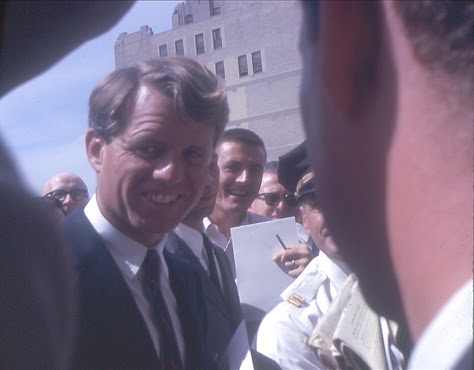
We were also part of the crowd at  the opening in Boston  of the JFK Library, attended by Robert and Edward Kennedy.    It is amazing to think back at the low level of security, as I was able very easily to  take  these photographs and even had Robert Kennedy sign the souvenir programme.  Two years on and Robert Kennedy himself was shot dead in Los Angeles whilst on a Presidential election campaign.


I know the Kennedy legend has long since been tarnished.  But that tragic day 50 years ago in November was for me, over 3000 miles away in Scotland,   a momentous event that has stayed in my memory.  


 Copyright © 2013 · Susan Donaldson.  All Rights Reserved.


Click HERE to read of other bloggers'
"Momentous Moments  
where big history and small history collide"


Monday, 18 November 2013

The Book of Me - What Do I Look Like


This  post was prompted by Julie at Anglers' Rest  and  her  series " Book of Me - Written by You", where she asks us to describe our looks.


Pigtails to Ponytails to Perms - Brown Eyes to Speccy Four Eyes - Plain Jane to Russian Spy to  the Dynasty Look - all phases of my  appearance over many years.  
 

"There was a little girl, who had a little curl, right in the middle of her forehead",


Big bows were all the fashion for little girls - and there is still a bit of a kink in my hair (right)  then, but  that soon disappeared and my hair has always been resolutely naturally straight.


Pigtails characterised my look as a child, complete with kirby grips and ribbons.  

On village gala days and on special occasions, my hair was wound into rags overnight  to hopefully create ringlets - which soon fell out.  

By my early teens my hair was long.  It was washed with a final rinse of  vinegar and rain water - my mother's idea of a beauty treatment -  and it took ages to dry in front of the fire.  No hair dryer then. 


"Speccy four eyes" was a popular call at my primary school for those of us unfortunate enough to have to wear glasses.   I was a quiet,  shy child, but funnily enough I cannot recall being upset by the taunt - it was just part and parcel of playground culture. 

My mother was emphatic that I was not going to wear the hideous national health service wire glasses  with pale pink frames and was prepared to pay for a slightly more flattering pair. 

There is a pony tail hiding behind this Plain Jane look (right). What is it about moving from childhood to teenage years, as this is the only family photograph I could find.  No holiday snaps, no school photos - nothing. 
 
Around the age of 15,  Mum suggested I get my hair cut professionally   - great - except we were both clueless afterwards how to style it at home,  and here I am being brave in highlighting publicly  this dreadful passport photograph, taken when I was to go on a school trip to Germany. This was the 1960's era of the Cold War and  I look  like the archetypal Russian spy.   

After five years, you could get a passport photograph updated,  and I could not wait to do this -  only to be further mortified when, instead of replacing the photograph,  the new one was just stuck beneath - to more family hilarity and more quizzical looks from passport control. 

I never did get the hair knack of beehives, back-combing and flicks, however much I aimed for that style.


I became a librarian, so had to work hard at counteracting the traditional dowdy image.  So here (below)  is the young professional look for my first job - worn with a   mini length sweater dress  and long necklace  - all the rage then.  


By the late 1960's,    vanity prompted me to try contact lenses and they proved a great source of stories with friends as we recalled  tales of losing them.  I remember one occasion where I was scrambling around on the floor of a pew at church, (not praying) but  trying to find this miniscule lens.

At least I was minus my glasses on my wedding day. 
 
This was my husband's first car  (above) - a silver grey Ford Escort, bought just a few weeks before we first met in 1970. He was always proud of his cars and looked after them well.   This brings back memories of our engagement. It must have been love, that he actually suggested I sat on top of the car for this photograph - not something he has allowed since!  Note the miniskirt  and 1970's striped  coat! 

Pregnancy and being an "at home" Mum meant I lost the incentive to bother with inserting, cleaning, and removing contact lens - I had trouble getting used to them again and I reckoned I had better things to do with my time, so it was back to spectacles - though I kept to the mini skirt look.


By the late 1980's grey hairs were beginning to creep in.   I recall one New Year's Day when we were due to go out in the evening.  I used a home colour shampoo to disguise the grey - but left it on too long and the result was rather too much  red.  The shampoo packet said it would run out after 6 washes, so I washed it about 6 times that day - to very little effect.

 I moved on to perms for my fine, limp, locks.  We were now at the time  on TV of Dallas, Dynasty and Charlie's Angels,  with big hair and shoulder pads all the rage - hence this rare look for me taken for a work Annual Report.  Less glamorously, I was also likened to Deidre Barlow of "Coronation Street" soap opera fame.  The big specs did it!   This look involved too much like hard work.
 
 I am now pleased to see natural styles are back in vogue which suits my age and rural life style!
 
Fashion has come full circle and here I am below  wearing spectacles remarkably like those I wore in my teens. 

Adapted from an earlier post of January 2012.

Copyright © 2013 · Susan Donaldson.  All Rights Reserved