.jump-link{ display:none }
Showing posts with label 52 Ancestors 2019. Show all posts

Thursday, 5 December 2019

Three Talented Danson Sisters: 52 Ancestors: Wk.49

Crafts is this week's theme from "52 Ancestors" and there was no question what I would write about.
 
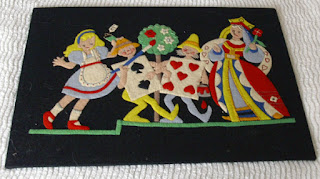
An Alice in Wonderland collage, stitched by my mother  for my daughter, 1973.   


The three Danson sisters, Edith, Kathlee (my mother) and Peggy were all talented dressmaker, using the old treadle sewing machine in a house that did not get electricity until the mid 1950s.  They also  enjoyed a range of crafts.
Mum  - Kathleen Danson was born in the small town of Poulton-le-Fylde, near Blackpool, daughter of William Danson and Alice English. At the age of 14, she was apprenticed to be a tailoress and was still making her own clothes in her 80's. For her going  into a fabric shop was like going into a jeweller's.   She was a creator in patchwork, crochet, collage, knitting, embroidery, smocking,  dolls and dresses, with dabbles into  rug making, millinery, lampshade making and china painting.  If she sat down, she was rarely without a needle in her hand - epitomised in the motto that sums her up - "Happiness in Stitching".

She set up her own dress-making business from home.  She continued with this this after her marriage and throughout my childhood working initially  in the spare bedroom which was icy cold in winter and hot and stuffy in summer.  I used to love getting the  old Simplicity pattern books and cutting out figures for make believe schools etc. 

As a child, I was a "dolly girl" and my dolls were the best dressed in the street.  But I have one huge regret.  Mum went into hospital for a major operation  at the time of the Queen's  Coronation in 1953.   She made me a very special doll, dressed as the Queen with a long fur trimmed purple velvet train and embroidered beaded dress. I so wish now I had kept it as a family heirloom, but of course by the time I became a teenager, dolls went overboard and there is not even a photograph.  
My own 8 year old daughter had a collection of Cindy dolls - the British version of Barbie, I think - with a lovely wardrobe of clothes again made by  my mother.  Mum was in her mid 70's  and with fading eyesight, yet the small scale stitching on the clothes is so impressive.  

Mum was a typical  1950s and 60s homemaker.   She was always making something cushions changed their covers regularly, new patchwork quilts appeared on the beds and new curtains at the windows, worn sheets were turned, old bath towels were cut, and trimmed into hand towels, old dresses were turned into aprons, and tray cloths and tablecloths were embroidered.  She was a regular contributor at village fetes and was called upon to help with the dresses for the village gala. 


b
Costumes made by my mother for Staining Gala, near Blackpool, Lancashire.  These dresses were in apple green satin with silver cardboard headdresses and I remember other years wearing peach satin and yellow taffeta. For me, the dress was always destined to be my party dress for the year. I always wanted to be one of the bigger girls who danced with garlands.


Aunt Edith specialty was embroidery and she was the artist in the family. 


Aunt Peggy emigrated to Australia in 1948 and I have just one example fo her talents - a small painted plate. 


I shared my mother's  interest in crafts,  but I cannot say her talent.  I have memories of sitting on the draining board in our old fashioned kitchen and being taught how to knit  a dishcloth from string.    I then graduated to a pixie hood and scarf.   In my teens I was knitting for myself  jumpers for school and weekend wear, and in the early glow of being engaged,  knitted my husband several jumpers to brighten up his rather drab wardrobe.

I was hopeless at embroidery and gave up on my tortuous efforts to sew lazy daisy stitch, satin stitch, stem stitch and French knots on increasingly crumpled material - a reminder on what it must have been like for very young girls to persevere at stitching their samplers centuries ago.

More of my mother's  creations:


Victorian collage
made by my mother
Mum and I shared an  interest in costume and I recall us making   a collage picture of Queen Elizabeth 1st in all her glory - plenty of scope for using lots of fancy trimmings.  Years later when my daughter was little (and money was tight) I made felt collage pictures for her bedroom, mounted on cake boards - ducks, teddies, a colourful wigwam etc. (Left - a Victorian couple stitched by my molter)


It was my mother who taught me how to sew patchwork - by hand in the English traditional Grandmother's floral garden pattern using hexagons, beginning with pincushions and eventually reaching the heights of a single bedcover.  I am still patchworking today. 

Animals were a favourite choice. 


Below - A lovely little jug & sugar bowl, and plate,   painted by my mother.


Mum died at the age of 91  and was still making her own clothes in her 80's as well as a patchwork quilt for the bed.   These heirlooms here, may not be all that old,  but they are precious to me and a potent visible reminders of my mother - a very talented lady.


 *********************


Join Amy Johnson's Crow
 Facebook Group  "Generations Cafe." 

to read posts from other bloggers taking part in the
2019  "52 Ancestors" Challenges.  


Wednesday, 20 November 2019

Soldier Edward Ingram Stuart Smith - A Sad Tale: 52 Ancestors Wk 47


There were over 3 million British  casualties in the First  World War. Of the men who survived, their suffering could include  physical injury including loss of limbs, blindness, effects of gas poisoning, and shell shock (what would now be  termed post- traumatic stress disorder),  Many would not  talk about the war  or forget the scenes they witnessed  but their experiences affected their lives ever after.

One  such man was my cousin's paternal  grandfather Edward Stewart Ingram Smith (1871-1923).


 Edward Stewart Ingram Smith on the back row, far right 
with his regiment Liverpool Scottish.  
An older man at 44, standing rather apart from his much younger colleagues.


Edward's Early Life 

Edward was a man of many parts -  boy soldier,  waiter, photographer,  and upholsterer.   In this photograph of him as a 20 year old young man, he has a sensitive and artistic air about him.


Edward was born in 1871 in Ceres, Fife,  Scotland, eldest son of John Ingram Smith and Isabella (Ella) Edward.   His Ingram middle name came from  that of the minister in the Shetland Isles  who had  baptized his  father - and was one adopted by future generations of Smiths, who were very proud of their island heritage. 


In his early childhood, Edward experienced several moves across country  as his father's hotel businesses failed.   

Edward's daughter Ella  (who lived to the age of 99)  left notes relating how her father  wore the kilt until he was 17 years old, played the bagpipes and spoke Gaelic  He enjoyed art and painted in oils.  He was well educated  in Edinburgh and spoke with a soft lilting accent. 

On leaving school, Edward joined the army as a  Gordon Highlander, but did not settle and was bought out by his parents. 


By the time of the 1891 census, 20 year old Edward was  in Leeds where his father John  was manager at the Victoria Hotel.  Edward's occupation was listed as photographer. 

A further move by the family followed, as by 1901  Edward was working as a waiter at the Belvedere Hotel, South Promenade, Blackpool, Lancashire.     In 1902 at Kirkham Registrar, near Blackpool,  Edward married Lily Beatrice Jones, 13 years his junior.   

 Four children were born to the marriage - Lily Ella, Arthur Stuart Ingram, Edith Florence and baby Edward who did not survive infancy.   Edward's interest in photographer is illustrated in the many delightful portraits he took of his children - with son Arthur,  in a "little Lord Fauntleroy"  outfit and a  mop of long fair curls.
 

Ella, Edith and Arthur


In the 1911 census, Edward's occupation was still given as photographer, but illness struck and Edward had to give it up.   He moved into upholstery, and eventually  opened up a furniture  business in Blackpool.
 

Called up to Serve
In 1915 at the age of 44, Edward, as a previously serving soldier,  was called up to return to the army. Determined to maintain his Scottish links,  he joined   the kilted Liverpool Scottish Regiment.  


 A serious looking family photograph, probably taken as Edward set out for war 
 with Arthur's hair shorn of its curls.

 
The sporran that Edward is wearing in this photograph is still held by the family, 


Edward served  in France, but was gassed and injured at the Battle of the  Somme. Wounded in action in the ferocious fighting in  the Battle of Delville Wood, (nicknamed Devil's Wood),  he was invalided back to England and hospitalised.   His daughter Ella related how he went to meet her  at the school gates and she did not recognize him, as his weight had dropped from 15 stone to 9 stone.

 Liverpool Scottish soldiers at Dellville  Wood.

An Army Discharge Certificate (the first time I have come across one) and Military Award Records show that Edward received the War Medal, Victory Medal and the Silver War Badge  to denote that he had been wounded in action. 

 Edward's army discharge certificate.
It is not a good image but I had never come across such a document before 
and was keen to feature it here.  


Life Post-War But following Edward's discharge,  family  life proved unhappy.  His mother died in July 1919 and at some point, he separated from his wife and children.  In searching local newspapers for an item on Edward's war service, I came across this report   of 24 November 1919 in "The Lancashire Evening Post"  It made sad reading:


One cannot  help reflect that having to return to active service at the age of 44 and face the harsh physical and mental conditions of the World War One battlefields took its toll on Edward, as on so many soldiers.   He died in 1923 aged 52.    His wife Lily survived him by a further 40 years and married for a second time.  


The photograph below shows an older Edward Stuart Ingram Smith with haunting eyes and a dispirited air - a  far cry from the smart,handsome young man of thirty years earlier.    


*************

Join Amy Johnson's Crow
 Facebook Group  "Generations Cafe." 

to read posts from other bloggers taking part in the

2019  "52 Ancestors" Challenges.    

Sunday, 17 November 2019

A Pauper in the Family Tree? - A Look at Poor Law Records.

"Poor Man"  is the theme of Week 46 of Any Johnson Crow's year long "52 Ancestors" prompt.

To find an ancestor described as a "pauper" in a census return conjures up images of Charles Dickens' "Oliver Twist" and a time when the word "workhouse” (or "poorhouse" in Scotland) struck fear in people living close to destitution.  But for family historians searching for a story beyond the simple names and dates, such a discovery is an immediate prompt to turn to poor law records. 

They are one of the most popular types of offline tools at, the Heritage Hub, Hawick, home of Scottish Borders Archives,  and, although they have not been a source for my own family,  I find it fascinating to browse through them. 


Poorhouses were set up in Scotland as a result of the Poor Law (Scotland) Act of 1845 and were built in five towns in the Scottish Borders, serving not only the immediate town but surrounding parishes - hence their name of Combination Poorhouse or Union Poorhouse. 
The Victorians  were great bureaucrats and the Heritage Hub holds a large collection of local Poor Law Registers, Poor Relief Applications and Parochial Board Minute Books, many of which can give a mini-biography of an ancestor, in often tragic circumstances, with details of name, address, age birhtplace, marital status,  occupation, whether disabled and if so how, financial circumstances, and dependents.  Here are some examples which caught my attention:
  • Robert Leck, once a well known clockmaker of Jedburgh, admitted to the poorhouse aged 67, with a pattern of admissions and discharges until the time came when he was "wholly disabled, nearly blind and wholly destitute".  Interestingly when I did a Google search, I found  an illustration of a Robert Leck grandfather clock about to be auctioned in London. I traced Robert's death ceertificate on Scotland's People , but sadly,failed to give me any information on his parents, as  the matron of the Poorhouse was the informant,  and did not know the details.


  • The story of Janet Scott had a more positive outcome.  Her admission record in 1877 gives us a glimpse of the desperate situation in which many applicants for poor relief found themselves.  A single mother with  two children and a baby, working as an agricultural  labourer, she  was "wholly disabled by a cart falling on her".  She was on parish relief for three years.  However she also demonstrated her resilience, as  in the 1881 census she was back earning a living, as an Ag. Lab, along with her two eldest daughters.  
Janet Scott's entry in the Jedburgh Union Poorhouse Register, 1877. 

Being a "pauper" did not always mean being admitted to the poorhouse,  as those on "out relief" lived in the  community and received support such as clothing, fuel or food, as illustrated in these records. 
  •  15 year old James Robertson is described as "delicate and deformed by spine curvature and will never be able to do much.  He needs a suit of clothes, 2 pairs of stockings and 2 handkerchiefs.  Allowed.

  • Mary Burns, also in need of clothing , was granted " 1 frock, 2 yards flannel, 2 yards drugget, 2 pinafores and a  pair of boots."

  • At Melrose, Roxburghshire, a mother and young children were "footsore and weary"  and given help as they made their way from Newcastle to Glasgow to rejoin family  - a distance of 114 miles.

  • Mary Phllips was admitted to the Poorhouse as "this woman's husband deserted her, having absconded to America.  She has 2 children and is about to be confined.  Her parents very poor."
  • The Inspector was not always the hard face of the law.  At Melrose two young children whose mother had run away with another man,  were given a penny to buy a roll and told to return home and send their father.   The record showed six  young children in the family aged from 13 to 3 years old.

  • Rebecca Ballantyne, however, "burdened with 2 illegitimate children" was refused poor relief on the grounds she was able bodied and earning a good wage - 15 shillings a week as a mill worker.

  • In Hawick "Robert Campbell, a weaver, almost disabled by rheumatism applied

  • "George Wilson, a labourer, wholly disabled by bronchitis,  as certified  by Doctor McLeod, was sent to the Poorhouse on 26th March but left the same on 2nd April."
So my tip of the day is always to contact your appropriate local archives centre - they will hold a wealth of records showing there is genealogical life well beyond the Internet and most offer a remote research service.  


You never know what might be unearthed to throw light on your ancestors' lives and provide fascinating material for a blog post or family history narrative.  

********

Source of Online Information
Workhouses - the definitive, comprehensive   guide to workhouses/poorhouses in England, Scotland, Ireland and Wales, by Peter Higginbothom.
  

**************

Join Amy Johnson's Crow
 Facebook Group  "Generations Cafe." 

to read posts from other bloggers taking part in the


 2019  "52 Ancestors" Challenges.  


Print

Saturday, 5 October 2019

Where Family History Meets Local History: 52 Ancestors - Wk 41

"Context" is the theme of this week's "52 Ancestors" prompt and this is a topic right up my street, for I am  a firm believer that family history is so much more than just names and dates on a family tree.  For it can takes us  in so many diverse and fascinating directions by linking family and local history. 


Some time ago, I came across a blog entry Writing on Family from Dawn,  where she reviewed an anthology entitled Women Writing On Family: Tips on Writing, Teaching and Publishing. It’s edited by Carol Smallwood and Suzanne Holland and published by The Key Publishing House, Inc. of Toronto, Canada (www.thekeypublish.com).  

A key quote in the book struck a chord with me.
"The best family histories are rich in detail." 

So how can we find that detail? 

LOCAL HISTORIES
These are invaluable in  putting our ancestors lives in the wider context of where they lived.  My "ancestral" home is Poulton-le-Fylde near Blackpool, Lancashire and I try to buy every local history book on the small town.   I have discovered photographs of my great uncle in a local football team,  early class photographs about the time my aunt and mother ere at the  school,  photographs of my nursemaid grandmother's employers,  and the terraced house (since demolished),  where my great grandmother raised  a large family of eight  sons, one daughter and one orphanage granddaughter.


 Bull Street, Poulton-le-Fylde, Lancashire
where my great grandparents and grandparents lived until 1926.

TIMELINES   to me are an important feature of a  family history narrative.  Our ancestors did not live in a vacuum, so set their  lives in a wider context of life around them - what was happening at a local, national and international leveL?  I usually present this in the form of a text box in each chapter, or as an chronology appendix at the end of my narrative.

My father was always called a Titanic baby - a bit of a misnomer, but it related to the  fact  he was born 15th April 1912, the night the Titanic sank.  For major events, date reference books can help, but local newspapers and local histories are invaluable sources of information.    Some ideas here: 
  • Was your British ancestor alive when there was the threat of a Napoleonic invasion with towns and villages ready to light beacons to warn of the French attack?  I have come across  front page advertisements in a local newspaper of 1804  warning of this danger.
  • Might your ancestors have seen the Jacobite army marching through Scotland and the north of England  in 1744-5,   as Prince Charles Edward Stuart (Bonnie Prince Charlie) attempted  to take the Hanoverian throne?   I have found in burgh records, discussions by the local council on this event.
  • The coming of the railway to a community had an immediate and dramatic effect  with local newspapers giving extensive coverage the plans, the construction, the accidents,  the role of navies, and the excitement generated by the opening, as in the report below from the "Kelso Chronicle" of 8 June 1836:
    “The Newcastle and Carlisle Railway is to be opened on the 18th inst. The journey, sixty miles, is expected to be performed in three hours. The sight will be splendid, and will do doubt draw together an immense multitude.”


  • What about the impact of the invention of the sewing machine  on the task of making a family's clothes? 

     
  • Might your female ancestors have seen suffragettes campaigning  locally?
  • When was your local cottage hospital built, or the local football  club formed? 
  • How did your  ancestral town or village mark the death of Queen Victoria in 1901? 
CENSUS RETURNS  are often the route to finding out more abut our ancestors.  The word "poorhouse" (or  "workhouse" in England) struck fear in people living close to destitution.  

But for family historians searching for a story beyond the simple names and dates, such a discovery is an  immediate prompt to turn to poor law records - not generally available online.
These
are one of the most popular types of offline tools at my local archive centre, the Heritage Hub, Hawick in the Scottish Borders,  and, although they have not been a source for my own family,  I find it fascinating to browse through them. 


WORK was a major part of our ancestors' lives, with long hours the norm.  So the more we can find out about their working life, the greater the rounded picture we bring to a family  history. 
We might not find the name of individual ancestors, but occupational records are invaluable in giving us a picture of working life and and have given me an insight into the lives of my husband's miner and mariner ancestors. So many of these records are not available online, and my message is -  search the online  catalogue of the Archive Centre relevant to your research,  and use their enquiry service if you cannot visit it. 


Leisure
- how did our ancestors spend their free time?   
Earlston Orchestra in concert in 1899


A concert in Peebles.


A tea party in the  Scottish Borders


  • How did your ancestors celebrate Christmas? Local  newspapers were full of the benevolent gestures by  landed gentry such as this report in the  Kelso Chronicle of 1836:
On the Duke of Roxburgh's  estate, two fine oxen were slaughtered and meat distributed to poor householders and indigent poor of the community.  The sum of £20 was used to purchase fuel for the poor of the town.
  •  What kind of weather did your ancestors experience, for instance at harvest time,or  in winter?  - local newspapers and local historical societies  would probably provide the answers.
    Market Square, Earlston, Scottish Borders in the winter of 1947 - 
    recognized as one of the worst winters on record.


The possibilities are endless for adding colour to your family story!
Enjoy the task!  

*********


Acknowledgements:


*********

Join Amy Johnson's Crow
 Facebook Group  "Generations Cafe." 

to read posts from other bloggers taking part in the

 2019  "52 Ancestors" Challenges.