.jump-link{ display:none }
Showing posts with label Sepia Saturday 2026. Show all posts

Friday, 17 April 2026

Delivering the Goods - Sepia Saturday

This week's Sepia Saturday prompt image shows a van  with the local business clearly identified on the side and all set to deliver goods,  whether they be coal and timber or food and drink. 

My mind turned immediately to my cousin's Oldham family of Blackpool, Lancashire, who were carters and coalmen down three generations - Joseph Prince Oldham (1855-1921), his son John William Oldham (1880-1939) and his granddaughter Elsie Smith, nee Oldham (1906-1989),The business  went from  using horses to horsepower  - and below is their first lorry purchased in 1921. 


This Oldham vehicle  was requisitioned during the Second World War by the Government  for use by  the Fire Service. It was never returned.  
 
 The Oldham business was founded around 1890, steadily became prosperous and in 1905 moved to near North Station, Blackpool, Lancashire in a house with a large yard, hay loft, tack room. and stabling for around 7 horses.
 
In the 1901 census Joseph Prince Oldham (below), son of William Oldham and Sarah Prince,  was described as a self-employed carter and coal merchant,  with his 20 year old son John  driver of a coal lorry.  Also in the  household were Joseph's  wife Mary Alice, 3 young daughters, Sarah Alice, Edith and Beatrice, and also mother-in-law Mary Ann Knowles.
Joseph Prince Oldham, with, on the left, his granddaughter Elsie 
who later took over the business. 


The Oldham family c.1910 - Back: Sarah and John William 
Front:  Father Joseph,  Beatrice, Edith  and mother Mary Alice. 
 
John William Oldham married Mary Jane Bailey (my grandfather's cousin)   in 1905 at St. John's Church, Blackpool.  


 ****************

From Blackpool to Earlston in the Scottisy Borders and photographs from  my local heritage group. 


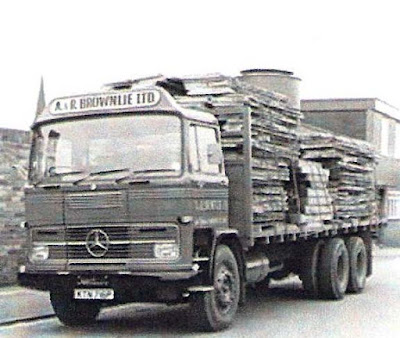
Two Lorries of the  Brownlie family who have been in the Saw Mill business since the mid 1850s and purchased the Earlston yard in 1920. in July 1988 it became part of BSW Timber Group 
 
 
  Another  Brownlie's lorry negotiating this tight bend 


Two lorries from a long standing local business Rodgers, builder, established in 1847  and operated until the 2020s.  Its work in the village included the renovation of the Parish Church in 1891  and the building of the War Memorial in 1921.  


 Taylors Grocers opened in Earlston in 1908 and was in business until the mid 1950s with members of the same family.  


A Baker's van in Earlston  

 From Baker to Butcher  with Donaldson's (no reelation) still serving customers today in Earlston. 


 ****************
 
And Finally: - My father in law John Robert Donaldson was a signwriter  and this is an example of his work. 


************** 
 
Sepia Saturday gives an opportunity for genealogy bloggers  
to share their family history and memories through photographs


Thursday, 9 April 2026

Memories of my Grandfather's Home - Sepia Saturday

This week's Sepia Saturday prompt image shows a house .   Here I take a nostalgic look back at my grandfather's house  in Poulton le Fylde, Lancashire in north west England.  

My grandfather's home c.1950 - The Danson family home 1926-2001

 
Grandfather was William Danson (1875-1962), 5th son of James Danson and Maria Rawcliffe. In 1907 he married Alice English and they had five children - Edith, Kathleen (my mother), Harry, Billy, with baby of the family Peggy, born after the First World War. Alice died in 1945 and I never knew her.
 
Grandad was a taciturn country man  who,  when he was conscripted in 1916,  was working as a cattle man at the local auction mart.   In the First World War he was awareded the Military  Medal for "Conspicious gallantary and determined devotion to duty in action."  But  I was warned by my aunt that he would never talk abiut his experiences then. I have memories of him taking my brother and I to the auction marst and out on country walks,  of spotting rabbits in the field,s and gathering  wild flowers, berries and leaves for the nature table at school.  
         
 
Grandad in army uniform 1916,  and relaxing in between his brother Robert on the left and a friend. 
 
The Danson family moved into the semi-detached house in 1926.   I still have the receipt for the deposit of £67. It looks quite a big house in the photograph, but, with only three small bedrooms, it must have still been a squash for William,  Alice,  three daughters and two sons.
 
The front door had a round stained glass window which I thought was very posh - until it had to be replaced with clear glass.  Half way up the side wall  of the house  was a small hatch door which revealed the coal shute where the coal men emptied  their sacks down into a small cellar under the stairs. My uncle Harry (a joiner)  much later took on the hard task to clear it all out to create a much needed "glory hole" and utility room.   He also modernised the kitchen and installed French windows in the living  room at the back of the house. 
 
In the living room a  copper kettle stood in the hearth (open fire) and I was told that had belonged to my great grandmother Maria Danson, nee Rawcliffe (1859-1919).  


To the left of the fireplace was a cupboard where a shoebox was kept,   holding family photographs and memorabilia.  It was a big treat if I was allowed to look thorough this box and it was the photograph of my great grandmother Maria (below)  which was the  inspiration  to draw up my first  Danson family tree and set me on the ancestral trail.  I was  about 12 years old then  


My great grandmother Maria Danson, nee Rawcliffe. with her eldest granddaughter,  Annie Maria Danson, my mother's cousin.  
 
Pride of place in the front small room (kept for best) was the piano, complete with candlestick holders,  which I learnt to play on.  The  bookcase held the   family bible recording the marriage of my great grandparents Maria Rawcliffe and James Danson in 1877 and the birth of their first four  (out of ten) children - entries petered out after that.  Another favourite book which had belonged to my grandmother and was treasured by my mother  was an 1899 edition of "Pride and Prejudice" with delicate pencil drawings protected by flimsy paper. 
 
But there was one surprising feature about the house, though - it did not have electricity until the late 1950s, because my grandfather refused to have it installed. I remember my aunt standing on a chair to light the ceiling gas lights, and ironing with a  flat iron, heaed in the fire, whilst the flames from the gas cooker frightened me. 

Outside the side trellis gate was later taken down and a driveway created to take my uncle's motor bike and side car, and later a car.  Grandad's hen house at the back then became the garage.  

The large gardens were my grandfather's and later my uncle's pride and joy - with floral displays in the  front and  productive vegetables and fruit  grown at the back. The front garden was a regular setting for family photographs.


My dressmaker mother modellin  one of her outfits - late 1930s.   


A unique photograph as the only one I have of both sets of grandparents William & Alice Danson on the left  and Albert and Mary Weston, taken in the garden after my parent's wedding in 1938.  


Sisters Peggy, Edith and Kathleen Danson  with their mother, a rather frail looking Alice  c.1941


1941 and my father is setting out for war service in the RAF.  Here with Mum on the right and her sister, my aunt Edith on the left

                     My aunt Edith,  with a little podgy me c 1944.


My brother and I in my long dress for the local Gala Day, c.1951   

       Full circle  - my mother with my uncle  Harry, c.1990s.  

My  mother was the first of the family to marry in 1938, followed  by Billy, then her younger sister Peggy who emigrated to Australia in 1948.   Grandad, William Danson died in 1962.     Edith and Harry lived in the house  nearly all their lives (apart from short term marriages)  until their deaths in 1995 and 2001.  This  marked the end of the house that had been a family home for nearly 80 years.  

****************

Sepia Saturday gives an opportunity for genealogy bloggers  
to share their family history and memories through photographs


Click HERE to see  posts from other Sepia Saturday bloggers.
 
************************** 

Friday, 27 March 2026

Women in the Workplace - Sepia Saturday


This week's Sepia Saturday prompt photogrpah shows  the scene in a munitions  factory in the First World War where the workers were largely women.  I featured munition workers recently so here I take a look at other "women  in the workplace" ranging from agriculture, and textiles,  to hairdressing and dressmaking. - and not forgetting housewives.  


Mill Workers at Rhymer's Mill. Earlston in the Scottish Borders- early 1900's. As in other Border textile towns, women were a significant part of the ẃorkforce and key contributors to the local economy.   But to me, as someone who is non-technical,   that machinery in the first image looks frightening! 

*********** 

 Housewives at Work - here shopping in the Traveling
Co-op Van in Earlston.

Where home was the workplace:   

                                           
Both before and after her marriage, my mother offered dressmaking services from her home.  Mum had been apprenticed to a tailor at the age of 14, and was still sewing well into her 80's.  I only came across her early business card after her death. 
 
She continued her home dressmaking  throughout her life.  In the 1950's this meant working in the small spare bedroom which was icy cold in winter and hot and stuffy in summer.  I remember one time when my little brother - a typical boy into everything - got hold of her oiling can, filled it with water and proceeded to "oil" the sewing machine!.  He was not very popular!   
 
Mum  was a typical homemaker of the 1950's and 60's -- and beyond.  She was always making something - cushions changed their covers regularly, new patchwork quilts appeared on the beds and new curtains at the windows, worn sheets were turned, old bath towels were cut, and trimmed into hand towels, tray cloths and table cloths were embroidered.  

  I remember as a young child  my mother wearing her apron with a front pocket for carrying dusters etc.  and putting up her long hair in a scarf and turban  on wash day - always a Monday - we were very traditional in the north.   This was the days before washing machines, not even a twin tub,  never mind an automatic.   She did the washing by hand and then got out the mangle  to feed the soaking clothes etc. through it to wring out the water. If I was at home on holiday I helped feed the sheets through, before  everything was hung outside to dry. 

All of this made wash-day an arduous task, so Monday tea was left overs - cold meat from the Sunday roast, served with chips. 

Needless to say  no photograph exists of my mother  on her housewife tasks.  Family snapshot were strictly for recording leisure activities, not housework.  
 
 **********

Workwear at the Egg Packaging Station at Georgefield Farm, Earlston 

 
 The distinctive work costume of the Bondagers.

Bondagers were female farm workers in south east Scotland and Northumberland. As part of their husband's contract (or bond) with the farmer, he would undertake to provide another worker (usually his wife) to help as and when required. The women wore a distinctive dress with bonnet, described as the "last remaining peasant costume" in Britain.  The custom of bondagers lasted well into the 20th century. 
 
******** 

And from my own family collection   photographs I have featured before, but are among my favourites and fit the theme so well. 


My great aunt Jennie Danson  (second on the left) with her work colleagues from the post office in Poulton-le-Fylde, Lancashire.  Her daughter Pam recalled a story that during the First World War, a telegram was received at the Post  Office for Jennie's widowed mother Mrs Maria Danson.  Fearing the worst, Jenny was allowed to run home with it.  Fortunately it was good news to say that brother Frank was wounded  but recovering in hospital in Malta. . 

**********

Home was the workplace for my mother's second cousin,  Elsie Oldham, who as "Elise" (note the French version of her name!) offered "Bobbing, Shingling, Marcel Waving and Perming", from her home in Blackpool, Lancashire, and advertised (above) on this lovely evocative 1920's blotter. 
 
 
The Oldham home in Blackpool, Lancashire with the adverts in the window and  on the garden pole, promoting Elsie's business.  
 
*********** 
 
 A different source gave me a lovely  insight  on my Aunt Edith (Danson),  a teacher . Ex pupils at the school set up a Facebook page  ahead of the centenary of the school in 2014 and in a google search found my blog and got in touch. I was delighted to read comments from former pupils of "Miss Danson",  who was remembered with fondness: "I always thought she was a wonderful teacher with lots of patience and 8nderstanding".


***********


  As for my working life life 
 - that ranged from student work in a variety of Einburgh shops including a fishmongers (totally out of my comfort zone), a bookshop (my favourite) and a tartan trash souvenir shop - think garish tasteless  tartan products aimed a tourists. I spent a year in the USA on an exchange  programme as a trainee librarian (a  wonderful American experience);  as a young mother I did voluntary work setting up a library  at my daughter's school and at the local Citizen's Advice Bureau.  
 
I returned to the workplace in 1978 at my local tourist information centre - above.  It now looks so old fashioned - old telephone, no computer, let alone a typewriter, no uniform, just a name badge - they all came years later!   But I loved it   -  until I was made redundant!   Finally I returned to my roots in the Local Studies Library,   before    being the Family History Researcher in the Scottish Borders  Archive Centre. How many people can say their hobby became their job!!

*****************
 
And finally - not to forget this week's prompt photograph ....../ 


Earlston Munition Workers in World War Two.  
 

With thanks to my local heritage group Auld Earlston for many of the images shown here.  
 
********** 
 

Sepia Saturday gives an opportunity for genealogy to share their family history and memories through photographs


Click HERE  for more memories of work  from fellow bloggers.
 
 
******************************* 


Saturday, 21 March 2026

Musical Notes- Past and Present - Sepia Saturday

This week’s Sepia Saturday  prompt photographs  features a small musical ensemble with an invitation for us to show our related old photographs. 

I begin with images from my local heritage group - Auld Earlston. 


Earlston Orchestra in Concert, 1898

The earliest reference found in the local press to the Orchestral Party (sometimes called Orchestral Society) was in “The Southern Reporter“: 28th October 1886. The occasion was a concert and dance, organised by Earlston Street Lighting Committee to raise funds to provide winter street lighting in the village. After the concert, part of the evening was given over to dancing.  


Throughout the first half of the 20th century, local newspapers regularly reported on the activities of the orchestra .  cheif conductor was Mr, SAmeul Fisher , with Miss May Smith and Miss Betty Kerr taking on the role of deputies.   
 
During the First World War, the Orchestral Party was a regular participant in fund raising concerts, held to provide Christmas gifts to serving soldiers; to assist the War Relief Fund; and for the War Comforts Fund under the banner “Under the Flag of Britain” in a programme of patriotic music, with the plaudits:
The Earlston Orchestra gained fresh laurels from the high standard of excellence reached by its members”. (Berwickshire News: 7th December 1915)

The 1920s & 30s  marked a busy time for the orchestra. Events included playing  at Carolside in aid of the Scottish War Memorial Church [at Edinburgh Castle]; at a major two-day Masonic Bazaar;  and at Earlston Horticultural Show. , a WRI (Women;s Rural Instiutute) sale of work where the orchestral played "in a tasteful and effective stye".   
 
Conductor Samuel Fisher died 8th May 1938 aged 75, buried in Earlston Churchyard.  With his death and the  impeding threat of war, this once showcase of Earlston  musical talent appeared to come to an end.  
 
*************** 


In 1944, Polish Lancers  were stationed in the village  in training for the Normandy landings, with their tanks taking over the concreted Rugby Football ground.     The Polish contingent involved themselves in the local community events, including playing for the dances which were a popular form of wartime  entertainment.  
 
********** 
 
Earlston Clown Band  - The earliest report found appeared in "The Berwickshire News" of 28th August 1906 and referred to a village picnic at Cowdenknowes House, near Earlston, where the band was the star performer in  the entertainment.
"The famous Clown Band was unanimously considered, nay acclaimed,   as the most striking and most original performance of the day..........  The performer on the big drum would be marked for distinction,  for never before "throbbed the war drum" under such handling as it got from  the wielder of the drum sticks."


 The last report found  was  in "The Berwickshire News" of 13th July 1937 when the band took part, with great acclaim.   in a fancy dress parade in Lauder.

 "Much of the success of the parade was due to the efforts of the Earlston Clown Band,  which led the procession through the streets of the Burgh .  The antics of the band, who were all in character,  and its leader Mr. John Murdison roused peals of laughter from the many spectators who had gathered to watch the procession.
At the presentation of the prizes, an extra vote of thanks was given to Earlston Clown Band, who had kindly given their services free.  
No further press reports were traced after that date. Did the outbreak of war bring an end to the Clown Band activities,  which had delighted its followers down the decades.   
 
*********** 

To more recent times - musical groups  in costumes that reflect their country’s heritage. 

A musical group in Austria  with a zither 
amongst the instruments. b eing played.   


A group laying  in the square in Krakow., Poland  

i

Pipe  Band leading the Civic Week Fancy Dress Parade in Earlston. 


The local band in St. Gilgen, Austria  

              Local Bavarian Band in Berchtesgarten, Germany 
 

 Image of Band of the Coldstream Guards - Wikipedia

 Band of the Grenadier Guards, the oldest regiment in the British army. 

************************

Sepia Saturday give bloggers an opportunity 
to share their family history through photographs


*******************