.jump-link{ display:none }
Showing posts with label Seoia Saturday 2024. Show all posts

Friday, 3 May 2024

All Aboard the Coach - Sepia Saturday

Sepia Saturday's May theme is  "Travel"  with the first prompt photograph a happy  group  relaxing outside their coach.  Cue for me to look a look back at how groups got around in the past - from coaches  and charabancs, to horse drawn carriages and stagecoaches.


 A happy group of people in Earlston, Scottish Borders, looking forward to their coach trip to Carlisle, the  city just over the border into England.  The year is 1947 - so it must have been a much welcomed event , just after the restrictions and rigours of wartime life. 

Here I am at the start of a big adventure - taking a jounrey around the  USA  on a Greyhound Bus, on the offer their offer of "99 days travel for $99".  The date  - summer 1966,  as I finished my year long stay in Cambridge, Mass.   as a trainee librarian on an exchange scheme.
 

Looking back to the age of the Charabanc 


I like the image  as a happy holiday photograph, (notice the little girl standing up to be photographed),   though  again I wonder how safe I would find the vehicle with so many people on board  I could imagine someone might need to get out and push, if going up hills!  
 
I knew next to nothing about this photograph. It was in the collection of my Great Aunt Jennie Danson  of Poulton-le-Fylde, Lancashire, and judging by the style of dress e.g. cloche hats it must have been taken in the 1920's. There was no inscription on the reverse, but the photographer/publisher was identified as Arthur Hadley, Photographer, Ramsey, Isle of Man. This could be a clue, as one of Jennie's eight brothers, Albert, worked on the Isle of Man ferry between Fleetwood, Lancashire and the Isle of Man.  And on the side of the charabanc is the famous three legged man that became the island's badge.


Another charabanc of the same period in the collection of my local heritage group, Auld Earlston.   To me it has an air of a vehicle cobbled together from various spare parts and  indicates an even more precarious jounrey for its passengers on crowded seats!

To go back some twenty years earlier to a horse-drawn carriage.

The date  is 1907 and  Earlston Parish Church Choir is setting   off from the Red Lion Hotel in the village  to drive to Yarrow Manse in Selkirkshire -  according to the Distances website a distance of some 29 miles over what would be a hilly, twisting  route.   

Hopefully it would be a dry day as there was no protection from the elements.     rk for part of the route and and then by waggonette to Yarrow.


The road today through the Yarrow valley

They must have got there  safely,  for here they are relaxing, with some hats off, outside Yarrow Manse.  

Stagecoaches - Romantic  v. Reality,

 When we look at the Images of stagecoaches on Christmas cards,   they look colourful, dashing and rather romantic, but what was the reality like for our ancestors traveling 180 years ago?


One of the many beautiful wall paintings you see on the outside of buildings in Austria. 
 
This image  of stagecoach travel has been   perpetuated by many writers including Jane Austen and Georgette Heyer.  However Charles Dickens, in "David Copperfield" published in 1850painted a rather different picture of the reality of a winter stagecoach journe
 
"How well I recollect the wintry ride! The frozen particles of ice brushed from the blades of grass by the wind and borne across the face; the hard clatter of the horses' hoofs beating a tune upon the ground;  the stiff-tilted soil,   the snowdrifts, lightly eddying in the chalk pit as the  breeze ruffled it;  the smoking team stopping to breathe on the hill top and shaking their bells musically,.........."


  A pub sign taken at at Greenwich,  London
 
Stagecoaches were public service vehicles designed specifically for passengers and running to a published schedule.  Eight passengers could be packed inside, with others sitting at the back of the coach and the poorest passengers atop along with the luggage.

Contemporary newspaper reports of the time present a graphic picture of the perils facing passengers and  (and pedestrian) alike.
 
"The Border Watch" - 19 November 1846: 

“A SLOW COACH. – The Edinburgh and Hawick coach, which left Princes Street, Edinburgh on Saturday afternoon at 4pm  did not reach the Bridge Inn, Galashiels, until about 10pm; thus accomplishing the distance of thirty-two miles in the astonishing period of six hours!   

 The coachman did his duty well with whip and voice, constantly urging forward his jaded steeds, and employing the box seat passenger to assist him with a spare thong.
But it was all of no avail. The animals would not move one foot faster than another. Up hill or down hill there was little perceptible difference, and several times the vehicle came to a dead halt, almost on a level.

The coach was full from Edinburgh, but a passenger having been let down on the road, another person was taken up. In spite of the loud remonstrances of the passengers, a second was buckled on behind, and a third was allowed standing room beside him. It appears there is now no restriction as to the number a stage coach may carry, and consequently three poor miserable horses were forced to drag, throughout a weary stage of fifteen miles, a heavy coach loaded with eighteen or twenty persons."

 "The Kelso Chronicle" - 16 June 1837: 

"ACCIDENT. – On Tuesday evening when the coach from Kelso had passed Ord, the reins broke, and the driver left his seat, and went along the pole to recover them. His foot slipped, and he fell between the pole and the horses to the ground. Fortunately, the wheels passed on both sides of him, and he escaped with no other injury than a slight blow to the head.The horses set off at rapid pace, and ran through Tweedmouth. The passengers kept their seats, and the horses while running furiously along the bridge, were stopped by a young man who, with great personal risk, seized the horses’ head.  Had they not been stopped, in all probability, from the speed with which they were proceeding, the coach would have been upset at the turn of Bridge Street.  The conduct of the young man deserves great praise.”
"The Kelso Chronicle" -  4 October 1844:
“WONDERFUL ESCAPE. – As the Defiance Coach was leaving the town on Friday last, a girl, about 10 years of age,  who was hastily crossing the High Street, and not perceiving the coach, ran in betwixt the fore and hind horses, by which she was struck down, when the horses and coach went over her, to the horror of the spectators, who could do nothing to save her. The wheels on the one side passed over one of her legs, bruising it most severely in two places, while the opposite wheels went over the top of her bonnet, close to the head, but without doing any injury. The poor girl’s thigh was also much bruised, apparently by one of the horses’ feet. We are glad to state that she is recovering from the effects of her injuries.”.


And Finally 


       We were on holiday in Warsaw when this stage-coach drove into a square  - but we  never found out what it was all about!


But the iconic image of the stagecoach as a mode of travel still captures our imagination. especially at Christmas time. 


******************** 

Sepia Saturday give bloggers an opportunity 
to share their family history through photographs.


Click HERE  to see  more Travel Tales  
from other Sepia Saturday blogger.

**************************

Postscript  - I have had trouble formatting this post  - I have no idea why some of the body text has come out in red, although I had it in my  Blogger draft as black. 

Friday, 19 April 2024

Family Pets in Happy Twosomes - Sepia Saturday


Continuing the April theme of Twosomes, a look back back at our three cocker spaniels who over thirty years  were part of our family.


 Two  - plus One!


Daughter with the first of our three cocker spaniels - very aptly named Beauty

 When Beauty died, we said we were not going through that experience again  of losing a well loved pet, but surreptiously we were scouring the classified adverts in the paper for another dog. The result was  two year old gentle blue roan cocker spaniel Coleen  joined the family.


 Two sleeping beauties! 


On the beach at Beadnell on the north Northumberland coast.

 Two plus two - this time with my parents taking a break from a walk in the park.

Colleen died suddenly at seven years old at a time when there were other stresses in the family. We could not imagine family life without a dog and that had to be a cocker spaniel.   So within a few months we had puppy Casmir (Cass) -  - she had such a distinctive orange roan colouring, she became well known around our small town and lived to the grand age of 13.  A pet and great friend of all the family. 

I always thought of Cass as the "princess"  
if she were to star in a Disney animated film.

By Loch Etive on the west coast of Scotland.


  It must be love! 

 
Three much loved pets who are a part of our family memories. 

 
*************
Sepia Saturday gives bloggers an opportunity to share 
their family history and memories through photographs. 


 Click HERE  to discover more twosomes
from other Sepia Saturday bloggers. 

***************


Saturday, 6 April 2024

Weddings Down the Decades - Sepia Saturday

"Two Together" is Sepia Saturday's April theme  - beginning with Weddings.  Where do I start on this topic, as I have no shortage of images! So focus on fashion and  take a look at styles down seven  decades from 1910 to 1971 - and read the stories surrounding the events. 

With images I have featured before but with many new ones from more recent family contacts. 

1910

An elegant portrait of Sarah Alice Oldham on her wedding to George Butler in Blackpool, Lancashire  and what a showy outfit, magnificently decorated large hat, and a large posy set off by  long broad ribbons.     Sarah came from a family of carters and coal-men. From the collection of my third cousin.  
 
 1918
 
The wedding of Florence Adelaide Mason to Charles Urstadt in New Jersey, USA.  The bride  is wearing  such a distinctive  headdress that I wondered if it had any links to Charles' German background.  And again what a large beribboned  bouquet.

Florence (1898-1963)  was the eleventh  child of John  Mason and Alice Rawcliffe - my great grandmother's sister.  They emigrated, with six children  from Fleetwood,   Lancashire to New York City  in 1888, where they had a further five children, before settling in Jamesburg, Middlesex, New Jersey. I am still in touch with Florence's descendants.  
 
It was my blog that  resulted me in contact with her family  

1919

Beatrice Oldham (sister of Sarah in the first  photograph)  married Jack Clarke in 1919 in Blackpool, Lancashire.   I feel the significance of the date after the First World War is not lost in this photograph where there is a air of informality (shorter skirt, trilby hat etc.), compared with the opulence of Sarah's dress above - and much more natural looking flowers. 
 
The bane of a family researcher's life!   The following two photographs were in the  collection of a Black relative - but nothing at all to identify who the couples were or when the photographs were taken.  


Early 1920s? 
 
 
 There were two weddings in the  Black family in 1921 and I feel this image is so similar to the one above with the groom wearing a tribly hat  and his bride in a simple stye of dress with a slightly shorter skirt than was fashionable before the First World wAr.

      Late 1920s 
 
An unmistakable image from the late 1920s for this unidientfied photogaph with the bride wearing a short skirt, a cloche hat  and carrying a huge bouquet.   But I have no idea who they are!  
                                                                             
No question who they are below - members of my mother's Danson family of Lancashire, whose weddings were featured in the local newspaper. The family still have the press cuttings. 
 
 1928

On 4 October 1928  my mother's cousin,  Annie Danson   "gowned in delphinium blue"   married Harry Ditchfield in Poulton le Fylde, Lancashire.   The local press report provided a colourful description of the wedding fashions of the day -  do take time to read it as it gives such an evocative description of the dresses

“A member of an old Poulton family,  Miss Annie M.  Danson, daughter of the late Mr and Mrs J. Danson was married in the Parish Church, Poulton. 

The bride, who was given away by her uncle Mr R.. Danson, was gowned in delphinium blue georgette, the sleeveless bodice being plain, while the circular skirt was side slashed and bordered all round with deep silver lace.  Her hat was ruched georgette to tone and she wore silver shoes and hose to tone.  Her bouquet was of pale pink chrysanthemums.  

The reception was held at the home of the bride’s uncle, after which Mr and Mrs Ditchfield went to New Brighton for the honeymoon, the bride travelling in a dress of rose-rust silk, with ecru lace en relief, over which she wore a cost of dove grey, with fox fur trimming and hat of grey felt”.  
 

1929

According to her daughter, Jennie Danson (my great aunt)  by her late twenties decided she had had enough of fulfilling a domestic role for her four brothers,  following the death of their parents.  The  brothers   showed no inclination to marry and set up their own homes.  So  1929 saw Jennie marrying Beadnell (Bill)  Stemp at St. Chad's Church,  Poulton.  This move prompted her brothers all to get married in the following few years! 
 
Another newspaper report gave the over-the-top account of the dress,writing in an effusive  journalistic  style that makes entertaining reading:
"A wedding of much local interest took place in the Poulton Parish Church on Saturday afternoon the bride being Miss Jennie Danson daughter of the late Mr and Mrs James Danson, Bull Street and the bridegroom Mr Beadnell Stemp, son of Mr and Mrs B. Stemp, Jubilee Lane, Marton.
The bride,  who was given away by her brother Mr R. Danson,  was stylishly gowned in French grey georgette, veiling silk to tone.  The bodice which was shaped to the figure was quite plain, with a spray of orange blossoms at the shoulder, while the skirt, which was ankle length, was composed entirely of five picot edged scalloped circular frills, and the long tight sleeves had circular picot edged frilled cuffs in harmony.  Her hat was of georgette to tone with uneven pointed dropping brim, having an eye veil of silver lace and floral mount.  She carried a bouquet of pink carnations with silver ribbon and horsehoe attached.

1934


Another Oldham family wedding, but this time in New Zealand as James William Oldham married Edith Keymer.  I do like the simple classic lines of Edith's dress, but bouquets were growing even longer  - here almost floor-length. 

James'  parents Alfred and Sarah Oldham emigrated to  New Zealand in 1906, where they they  ran a wholesale tobacconists and stationery business on Karangahape Road,  Auckland.  Following James death the family moved to Sydney Australia where his descendants still live today.  
 
1938
 
 
A low key April wedding for my parents John Weston and Kathleen Danson  at St. Chad's Church, Poulton-le-Fylde, Lancashire. My mother was neasrly 30 in age, so was  that anythiing to do with her choice  of dress rather than the traditional long white gown - I never thought to ask her?  Flower wise, corsages were the order of the day

1941


Wartime simplicity was the look for the wedding of my uncle Bill Danson and his wife Louisa Cerone who I always knew as Auntie Lou, and  who had an Italian  background.
 
1946 
 

Horrors to Happiness.  A wintry austerity Britain in December 1946 when my uncle Charles Weston married his bride Vera.  This was a happy day for the family as Charles had suffered harsh experiences as  a prisoner of war in the Far East.     I made my debut as a little flower girl here - the the only time when I was a bridesmaid. 


Postwar simplicity for my aunt Peggy Danson and her husband Harold Constable, always known as Con. It was a wartime courtshuip  whilst  Peggy was working on the barrage balloons on the east coast. They emigrated after their wedding to Australia.  I  have two cousins there,  but unfortunately  contact was lost following Peggy and Con's death.  A pity!
 
 
1963 
 A beautiful portrait of the happy couple  - my third cousin Stuart and his wife Jennifer  who married in formal style in 1963.  Stuart represents another blog success story  as that is how we made initial contact  and exchanged stories and photographs, including ones of his Oldham family featured here. 

And Finally
1971


The omens were not good on our wedding day on 24th July 1971. It poured down and we have no photographs taken outside; my husband Neil looks a bit shell shocked in this  picture; and with the Tudor monarchs all the rage on film and TV at the time, I chose to wear an Ann Boleyn style headdress - she suffered the fate of being beheaded by Henry VIII.   

A few nights before,  I had this awful dream where I turned up at the church in all my finery to discover it all shut up  and there had been some mix up over the date.  Was this a portent? 

Then the evening  before,  we had a wedding rehearsal at the church.  On the way, with my mother and aunt in Neil's car, we had a blow out on the main A1 road into Edinburgh.  We managed to get a taxi and left Neil to change the tyre.   He arrived late at the church with oil over his cream Arran sweater.  He had to spend the morning of his wedding getting the tyre repaired, so we had a spare one, ahead of us driving  north to the Highlands for our honeymoon.

Wedding day dawned and I was with my mother and bridesmaid fitting my headdress on,  when the phone rang  It was the car hire firm to say in the heavy rain one of their cars had broken down on its way.   It seemed to be left to me to suggest that the one car would have to do a double journey for the wedding party and of course I was late at the church.  We never did get any money back on that missing car.


Still we survived - and will celebrate our 53rd wedding anniversary this year!  The omens were wrong!  


************************ 
 
 
Sepia Saturday gives an opportunity for genealogy bloggers   to share their family history and memories through photograph
 

Click HERE  to see  more wedding tales from other bloggers.


*********************


Saturday, 30 March 2024

Facing the Paperwork - Sepia Saturday

 This week's Sepia Saturday prompt photograph on the theme of work features a man working at his desk with a piles of paperwork at his side.     Immediately I saw this prompt, I knew  which photograph I would feature as a tribute to my father John Weston.   He began his working life as a 14 year old delivery boy and retired as sales director of a small drinks company in Scotland - very much a self made man.  

 Cue for images of my father and myself at our respective desks - or work stations  - to use more up to date parlance! 

 Dad's Bureau - A Wedding Present for Life


This week's  prompt immediately brought back memories of my father, sitting at his bureau - a wedding present from my mother in 1938.  It remained with them through all their many house moves  and  became an important part of the furniture. This is not a great quality photograph (taken off a slide) but it is the only one I have of Dad at his bureau, c.196
 
 Dad - John P. Weston (1912-2003) was born in Bilston, Staffordshire,  in the heart of the industrial Midlands,  the third child of Albert Ernert Weston and Mary Barbara Matthews.  The family later moved to Broseley, Shropshire, across the river from the famous Ironbridge, known as the seat of Britain's Industrial Revolution.
 
Dad left school at the age of 14He wrote in his memoir:

"I went to work at the grocers, where still at school I had been an errand boy and also worked on Saturdays with time off for soccer.  The main assistant was 19 and one morning as I passed the shop,  he asked me if I would help him move some bags of corn, I did and he gave me a bag of biscuits,  so that was my introduction.  I then went out with him delivering orders (we sold bags of corn 80 plus pounds).  The pony, a Welsh cob named Tommy, was inclined to be lazy.  After time,  I did the deliveries with Tommy and the trap.  At night time I rode him bareback to a field!     
 
 This was  a surprising memory as Dad never gave any indication later in life of having the slightest interest or affinity with horses!    Kelly' Directory of Broseley for 1926 listed the shop at 84 High Street  where Dad worked until the family left the town in 1929.  
 
 https://blogger.googleusercontent.com/img/b/R29vZ2xl/AVvXsEiZmS8LiIRatGe-O4lsASgrILA9mKzgFV8S4A0sUQRQ_JQEBrpcRLV_-_IUsnZXVUc7ed82QuBsIvnBElW7vGKiM40HQjOo-wTFvYE5GK97OTbkK6GhnXcH-QC4VriFEPA-wxhY44QpXgJQ/s1600/Dad%2527s+typing.jpg
 A page from Dad's typing of his early life.
 
Like many of his generation, Dad continued his education in a "self taught" manner.  He also  had an interest in journalism and it was a familiar sight to see him seated at the small typewriter on his bureau.  He was either ploughing through the paperwork of his job (now a commercial traveller)  or keeping in touch with his widowed mother, sister and brothers  by letter.   
 
Wherever  we lived, Dad threw himself into the local community - he was a people person, a "joiner" and  an organizer of fetes and festivities in the church and village - so out came the typewriter again for "to do" lists and press releases.   

In later life Dad was a regular contributor of  letters to local newspapers - my mother was not too happy about this,  as he could get,  in return,  political brickbats from people of divergent views.   He also prepared talks on a variety of topics  to present  to local societies and I have the originals of his typed scripts
 
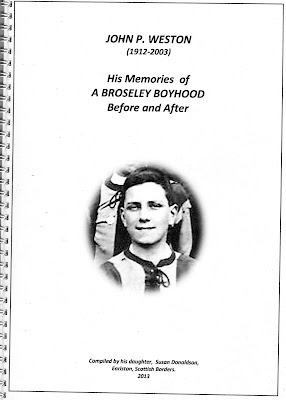
  Dad often talked not only about his boyhood and also of  his war-time  experiences and I am afraid it did provoke the reaction “Not the war again, Dad”. We also used to joke about him being in the Intelligence Branch.  It was only later that we came to realise what a life-defining period it was and  I persuaded him to write (type) his memoirs. 
 
  A memory of entering France shortly after D Day  in 1944.  

"On the Monday morning we zig-zagged our way across the Channel  (to avoid enemy submarines)  and arrived off the beach at around 11pm, some distance off our landing point.  Sporadic  bombing went on during the night from high level German bombers. We slept where we could on the craft.  Just as dawn was breaking,  at 04.00am the captain started up the engines (there was quite a roar) and we moved in  fast to the beach.  The ramp was dropped, we drove off  - and we were in France!"   


 A letter to my mother dated 10th September  [1944]

 Dad - dated on the reverse of the photo - Paris - Sept. 12th 1944
 
 
I am so pleased I have these now, as they, with the correspondence between my parents (discovered after their deaths),   formed the basis of two narratives I have written  based on Dad's memories.


My parents - a photograph taken 1965 on the day of my graduation from university.  I was the first member of the family to go to university, followed later by my brother - and they were so proud of us. 
 
Like father - like daughter
 
Growing up I was always told I was like my mother,  but much later I came to realise how much my working life reflected my father's  interests. I worked for 22 years in the  Scottish Borders network of tourist information centres - first in front line positions helping visitors get the most of holidaying  in the region, and later as visitor services manager  for the Scottish Borders Tourist Board.  


 Surrounded by paper work at  Jedburgh Tourist Information Centre,  a large purpose built building acting as a Gateway Centre for Scotland,  as we were only 14 miles north of the English border.  I loved the job!

My professional look in the staff uniform of Douglas tartan kilt. c.1990
 

A move to Head Office, where I did miss the contact with visitors and dealing with enquiries - I do not like to be beaten!  But I benefited from an excellent staff training programme.   And what was I doing?  Writing mini guides for visitors on the local towns, writing press releasers delivering presentations and training courses - and handling loads of paperwork!  
 
My final work position was with the Scottish Borders Archive, Family History and Local History Service  where I was doing much the same -- presenting workshops on family history, writing information sheets on resources.  It was there I was introduced to the world of blogging - and have never looked back since.   My father would have loved blogging!  
 
 Like my father I enjoy playing a part in my local community and I am still using all my work experience in my activities in retirement.
 
So for Dad and I, the world of work suited us very well!   

***************

Sepia Saturday gives an opportunity for genealogy bloggers   to share their family history and memories through photograph


 Click HERE to see  other bloggers at work