.jump-link{ display:none }
Showing posts with label War and Remembrance. Show all posts

Friday, 9 August 2024

Postcards of Love from Flanders Field: Sepia Saturday


Continuing Sepia Saturday's August theme of "Postcards with Memories",
I look back on on my family treasures - the cards my grandfather William Danson (1885-1962) sent  from the battlefields of World War One to his wife Alice, at home with their four young children in Poulton-le-Fylde, Lancashire. 

This first card below was posted  on 7th February 1918,    and I like to think was sent to Alice for Valentine’s Day.


I never knew my grandmother who died when I was a baby.  Grandad was a taciturn countryman, who was working as a cattle man at the local auction mart when he was called up in 1916.  He was not given to flowery language, so the emotions expressed through these cards seemed out of character, but revealed his closeness to Alice.  In contrast the penciled  messages on the back were very prosaic.  
 
"Field Post Office - Feb. 7th 1918    
Dear Alice, received your letter allright.  I have landed back at the Batt and am in the pink.  I have had a letter from Jenny [sister] and am glad they have  heard from Tom [brother].  Your loving husband, Billy   XXX."
 
The "In the pink" phrase seemed to be a favourite term that William used in other messages as well. But not really I think, given the horror he must have witnessed.

"Batt" - I take it to mean the battalion.

"Blighty" in the address was used as   a nickname for Britain, or often specifically England.  It was first used by soldiers in the Indian army in the 19th century and was popularised in the First World War.  According to the Oxford English Dictionary, the word derives from "bilayati", a regional variant of the Urdu word " meaning "foreign", "British", "English" or "European." or "Anglo-Indian".

A "blighty wound" was a wound serious enough to  require recuperation away from the trenches, but not serious enough to kill or maim the victim - it was hoped for by many, and sometimes self-inflicted.


"Field Post Office 29 April 1918
Dear Alice, just a line to let you know I am in the pink and hope all at home is the same. There is nothing that I want.  Will write again shortly.  Your loving Billy, xxxx."
 
My aunt thought this was a very "risque" card, and totally unlike her father! 

William and Alice, c.1916 
 
 
William's family back home
Alice with Edith, Kathleen (my mother), Harry and baby Billy . c.1916  
 
Below cards sent by William to his children for their birthdays 


A card sent to my mother for her birthday on September 8th.
 
"September 2nd 1917.    Dear Kathleen, I am sending you this card and hope you like it.  I  am well and  hope mother and baby is the same.  From your Dad."  

The armistice was signed 11th November 1918 and somehow I had the picture that all the troops immediately went home.  
 

But it was not the case. For the following two cards with pictures of Brussels were sent by William to his daughters in December 1918.
 
"24th December 1918.  Dear Edith, Just a card to let you know that I am in the best of health.  I am staying not far from the ?  that is on the card.  From her Dad XXXXXX"
 
 
"30th  December 1918.  Dear Kathleen,  I'm in the pink and hope mother and family are the same.  Will send a few more cards in a day or so.  From her Dad xxxxxx."
 
*******************
Postcript

             William and Alice, at my own parents' wedding in 1938.  
 
The Dansons at a family wedding in 1941 - Edith, Peggy, William, Alice,  Harry and Kathleen (my mother).  Peggy was born after the First World War.  Only missing  - son Billy, who was serving in the navy.
 
************
 
Sepia Saturday gives bloggers an opportunity
to share their family history through photographs.


Click HERE to see more Postcard Memories  from Sepia Saturday bloggers. 

**************************
 

Saturday, 4 December 2021

Tropical Headgear? Sepia Saturday

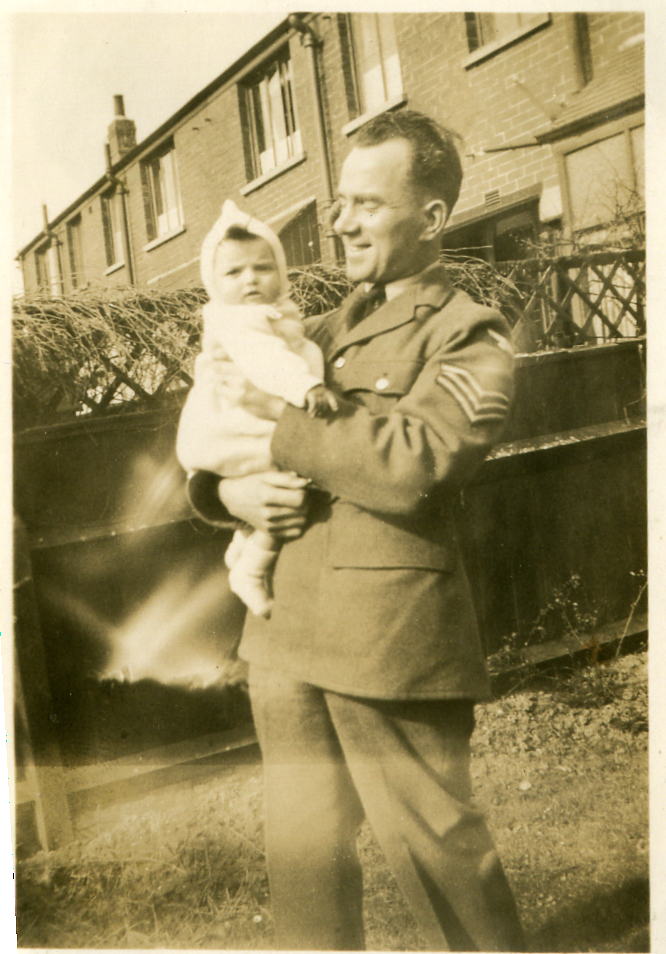
No information was given on this week's Sepia Saturday prompt photograph.  A man in a tall straw hat, with a basket on his back  -  I had no idea what he was doing with that pole or where he was  - a tropical setting perhaps?  I have focused on the hat, as in a small way, it reminded me of the only wartime photograph of my father in his tropical uniform. 

Dad (John P. Weston)  often talked about his war time  experiences. when he served in the RAF, in a Special Liaison Unit, Codes and Ciphers. I am afraid it did often provoke the reaction “Not the war again, Dad”. We also used to joke about him being in the Intelligence Branch.  It was only later that we came to realise what a life-defining period it had been  and I asked him to write down his memories, all be it,  I am sure a sanitized version of the  scenes he must have witnessed.   Dad always had an interest in journalism and it was a familiar sight to see him seated at the typewriter on his bureau, which had been a  wedding present from my mother.
 
In  May 1945 Dad thought his war had ended in Germany, and was looking forward to heading home,  but to his shock he was posted to the Far East.  This is his story, written in his own words.
 
 "Off on a circuitous route,  because we were not allowed to overfly certain counties.  My travel documents said I was priority three – there were ten degrees, with Generals number one.   We flew to Marseilles, then to Sardinia (refuel), over Malta to El Adam, near Tobruk., along the North African coast past Cairo and onto Palestine for a 36 hour break and went to Bethlehem.  Our base was Lydda right on the coast. The flies were a major menace!" We flew onto Bahrain in the Gulf and then to Habayra (RAF airfield in Iraq) – temperature 104F when we landed there at 4a.m.  I could hardly breath.  Then onto Pakistan, Bombay, Calcutta, Madras and across to Ceylon.  I went by train to Mountbatten’s HQ some 8000 feet in a tropical town of  Kandy.

My stay there was brief, but I remembered the good food.  I was told plans had changed and I was rerouted to Bombay.   It was take off in Colombo and we had almost reached the point of no return when the plane burst a tyre, which delayed us 24 hours. We took off at 4am on the second occasion." 

          I only came across these travel papers, after Dad had died. 

"In Burma things were moving to a close.  I was there at the ceremony in Rangoon when the Japanese capitulated.  I was based at the university.  We were always short of tea, which seemed odd in that part of the world, but there was plenty of cocoa.  I also had a ration of one bottle of gin and one of lime juice a month.  I used to drink that under my mosquito net at night watching the mosquitoes  run up and down the wall. 
In November 1945, I was called back for demob.  A driver took me by jeep to the airfield some 20 miles away.  I sat with a rifle (loaded) on my knee since we had to travel through some forests frequented by Dacoits (a terrorist organization in Burma).  The time was 5am. and we made it all right. I flew to Calcutta again and was there for some days.  Calcutta was an awful experience.    Flies crawled over people sitting in the gutters day and night.

We were due to take a train across the desert to Bombay, some 3000 miles.  But there was rioting against the English  in Calcutta and we had to return to camp.  Later we were taken by armoured cars to the station.  On the long journey across India, we stopped at stations to get some food.  We had this on trays, and as we walked along the platform back to the train, hawks dived down and snatched the food.  

I had a short break in Bombay before sailing on the "City of Asia" for Liverpool and home to Blackpool.  One of the first things I did was to cradle you in my arms – you were shy – no wonder!" 
Dad died at the age of 91 in 2003 - and I was so proud to have his memories written down for posterity.  which I presented in the narratives below. 


    ******
Based on a blog post I first wrote in May 2014 

 
Sepia Saturday gives an opportunity for genealogy bloggers  
to share their family history and memories through photographs


Click HERE to see what other Sepia Saturday bloggers are writing about  this week.

Saturday, 13 November 2021

Comrades in Arms - Sepia Saturday

This week's Sepia Saturday prompt photograph shows a group of soldiers relaxing.   Cue for me to look at the life of soldiers in my extended family. 

 My husband's uncle Matty (Matthew Iley White) of South Shields, County Durham is among this group of soldiers perched on a rock in India.  

Matty )1914-1978)  served in the  Durham Light Infantry in India 1933-1937, as listed in his service book below.


 Matty, seated on the left) tucking into his food at army camp.


 In the Sudan, where Matty served March to October 1937 

 Matty's next posting was to China, where in Tiensin the troops celebrated Inkerman Day.  The Battle of Inkerman was fought n 5 November 1854 during the Crimean War, between the allied armies of Britain, France and the Ottoman Empire, against the Imperial Russian Army.  Accounts recalled that the Durham Light Infantry in their red coats attracted heavy fire from the Russian artillery and were reduced to half their strength.  However the remaining Durhams pressed on with a bayonet charge and the opposing regiment  fled the field of battle. Since that date,  the Regiment has always marked Inkerman Day with a dinner.  

 Images taken from Matty''s own album

 **********

My great Uncle Frank Danson  (1892-1977)  was the seventh of eight sons born    to James Danson, a joiner journeyman and Maria Rawcliffe of Poulton-le-Fylde, Lancashire.  Five sons served in the First World War - I have been unable  to trace a service record for Frank.  with many destroyed in enemy bombing in World War Two.  At some point he  was injured and was in hospital in Malta when these photographs were taken - found in the collection of my great aunt Jennie Danson - the only girl in the family.


 On the reverse in Jenny's handwriting, she identified Frank as on the back row right.


 This  photograph seems to be some kind of celebration.  Frank is front row left,  dressed formally in his uniform and cap, but what about those two fellows on the  back row in what appears to be their pyjamas and beanie hats? 

  
This photograph was unfortunately unidentified, but I think Frank could be on the right of the front row.  In hospital, wounded soldiers, fit enough to go out, wore a distinctive uniform of blue flannel suits with white revers and a red tie.   Frank survivwed the war and died  in 1971 at the age of 79.
 
**********
 
 My Mystery Photograph 


 I must admit I know nothing at all about this photograph which was in my Great Aunt Jennie's collection.  She was usually good at labeling the photos on the reverse, but there was nothing here to indicate who it was or where it was taken.   I am presuming they are First World War soldiers and might include one of Jennie's five brothers who served - William Danson  (my grandfather), John who died in army training,  Tom, Frank and George, killed on the Somme a week after his 22n 
birthday. I could possibly say Tom or Frank are among the soldiers here.  
 
Was it a group of new recruits in training?  How many, I wonder survived the conflict.  The background looks very like the many terraced rows of houses and bed & breakfasts you find in Blackpool.  Does anyone have any ideas?  

************
Some  humour even in war time - as illustrated by the photograph of my grandfather William Danson, that shows the camaraderie that could exist amongst soldiers.   

The photo  intrigued me when I first saw it as a child. There was no Scottish connections at all on my mother's side of the family, so why was Granddad wearing a kilt and a tammie?   The story was that he became friendly with some Scottish soldiers, and as a laugh he had dressed up in one of their uniforms and had his picture taken to send home.  It must have been taken in France as the reverse of the photograph  indicates it is a "Carte Postale" with space for "Correspondance" and "Addresse".

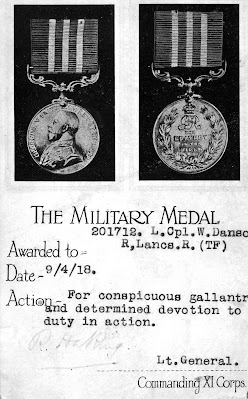
Grandad, William Danson with two colleagues.  He served in the King's Own Royal Lancaster Regiment, fought at the mudbath that was the Battle of  Passchendaele and won the Military Medal at Givenchy, with the postcards below kept in the shoebox of family memorabilia in a cupboard by the fire.


 I wrote to the regimental museum at Lancaster Castle for more information and  was sent a copy of an extract from the Regimental War Diary,  and the award citation which read: 
 
"For conspicuous gallantry in action at GIVENCHY on 9th April 1918,This N.C.O commanded a Lewis Gun section...He did good work with his gun during  the attack inflicting heavy casualties on the enemy. When the other N.C.O. in command of the other Lewis Gun was wounded,he took over the gun and controlled the fire of both teams".
 
9th April was five  days after Granddad's 33rd birthday,  Grandad was a taciturn country man who before conscription had been a  livestock foreman at the local auction mart.  He,   like many of those who had experienced the horrors of the First World War, would never talk about this time. 
 
But Granddad left a moving legacy of his war   in the many embroidered postcards he sent and brought back home.   These remain my  family treasures. 


 *****************

Sepia Saturday gives an opportunity for genealogy bloggers   to share 

their family history and memories through photographs.


Click HERE to see how other Sepia Saturday bloggers
this week have related their soldiers' stories 


*************

As we remember in this week soldiers lost in war, you may be interested in a post on my new blog Photo Ramblings where I feature war memorials across Britain from the Scottish Highlands to national monuments in London. 
Take a look HERE 

Earlston, Scottish Borders 
 
************************


Friday, 30 July 2021

Lest We Forget: Sepia Saturday

This week's Sepia Saturday prompt photograph features the war memorial looking out to sea at Southport, Queensland, Australia.

War Memorials give no more than a name, yet they are one of the most powerful, poignant and emotive of family history resources, recording the loss of often young lives under harrowing circumstances. War Memorials are not only significant features for the family of individuals they commemorate,  but also for the local community who bear witness to the sacrifice of their people in war. 


The simple but moving monument on the Isle of Iona off western Scotland, looks  across the water to the Isle of Mull.

The war memorial at Oban on the west coast of Scotland is in a most beautiful peaceful setting, with a background of sea and hills over to the Isle of Mull - far removed from the horrors of war.

A Scottish soldier, remembered in the small village of Taynuilt, near Oban.


 Another Scottish soldier portrayed on the war memorial at Aberfeldy, in Perthshire.


The War Memorial in the small village of Minto, near Hawick in the Scottish Borders.

The Commando Memorial at Spean Bridge in the Scottish Highlands overlooks the training areas of the Commando Training Depot established in 1942 at Achnacarry Castle.


Earlston War Memorial in the rural Scottish Borders, where I now live. 


The peaceful parkland setting of the war memorial in Clitheroe, Lancashire, England.


The Cenotaph, Britain's national memorial - photograph taken on a visit to London in 2008. shortly after Remembrance Day.

***************** 

A Query?   I am puzzled!  The prompt photograph quotes the date "c.1910".  So what war did it commemorate?  Did Australians fight in the Boer War 1899-1901? 

The South African Boer War  is an  often forgotten conflict,  but below is remembered in Hawick in the Scottish Borders,  where in Wilton Lodge Park the memorial was unveiled in 1903  by Head of the British Forces, Lord Roberts,  Twenty three men from Hawick and district died in the South African conflict and are named on the memorial. 

*************** 

Sepia Saturday gives an opportunity for genealogy bloggers  
to share their family history and memories through photographs
 
  Click  HERE to see how other Sepia Saturday blogger have reflected 
this week's photograph