.jump-link{ display:none }
Showing posts with label Working Lives. Show all posts

Friday, 9 October 2026

Sea Stories from Master Mariners - Sepia Saturday


Water is the theme of this  week’s Sepia Saturday prompt photograph.  So here I  take a look at my husband's  Donaldson, White and Moffet ancestors who were master mariners, sailing out into the North Sea from  South Shields in north east England.  Extended family members were in related occupations as a caulker, seaman, river policemen, shipwright, roper, ship's carpenter and marine engine fitter.

To me "snow" was the white stuff falling in winter and a "smack" was a slap to a recalcitrant child. But that all changed as I began researching my husband's maritime ancestors and learnt about the different names for ships in the 19th century - barque or bark or barc, brig, sloop. smack and snow - an illustration of the diverse routes that family history can take you.  

Great Great Great Grandfather - Robert Donaldson, Master Mariner  (1801-1878)
Mariner records at the National Archives at Kew  showed that Robert Donaldson was  registered as a mariner on 20th July 1852.

Free Sailing Ship Sunset illustration and picture 

Image - Courtesy of  Pixabay

Tyne and Wear Archives provided invaluable  information on the sea-going  life of Robert Donaldson and the ships he sailed on, listed in "“A Dictionary of Tyne Sailing Ships: a record of merchant sailing ships owned, registered and built at the Port of Tyne 1830-1930”, compiled by Richard Keys. This is a complete A-Z of Ships, master mariners and owners, detailing ships, voyages, disasters and share-ownerships, and much more - an  absolute  must for anyone  researching  maritime ancestors in this region.

The entries make fascinating reading, with all six ships on which Robert Donaldson sailed, having an eventful history and coming to a sad end  - though not under his charge. 
 

  • The Thetis became a wreck after sinking off the Yorkshire coast in 1869.
  • The John was stranded in 1861 and became a wreck during a severe easterly gale. Twenty-eight other Tyne ships went ashore in the same area during the same gale.
  • The Emerald, in December 1855, when on passage from the Tyne to London, foundered in five fathoms on the Dough Sand (Long Sand) Thames estuary. Three survivors were brought ashore by two Bridlington smacks. Eleven others were unaccounted for, including some of the crew of the rescuing smack who were in a small boat, which disappeared.
  • The Hebe was wrecked in Robin Hood’s Bay, along with other vessels on 27 January 1861. The Ann & Elizabeth disappeared after leaving the Tyne in November 1863, with her captain' wife left a widow with six children.  
  • The William Metcalfe was Robert Donaldson's largest ship.  On her maiden voyage, it transported 240 male convicts from Portsmouth to Hobart,Tasmania  on a passage that took 102 days. In January 1855 eight of her crew were sent to goal for three months each by the North Shields magistrates for refusing duty. In October 1858 her master and one man were washed overboard. Nine days later, the ship was abandoned, with the crew taken off.

These incidents were by no means unusual and bring home the hazards our mariner ancestors faced in their daily lives.

************ 

Great Great Grandfather John Robert Moffet (1814-1881)   

John Robert Moffet in a Napoleonic pose - the only photograph I have of my husband's mariner ancestors - shared with me by internet contact who was also a descendant of John.  
 

John's family originated from Tynmouuth, north of the river Tyne,  with his father Robert and brother William both mariners. Two puzzles about the family  remain unanswered.   John was born in Chatham, the site of the Royal Navy dockyard on the River Medway on the south  of England.  What had brought his family there?    

John's   wife Frances Dunn Thomas, daughter  and widow of a mariner,   had three children, with two, according to the census entr,    born in the USA.   It would be wonderful to find the background to that, but nigh impossible without any indication of which state.  The family first settled in the London docklands area before returning to South Shields.  

In the 1861 Census,  John  was listed as master of "The Brotherly Love" sailing off Flamborough Head in the North Sea.     The crew of eight included three young apprentices, four seamen, and a mate, with most born in South Shields.


The caption  reads"The Brotherly Love" model. made for her  master Captain  Moffet."    

Illustration  supplied by a Moffet descendant. 

In South Shields Museum and Art Gallery, there is  a portrait  " The Brig "Brotherly Love" and the Tug "William" painted by  John Scott (1802-1885).


 Other mariner ancestors of my husband included, on his mother's side:

Great Great Grandfather  Matthew White (1821-187 ).   
The 1861 census listed Matthew  as master mariner on board the brig "Caroline" off South Shields.  Lloyd’s Captains’ Register,  recorded the ships Matthew sailed on, travelling as far as the Adriatic, Mediterranean and Baltic ports.
 
From: the National Archives at  Kew, London 
 
Sadly Matthew was,with  others,   drowned at sea  on 10th January 1872,  whilst master mariner of the brig "Caroline" - as recorded in    "Births, Marriages and Deaths at Sea",  online on Find May Past.   
 
 Great Grandfather  Matthew Iley White. (1849-1901)
On his marriage to young widow Louisa Moffet Pierce in 1884 at South Shields, Matthew was described as a mariner.  However he had a change of occupation and was next found as a member of the Tyne River Police, along with his brother Henry.
 
A  long-held story in my husband's family recollected a photograph (sadly lost) of a White ancestor in a top hat in the uniform of the River Tyne police.   A silver uniform button  (below) is  still held by the family.   


Tyne and Wear Archives again provided some answers. The Nominal Roll of the Tyne River Police gave details that  two sons of Matthew Iley White  (senior),   had been  members of the river police force – but both with rather a chequered career. Henry White  joined 9th January 1882 and brother Matthew June 1896.  
 
The Police Defaulters Book recorded on 11th June 1889 their  misconduct in the same incident -  "for assaulting a seaman A. W. Hanson and other irregularities, whilst off duty".   
 
Matthew was fined 2/6 and transferred to the Newcastle Division at his own expense.  However he resigned a few months later. Henry was fined 2/6 and transferred to Walker Division at his own expense.  The Nominal Roll of 1904 noted his age as 42 and that he had 22 years of service, with a wage of 29/6. 
 
************ 
 
Storms off South Shields
 "The Shields Gazette" on  (FindMyPast Newspaper Archive)  abounds with  headlines and reports on disasters at sea, storms and gales;  the lifeboat responses. and the ensuing work of the Mariners' benevolent societies in helping families in distress.  Below is one typical  instance of what mariners faced. 


 Image Courtesy of  Pixabay 
 
 
A Fascinating Fact  - one of the first purpose built lifeboats  was constructed in South Shields in 1789, prompted by a tragedy  when a ship with all its crew was  lost  at sea just off shore.  
 
To Conclude -  
My husband's maritime ancestors (Donaldson, White & Moffet)  must have had a streak of Adventure  in them to venture out from South Shields  into the North Sea in all weathers, as they plied their trade as master mariners. They faced storms at sea  as part of their daily lives - as evidenced by local newspaper reports of shipping disasters.  I was pleased to find such detail of their  experiences in the course of my research. 


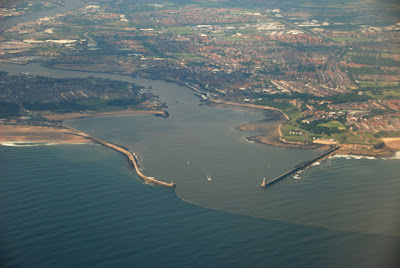
Here is an aerial view taken as we were coming into land at Newcastle Airport, with a clear picture of the River Tyne, its north and south piers. and on the left South Shields, the home of my husband's ancestors.  
 
*********************** 

**************** 

Sepia Saturday gives bloggers an opportunity

 to share their family history through photographs. 

Click HERE to  see more watery stories  from other Sepia Saturday  bloggers

*******************************


Monday, 20 April 2026

Sea Stories of Master Mariners - Week 17 of 52 Ancestors in 52 Weeks

Working LIves is the theme of Week 17 in the blogging challenge "52 Ancestors in 52 Weeks".   I am taking a look at the lives of my husband's ancestors who were 19th century mariners,  sailing  out of the River Tyne at South Shields, County Durham  in north eat England.

A Genealogical Sideline:   To me "snow" was the white stuff falling in winter and a "smack" was a slap to a recaltrant child.  But that all changed,   as I  began researching my husband's maritime ancestors and learnt about the different names for ships in the 19th century - barque or bark or barc, brig, sloop, smack and snow - an illustration of the diverse routes that family history can take you.

Great Great Great Grandfather - Robert Donaldson, Master Mariner  (1801-1878)
Mariner records at the National Archives at Kew  showed that Robert Donaldson was  registered as a mariner on 20th July 1852.

Tyne and Wear Archives provided information on the sea-going  life of Robert Donaldson and the ships he sailed on, listed in "“A Dictionary of Tyne Sailing Ships: a record of merchant sailing ships owned, registered and built at the Port of Tyne 1830-1930”, compiled by Richard Keys. This is a complete A-Z of Ships, master mariners and owners, detailing ships, voyages, disasters and share-ownerships, and much more - a must for anyone with maritime ancestors in this region.

The entries make fascinating reading, with all six ships on which Robert Donaldson sailed, having an eventful history and coming to a sad end  - though not under his charge. 
 

Free Sailing Ship Sunset illustration and picture 
Image - Pixabay

  • The Thetis became a wreck after sinking off the Yorkshire coast in 1869.
  • The John was stranded in 1861 and became a wreck during a severe easterly gale. Twenty-eight other Tyne ships went ashore in the same area during the same gale.
  • The Emerald, in December 1855, when on passage from the Tyne to London, foundered in five fathoms on the Dough Sand (Long Sand) Thames estuary. Three survivors were brought ashore by two Bridlington smacks. Eleven others were unaccounted for, including some of the crew of the rescuing smack who were in a small boat, which disappeared.
  • The Hebe was wrecked in Robin Hood’s Bay, along with other vessels on 27 January 1861. The Ann & Elizabeth disappeared after leaving the Tyne in November 1863, with her captain leaving a wife and six children.
  • The William Metcalfe was Robert Donaldson's largest ship.  On her maiden voyage, it transported 240 male convicts from Portsmouth to Hobart,TAsmania  on a passage that took 102 days. In January 1855 eight of her crew were sent to goal for three months each by the North Shields magistrates for refusing duty. In October 1858 her master and one man were washed overboard. Nine days later, the ship was abandoned, with the crew taken off.

These incidents were by no means unusual and bring home the hazards our mariner ancestors faced in their daily lives.

Great Great Grandfather John Robert Moffet (1814-1881)   

John Robert Moffet in a Napoleonic pose - the only photograph I have of my husband's mariner ancestors - shared with me by internet contact who was also a descendant of John.  
 

John's family originated from Tynmouuth, north of the river Tyne,  with his father Robert and brother William both mariners. Two puzzles about the family  remain unanswered.   John was born in Chatham, the site of the Royal Navy dockyard on the River Medway on the south  of England.  What had brought his family there?    

John's   wife Frances Dunn Thomas, daughter  and widow of a mariner,   had three children, with two  born in the USA.   It would be wonderful to find the background to that, but nigh impossible without any indication of which state.  The family first settled in the London docklands area before returning to South Shields..   

In the 1861 Census,  John  was listed as master of "The Brotherly Love" sailing off Flamborough Head in the North Sea.     The crew of eight included three young apprentices, four seamen, and a mate, with most born in South Shields.

The caption  reads"The Brotherly Love" model. made for her  master Captain  Moffet."    

llustration supplied by a Moffet descendant. 

In South Shields Museum and Art Gallery, there is  a portrait  " The Brig "Brotherly Love" and the Tug "William" painted by  John Scott (1802-1885).


 Other mariner ancestors of my husband included, on his mother's side:

Great Great Grandfather  Matthew White (1821-1872).   
The 1861 census listed Matthew  as master mariner on board the brig "Caroline" off South Shields.  Lloyd’s Captains’ Register,  recorded the ships he sailed on, travelling as far as the Adriatic, Mediterranean and Baltic ports.
 
From: the National Archives at  Kew, London 
 
Sadly Matthew was, wih others,   drowned at sea  on 10th January 1872 whilst master marinder of the brig "Caroline" - as recorded in    "Births, Marriages and Deaths at Sea",  online on Find May Past.  
 
 Great Grandfather  Matthew Iley White. (1849-1901)
On his marriage to young widow Louisa Moffet Pierce in 1884 at South Shields, Matthew was described as a mariner.  However he had a change of occupation and was next found as a member of the Tyne River Police, along with his brother Henry.
 
A  long-held story in my husband's family recollected a photograph (sadly lost) of a White ancestor in a top hat in the uniform of the River Tyne police.   A silver uniform button  (below) is  still held by the family.   


Tyne and Wear Archives provided some answers. The Nominal Roll of the Tyne River Police gave details that  two sons of Matthew Iley White  (senior),   had been  members of the river police force – but both with rather a chequered career.    Henry White  joined 9th January 1882 and brother Matthew June 1896.  
 
The Police Defaulters Book recorded on 11th June 1889 their  misconduct in the same incident -  "for assaulting a seaman A. W. Hanson and other irregularities, whilst off duty".   
 
Matthew was fined 2/6 and transferred to the Newcastle Division at his own expense.  However he resigned a few months later. Henry was fined 2/6 and transferred to Walker Division at his own expense.  The Nominal Roll of 1904 noted his age as 42 and that he had 22 years of service, with a wage of 29/6
 
Storms off South Shields
 "The Shields Gazette" on  (FindMyPast Newspaper Archive)  abounds with  headlines and reports on disasters at sea, storms and gales;  the lifeboat responses. and the ensuing work of the Mariners' benevolent societies in helping families in distress.  Below is one typical  of what mariners faced. 


 Image - Pixabay 
 
 
A Fascinating Fact  - one of the first purpose built lifeboats  was constructed in South Shields in 1789, prompted by a tragedy  when a ship with all its crew was  lost  at sea just off shore.  
 
To Conclude -  
My husband's maritime ancestors (Donaldson, White & Moffet)  must have had a streak of Adventure  in them to venture out from South Shields  into the North Sea in all weathers, as they plied their trade as master mariners. They faced storms at sea  as part of their daily lives - as evidenced by local newspaper reports of shipping disasters.   
 
 
* *******************
  
May be an image of text that says "52 Ancestors in 52 Weeks Week 17 WorkingforaLiving Working for aLiving AmyJohnsonCrow. AmybohnsonCrow.com/52ancestors"


Thursday, 27 November 2025

Sea Stories from Master Mariner Ancestors - Sepia Saturday

"Ships" feature in this week’s Sepia Saturday prompt photograph -  a theme I featured earlier this year HERE.  So this time I am taking a look at the lives of my husband's ancestors who were 19th century mariners,  who sailed out of the River Tyne at South Shields, County Durham  in north eat England.  

Great Great Great Grandfather - Robert Donaldson, Master Mariner  (1801-1878)
Mariner records at the National Archives at Kew  showed that Robert Donaldson was  registered as a mariner on 20th July 1852.

Tyne and Wear Archives provided information on the sea-going  life of Robert Donaldson and the ships he sailed on, listed in "“A Dictionary of Tyne Sailing Ships: a record of merchant sailing ships owned, registered and built at the Port of Tyne 1830-1930”, compiled by Richard Keys. This is a complete A-Z of Ships, master mariners and owners, detailing ships, voyages, disasters and share-ownerships, and much more - a must for anyone with maritime ancestors in this region.

The entries make fascinating reading, with all six ships on which Robert Donaldson sailed, having an eventful history and coming to a sad end  - though not under his charge. 
 

Free Sailing Ship Sunset illustration and picture 
Image - Pixabay

  • The Thetis became a wreck after sinking off the Yorkshire coast in 1869.
  • The John was stranded in 1861 and became a wreck during a severe easterly gale. Twenty-eight other Tyne ships went ashore in the same area during the same gale.
  • The Emerald, in December 1855, when on passage from the Tyne to London, foundered in five fathoms on the Dough Sand (Long Sand) Thames estuary. Three survivors were brought ashore by two Bridlington smacks. Eleven others were unaccounted for, including some of the crew of the rescuing smack who were in a small boat, which disappeared.
  • The Hebe was wrecked in Robin Hood’s Bay, along with other vessels on 27 January 1861. The Ann & Elizabeth disappeared after leaving the Tyne in November 1863, with her captain leaving a wife and six children.
  • The William Metcalfe was Robert Donaldson's largest ship.  On her maiden voyage, it transported 240 male convicts from Portsmouth to Hobart,TAsmania  on a passage that took 102 days. In January 1855 eight of her crew were sent to goal for three months each by the North Shields magistrates for refusing duty. In October 1858 her master and one man were washed overboard. Nine days later, the ship was abandoned, with the crew taken off.

These incidents were by no means unusual and bring home the hazards our mariner ancestors faced in their daily lives.

Great Great Grandfather John Robert Moffet (1814-1881)   

John Robert Moffet in a Napoleonic pose - the only photograph I have of my husband's mariner ancestors - shared with me by internet contact who was also a descendant of John.  
 

John's family originated from Tynmouuth, north of the river Tyne,  with his father Robert and brother William both mariners. Two puzzles about the family  remain unanswered.   John was born in Chatham, the site of the Royal Navy dockyard on the River Medway on the south  of England.  What had brought his family there?    John's   wife Frances Dunn Thomas, daughter  and widow of a mariner,   had three children, with two  born in the USA.   It would be wonderful to find the background to that, but nigh impossible without any indication of which state.  The family first settled in the London docklands area before returning to South Shields..   

In the 1861 Census,  John  was listed as master of "The Brotherly Love" sailing off Flamborough Head in the North Sea.     The crew of eight included three young apprentices, four seamen, and a mate, with most born in South Shields.


The caption  reads"The Brotherly Love" model. made for her  master Captain  Moffet."    

llustration supplied by a Moffet descendant. 

In South Shields Museum and Art Gallery, there is  a portrait  " The Brig "Brotherly Love" and the Tug "William" painted by  John Scott (1802-1885).


 Other mariner ancestors of my husband included, on his mother's side:

Great Great Grandfather  Matthew White (1821-?).   
The 1861 census listed Matthew  as master mariner on board the brig "Caroline" off South Shields.  Lloyd’s Captains’ Register,  recorded the ships he sailed on, travelling as far as the Adriatic, Mediterranean and Baltic ports.
 
From: the National Archives at  Kew, London 
 
 Great Grandfather  Matthew Iley White. (1849-1901)
On his marriage to young widow Louisa Moffet Pierce in 1884 at South Shields, Matthew was described as a mariner.  However he had a change of occupation and was next found as a member of the Tyne River Police, along with his brother Henry.
 
A  long-held story in my husband's family recollected a photograph (sadly lost) of a White ancestor in a top hat in the uniform of the River Tyne police.   A silver uniform button  (below) is  still held by the family.   


Tyne and Wear Archives provided some answers. The Nominal Roll of the Tyne River Police gave details that  two sons of Matthew Iley White  (senior),   had been  members of the river police force – but both with rather a chequered career.    Henry White  joined 9th January 1882 and brother Matthew June 1896.  
 
The Police Defaulters Book recorded on 11th June 1889 their  misconduct in the same incident -  "for assaulting a seaman A. W. Hanson and other irregularities, whilst off duty".   
 
Matthew was fined 2/6 and transferred to the Newcastle Division at his own expense.  However he resigned a few months later. Henry was fined 2/6 and transferred to Walker Division at his own expense.  The Nominal Roll of 1904 noted his age as 42 and that he had 22 years of service, with a wage of 29/6
 
Storms off South Shields
 "The Shields Gazette" on  (FindMyPast Newspaper Archive)  abounds with  headlines and reports on disasters at sea, storms and gales;  the lifeboat responses. and the ensuing work of the Mariners' benevolent societies in helping families in distress.  Below is one typical  of what mariners faced. 


 Image - Pixabay 
 
 
Fascinating Fact  - one of the first purpose built lifeboats  was constructed in South Shields in 1789, prompted by a tragedy  when a ship with all its crew was  lost  at sea just off shore.  
 
 
* *******************
  
 Sepia Saturday gives bloggers an opportunity to share 
their family history and memories through photographs.


Click HERE to see more posts  from Sepia Saturday bloggers. 

 
 *******************

Friday, 13 September 2024

Ups and Downs at the Mill - Sepia Saturday

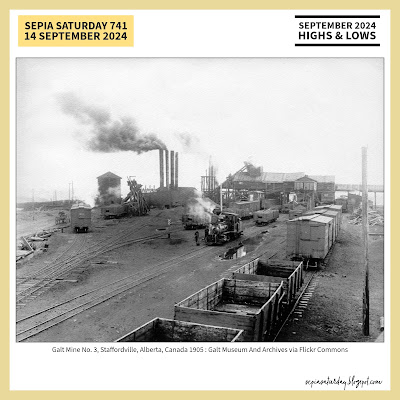
Continuing  the Highs and Lows September theme, this week’s Sepia Saturday's prompt photograph shows an industrial scene,  including a factory, a tall chimney  and a goods train (see the end of this post).  So take a look here at the local history story of  Rhymer’s Mill  in the rural Scottish Borders.


 For over 200 years, textile production was an important part  of the local economy.  

We have one of the earliest descriptions of the village  in  t 1799 in  "The First Statistical Account of Scotland, 1791-1799," edited by Sir John Sinclair, where  Parish Minister Rev.  Lawrence Johnston wrote:

 "The principal manufacture is linen cloth.  There are between 40 and 50 weaver looms mostly employed weaving linen........ We have only one woollen manufacturer,  though no place could be better  situated for carrying out that branch of trade.   The Leader Water runs along the west and there is plenty of wool to supply 20 manufacturers."
 In the late 18th century, RHYMER'S MILL was  a corn mill before being transformed by the Whale family into a textile mill where  the production of gingham was introduced by Thomas Whale, succeeded by his two enterprising  daughters Christian and Marion - two formidable women ahead of their time.  


A carved inscription on the old mill building, 
 with  the names C & M Whale clearly visible.


The 1851 Census identified Christian  Whale as a 64 year old manufacturer of gingham and cotton, employing 60 workers, mainly weavers and winders of cotton. Also in the business was her sister Marion aged 56.    Ten years on in 1861 Christian, now aged 74  and Marion 66, were both described as Gingham Manufacturers.
 

Rutherfurd’s 1866 Directory of the Southern Counties, commented
 “Earlston produces quantities of the Earlston ginghams. There is no other place in the country where the same class of gingham is made”.

Two surviving examples of the Earlston Gingham  in the collection of Auld Earlston
 
Rhymer's Mill later became a dye works run by and the path  alongside the Leader Water is still referred to as "The Tenters" where the dyed wool was hung out to dry.  In 1911 the premises were taken over by John Rutherford & Sons,  agricultural engineers, who operated at the mill until the business closed down in 2014. 
********
 In the 1851 Census, at MID MILL Charles Wilson was owner:
""of the firm of Charles Wilson & Sons,  blankets and plaiding manufacturers employing 18 men 7 women and 19 girls".  Ten years on, the business had extended to making tweeds, and employed  "28 men and 44 women, boys and young women". 
Young workers listed in the censuses include:
  • Piecer in a Woollen Factory   (a 13 year old boy)
  • Machine Feeder in a Woollen Factory (15 year old girl - sounds dangerous! )
  • Steam Loom Weaver of Wool (18 year old girl)

Subsequently Simpson and Fairbairn took over the business and greatly extended its operations. It appears that the firm later adopted the name of Rhymer's Mill. The local heritage group Auld Earlston is fortunate to have a collection of photographs of the mill dating from the early 1900's . 
 
 We often think that the role of women in the 19th century was one of all things domestic.  But for many of our female ancestors, life involved working long hours in the mill in   various aspects of textile production, whether it be knitwear, tweed, cotton, lace or carpet production.   


Down to the job in hand

Mill Road  where houses were built for the workers

Rhymers Mill  weathered the storm of global depression in the 1920's and 30's.  The Mill was fully employed on service and  utility clothing during the Second World War.   and the post war years saw  a boom time for the Borders as world wide stocks of clothes had to be replaced, with the firm employing more than 300 workers, making it  the  mainstay of the Earlston economy. 

But by the late 1950's and early '60's, the old problems of cheaper competitors and vulnerability to changing fashions had returned.  The decline could not be stemmed and tidal wave of workers along Mill Road turned to a trickle.  The mill finally closed in 1969 when a workforce of almost 100 was made redundant.  

Earlston's role in the  Borders textile industry  
came to an end.


Two photographs taken in 1974  
of the derelict Rhymer's Mill


  A current street sign in Earlston reminds us of the village's industrial past.  
 
 
*****************
 
With grateful thanks to Auld Earlston for permission 
to feature photographs from its collection.  
 
 
Sepia Saturday gives an opportunity for genealogy bloggers  to share their family history and memories through photographs
 
 
Click HERE to  see how other Sepia Saturday bloggers 
have been hard at work this week .