.jump-link{ display:none }
Showing posts with label Donaldson Family. Show all posts

Monday, 20 April 2026

Sea Stories of Master Mariners - Week 17 of 52 Ancestors in 52 Weeks

Working LIves is the theme of Week 17 in the blogging challenge "52 Ancestors in 52 Weeks".   I am taking a look at the lives of my husband's ancestors who were 19th century mariners,  sailing  out of the River Tyne at South Shields, County Durham  in north eat England.

A Genealogical Sideline:   To me "snow" was the white stuff falling in winter and a "smack" was a slap to a recaltrant child.  But that all changed,   as I  began researching my husband's maritime ancestors and learnt about the different names for ships in the 19th century - barque or bark or barc, brig, sloop, smack and snow - an illustration of the diverse routes that family history can take you.

Great Great Great Grandfather - Robert Donaldson, Master Mariner  (1801-1878)
Mariner records at the National Archives at Kew  showed that Robert Donaldson was  registered as a mariner on 20th July 1852.

Tyne and Wear Archives provided information on the sea-going  life of Robert Donaldson and the ships he sailed on, listed in "“A Dictionary of Tyne Sailing Ships: a record of merchant sailing ships owned, registered and built at the Port of Tyne 1830-1930”, compiled by Richard Keys. This is a complete A-Z of Ships, master mariners and owners, detailing ships, voyages, disasters and share-ownerships, and much more - a must for anyone with maritime ancestors in this region.

The entries make fascinating reading, with all six ships on which Robert Donaldson sailed, having an eventful history and coming to a sad end  - though not under his charge. 
 

Free Sailing Ship Sunset illustration and picture 
Image - Pixabay

  • The Thetis became a wreck after sinking off the Yorkshire coast in 1869.
  • The John was stranded in 1861 and became a wreck during a severe easterly gale. Twenty-eight other Tyne ships went ashore in the same area during the same gale.
  • The Emerald, in December 1855, when on passage from the Tyne to London, foundered in five fathoms on the Dough Sand (Long Sand) Thames estuary. Three survivors were brought ashore by two Bridlington smacks. Eleven others were unaccounted for, including some of the crew of the rescuing smack who were in a small boat, which disappeared.
  • The Hebe was wrecked in Robin Hood’s Bay, along with other vessels on 27 January 1861. The Ann & Elizabeth disappeared after leaving the Tyne in November 1863, with her captain leaving a wife and six children.
  • The William Metcalfe was Robert Donaldson's largest ship.  On her maiden voyage, it transported 240 male convicts from Portsmouth to Hobart,TAsmania  on a passage that took 102 days. In January 1855 eight of her crew were sent to goal for three months each by the North Shields magistrates for refusing duty. In October 1858 her master and one man were washed overboard. Nine days later, the ship was abandoned, with the crew taken off.

These incidents were by no means unusual and bring home the hazards our mariner ancestors faced in their daily lives.

Great Great Grandfather John Robert Moffet (1814-1881)   

John Robert Moffet in a Napoleonic pose - the only photograph I have of my husband's mariner ancestors - shared with me by internet contact who was also a descendant of John.  
 

John's family originated from Tynmouuth, north of the river Tyne,  with his father Robert and brother William both mariners. Two puzzles about the family  remain unanswered.   John was born in Chatham, the site of the Royal Navy dockyard on the River Medway on the south  of England.  What had brought his family there?    

John's   wife Frances Dunn Thomas, daughter  and widow of a mariner,   had three children, with two  born in the USA.   It would be wonderful to find the background to that, but nigh impossible without any indication of which state.  The family first settled in the London docklands area before returning to South Shields..   

In the 1861 Census,  John  was listed as master of "The Brotherly Love" sailing off Flamborough Head in the North Sea.     The crew of eight included three young apprentices, four seamen, and a mate, with most born in South Shields.

The caption  reads"The Brotherly Love" model. made for her  master Captain  Moffet."    

llustration supplied by a Moffet descendant. 

In South Shields Museum and Art Gallery, there is  a portrait  " The Brig "Brotherly Love" and the Tug "William" painted by  John Scott (1802-1885).


 Other mariner ancestors of my husband included, on his mother's side:

Great Great Grandfather  Matthew White (1821-1872) 
The 1861 census listed Matthew  as master mariner on board the brig "Caroline" off South Shields.  Lloyd’s Captains’ Register,  recorded the ships he sailed on, travelling as far as the Adriatic, Mediterranean and Baltic ports.
 
From: the National Archives at  Kew, London 
 
Sadly Matthew was, wih others,   drowned at sea  on 10th January 1872 whilst master marinder of the brig "Caroline" - as recorded in    "Births, Marriages and Deaths at Sea",  online on Find May Past.  
 
 Great Grandfather  Matthew Iley White. (1849-1901)
On his marriage to young widow Louisa Moffet Pierce in 1884 at South Shields, Matthew was described as a mariner.  However he had a change of occupation and was next found as a member of the Tyne River Police, along with his brother Henry.
 
A  long-held story in my husband's family recollected a photograph (sadly lost) of a White ancestor in a top hat in the uniform of the River Tyne police.   A silver uniform button  (below) is  still held by the family.   


Tyne and Wear Archives provided some answers. The Nominal Roll of the Tyne River Police gave details that  two sons of Matthew Iley White  (senior),   had been  members of the river police force – but both with rather a chequered career.    Henry White  joined 9th January 1882 and brother Matthew June 1896.  
 
The Police Defaulters Book recorded on 11th June 1889 their  misconduct in the same incident -  "for assaulting a seaman A. W. Hanson and other irregularities, whilst off duty".   
 
Matthew was fined 2/6 and transferred to the Newcastle Division at his own expense.  However he resigned a few months later. Henry was fined 2/6 and transferred to Walker Division at his own expense.  The Nominal Roll of 1904 noted his age as 42 and that he had 22 years of service, with a wage of 29/6
 
Storms off South Shields
 "The Shields Gazette" on  (FindMyPast Newspaper Archive)  abounds with  headlines and reports on disasters at sea, storms and gales;  the lifeboat responses. and the ensuing work of the Mariners' benevolent societies in helping families in distress.  Below is one typical  of what mariners faced. 


 Image - Pixabay 
 
 
A Fascinating Fact  - one of the first purpose built lifeboats  was constructed in South Shields in 1789, prompted by a tragedy  when a ship with all its crew was  lost  at sea just off shore.  
 
To Conclude -  
My husband's maritime ancestors (Donaldson, White & Moffet)  must have had a streak of Adventure  in them to venture out from South Shields  into the North Sea in all weathers, as they plied their trade as master mariners. They faced storms at sea  as part of their daily lives - as evidenced by local newspaper reports of shipping disasters.   
 
 
* *******************
  
May be an image of text that says "52 Ancestors in 52 Weeks Week 17 WorkingforaLiving Working for aLiving AmyJohnsonCrow. AmybohnsonCrow.com/52ancestors"


Thursday, 27 November 2025

Sea Stories from Master Mariner Ancestors - Sepia Saturday

"Ships" feature in this week’s Sepia Saturday prompt photograph -  a theme I featured earlier this year HERE.  So this time I am taking a look at the lives of my husband's ancestors who were 19th century mariners,  who sailed out of the River Tyne at South Shields, County Durham  in north eat England.  

Great Great Great Grandfather - Robert Donaldson, Master Mariner  (1801-1878)
Mariner records at the National Archives at Kew  showed that Robert Donaldson was  registered as a mariner on 20th July 1852.

Tyne and Wear Archives provided information on the sea-going  life of Robert Donaldson and the ships he sailed on, listed in "“A Dictionary of Tyne Sailing Ships: a record of merchant sailing ships owned, registered and built at the Port of Tyne 1830-1930”, compiled by Richard Keys. This is a complete A-Z of Ships, master mariners and owners, detailing ships, voyages, disasters and share-ownerships, and much more - a must for anyone with maritime ancestors in this region.

The entries make fascinating reading, with all six ships on which Robert Donaldson sailed, having an eventful history and coming to a sad end  - though not under his charge. 
 

Free Sailing Ship Sunset illustration and picture 
Image - Pixabay

  • The Thetis became a wreck after sinking off the Yorkshire coast in 1869.
  • The John was stranded in 1861 and became a wreck during a severe easterly gale. Twenty-eight other Tyne ships went ashore in the same area during the same gale.
  • The Emerald, in December 1855, when on passage from the Tyne to London, foundered in five fathoms on the Dough Sand (Long Sand) Thames estuary. Three survivors were brought ashore by two Bridlington smacks. Eleven others were unaccounted for, including some of the crew of the rescuing smack who were in a small boat, which disappeared.
  • The Hebe was wrecked in Robin Hood’s Bay, along with other vessels on 27 January 1861. The Ann & Elizabeth disappeared after leaving the Tyne in November 1863, with her captain leaving a wife and six children.
  • The William Metcalfe was Robert Donaldson's largest ship.  On her maiden voyage, it transported 240 male convicts from Portsmouth to Hobart,TAsmania  on a passage that took 102 days. In January 1855 eight of her crew were sent to goal for three months each by the North Shields magistrates for refusing duty. In October 1858 her master and one man were washed overboard. Nine days later, the ship was abandoned, with the crew taken off.

These incidents were by no means unusual and bring home the hazards our mariner ancestors faced in their daily lives.

Great Great Grandfather John Robert Moffet (1814-1881)   

John Robert Moffet in a Napoleonic pose - the only photograph I have of my husband's mariner ancestors - shared with me by internet contact who was also a descendant of John.  
 

John's family originated from Tynmouuth, north of the river Tyne,  with his father Robert and brother William both mariners. Two puzzles about the family  remain unanswered.   John was born in Chatham, the site of the Royal Navy dockyard on the River Medway on the south  of England.  What had brought his family there?    John's   wife Frances Dunn Thomas, daughter  and widow of a mariner,   had three children, with two  born in the USA.   It would be wonderful to find the background to that, but nigh impossible without any indication of which state.  The family first settled in the London docklands area before returning to South Shields..   

In the 1861 Census,  John  was listed as master of "The Brotherly Love" sailing off Flamborough Head in the North Sea.     The crew of eight included three young apprentices, four seamen, and a mate, with most born in South Shields.


The caption  reads"The Brotherly Love" model. made for her  master Captain  Moffet."    

llustration supplied by a Moffet descendant. 

In South Shields Museum and Art Gallery, there is  a portrait  " The Brig "Brotherly Love" and the Tug "William" painted by  John Scott (1802-1885).


 Other mariner ancestors of my husband included, on his mother's side:

Great Great Grandfather  Matthew White (1821-?) 
The 1861 census listed Matthew  as master mariner on board the brig "Caroline" off South Shields.  Lloyd’s Captains’ Register,  recorded the ships he sailed on, travelling as far as the Adriatic, Mediterranean and Baltic ports.
 
From: the National Archives at  Kew, London 
 
 Great Grandfather  Matthew Iley White. (1849-1901)
On his marriage to young widow Louisa Moffet Pierce in 1884 at South Shields, Matthew was described as a mariner.  However he had a change of occupation and was next found as a member of the Tyne River Police, along with his brother Henry.
 
A  long-held story in my husband's family recollected a photograph (sadly lost) of a White ancestor in a top hat in the uniform of the River Tyne police.   A silver uniform button  (below) is  still held by the family.   


Tyne and Wear Archives provided some answers. The Nominal Roll of the Tyne River Police gave details that  two sons of Matthew Iley White  (senior),   had been  members of the river police force – but both with rather a chequered career.    Henry White  joined 9th January 1882 and brother Matthew June 1896.  
 
The Police Defaulters Book recorded on 11th June 1889 their  misconduct in the same incident -  "for assaulting a seaman A. W. Hanson and other irregularities, whilst off duty".   
 
Matthew was fined 2/6 and transferred to the Newcastle Division at his own expense.  However he resigned a few months later. Henry was fined 2/6 and transferred to Walker Division at his own expense.  The Nominal Roll of 1904 noted his age as 42 and that he had 22 years of service, with a wage of 29/6
 
Storms off South Shields
 "The Shields Gazette" on  (FindMyPast Newspaper Archive)  abounds with  headlines and reports on disasters at sea, storms and gales;  the lifeboat responses. and the ensuing work of the Mariners' benevolent societies in helping families in distress.  Below is one typical  of what mariners faced. 


 Image - Pixabay 
 
 
Fascinating Fact  - one of the first purpose built lifeboats  was constructed in South Shields in 1789, prompted by a tragedy  when a ship with all its crew was  lost  at sea just off shore.  
 
 
* *******************
  
 Sepia Saturday gives bloggers an opportunity to share 
their family history and memories through photographs.


Click HERE to see more posts  from Sepia Saturday bloggers. 

 
 *******************

Friday, 5 September 2025

Grassy Settings for Family Fun - Sepia Saturday

This week’s prompt photograph from  Sepia Saturday features friends enjoying  a picnic.  I have only one match of a picnic, but take a look at other photos of family enjoying themselves on grass.  


A 1950s  family picnic  with my parents, aunt,  brother  &  myself.   


In the back garden -  left my first photograph with my father, and right with my mother  and our kitten.  A pity no one thought to move the dustbin from the shot!  Late 1940s.  
 
 
In the same back garden, with my father enjoying a smoke. 
 
 
 My first photograph with my brother.


 At my grandparent's house with my grandmother , the rather frail figure with her three daughters, peggy, edith and Kathleen (my mother).  c.1940. 
                
                       
      The same garden.  lLttle me with my aunt a

 
 My parents  looking very smart - the occasion my graduation from Edinburgh University,  in 1965.

 
The family photogaph I took with me,  as I  set out for a year in the USA on a library exchange scheme, 196.


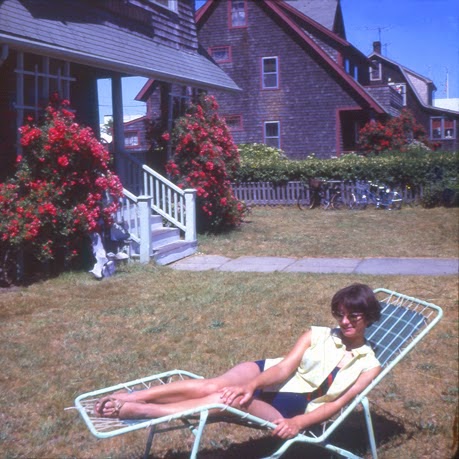
 Enjoying the sun on a break on Nantucket Island, Mass. USA 
 
Onto more recent times:   
 

1981 and the back garden of our home in Hawick in the Scottish Borders.  It is summer and this is my first attempt (and virtually the last)  at cooking on a barbecue, but my efforts fell foul of the weather - hence the umbrella. Did I really need that watering can there as a health & safety measure?       


Playtime in the garden for daughter  1975
 
 
Granddaughter bright eyed for her first day at school, 2012


Happy landing on grass for granddaughter  


Practicing handstands on our front lawn  

 
Our dog joins in the fun , enjoying a long chew on the grass of our back garden in Hawick.  
 
 
*****************
 Sepia Saturday gives bloggers an opportunity
 to share their family history through photographs.


Click HERE to read posts  
from other Sepia Saturday bloggers.
 
****************************

Thursday, 7 August 2025

Fun on Horseback - Sepia Saturday

A happy holiday snapshot is this week's Sepia Saturday  prompt photograph, with a baby boy perched at the seaside on the back of a donkey.

Not the real thing, but here is my family having fun on horseback. - a fitting link with the fact this post marks my my 1200th contribution to my Family History Fun blog.  

I wanted to convey the enjoyment  and enthusiasm  blogging has given me in sharing my stories of my ancestral trail, past and present.  


 My daughter celebrating her 1st birthday with  a present  from her Nana and Grandad  - this  present of "Donkey" remained a favourite.   

"Donkey"had an extended holiday up in the loft before coming  down again, with a new saddle cloth,  for granddaughter.   


I showed this on  my blog very recently but it is such a good link to the prompt image, so here it is again.  Daughter is the middle rider on an empty Blackpool beach, in Lancashire, taken on a October half term holiday.  

Daughter and granddaughter continued to have fun on horseback.


Daughter in the 1980s  


Granddaughter c. 2014  


Another little one perched this time on  a cart horse - my cousin Gloria at the the family business of carters & coalmen in Blackpool, Lancashire, c.1940

 **************

Onto a bit of local history:    

We live in the Scottish Borders,  in the town of Hawick and later the village of Earlston -  a region often called "Scotland's Horse Country", where riding is in the blood.   

In the summer the towns celebrate their history and heritage with the annual Common Ridings - with  cavalcades of riders re-enacting  the age old ritual of  "riding the marches", made in the past to safeguard common land and burgh rights.

In Hawick the event is also a commemoration of the "callants", young lads of Hawick, who in 1514, raided a body of English troops  and captured their flag - the "banner blue".  This skirmish followed the  the ill-fated Battle of Flodden in 1513,  when  King James IV and much of the "Flower of Scotland" were killed.  

The 1514 Monument below, unveiled in June 1914 in the town centre  and known locally as "The Horse",  commemorates this event.  


Each year, a young man is chosen to be the the key figure, called a Cornet,   and leads his followers on ride outs.  

 In the main ceremony  on a local holiday,  the Cornet proudly carries the town's "banner blue".   

 It is a time for   local pride and passion when exiles return to their home town to renew friendships and join in the celebrations - in ceremonies and processions,  picnics and horse-racing, and  in ,usic, songs,and ballads  such as this one below - one of my favourites.

"Where Slitrig dances doon the dell
To join the Teviot Water
There dwells auld Hawick's honest men
and Hawick's bright-eyed daughters."

 The Slitrig and Teviot  are two rivers that meet in Hawick. 


 Photographs by Lesley Fraser, www.ilfimaging.co.uk 


Over the centuries all of the towns and villages  in the Borders have come to celebrate their own special week of events, but each one with its own unique community spirit and specific traditions.

*******************


Sepia Saturday give bloggers an opportunity 
to share their family history


Friday, 7 March 2025

Hairstyles to the Fore: Sepia Saturday.


A head and shoulders portrait  of a young girl features in this week's Sepia Saturday  prompt photograph.  Cue for me to look at hairstyles of my family down the ages. 
 
         
My paternal grandmother  Mary Barbara Weston, nee Matthews (1876-1959) 
 
Nana Weston was born in Wolverhampton in the English Midlands, one of 10 children born to John Matthews and Matilda Such.    Her sister Fanny died tragically when her apron caught fire whilst she was carrying a candle, and she died from her burns.  Brother Arthur died in the First World War at Gallipoli,  leaving a young widow and 3 children. 
 
Her hairstyle is typical of the  1880s and 1890s.  
 
My other grandmother Alice Danson, nee English (1883-1945)   
 
I never  knew Alice as she died when I was a baby. For many years she was my major brick wall, until last year I discovered  she had been born in a Liverpool Workhouse, though she  quoted another birthplace   in the 1911 and 1921 census returns. This photographs is part of a large family photogaph taken in 1916 as my grandfather was setting out to war.  
 
 Again her plain no nonsense hairstyle was typical of the times.
 
The impact on the First World War on the changing role of  women saw an abandonment of the  traditional long hair styles of the Victorian - Esdwardian  period to the new short styles of the bob, finger-wave, Marvel wave, shingle and Eton crop, with their popularity continuing well into the 1930's. 


My great aunt Jennie Danson (1897-1986)  who sacrificed her long plait for the new look, without telling her mother.  This is one of my favorite photographs in my family collection. Jennie by all accounts was a feisty woman  - she needed to be to hold her own, growing up with eight older brothers whose ages,  when she was born,  ranged from 3 to 20. 
 
 An elegant unidentified portrait in my husband's collection - thought to be a relation of his aunt Annette.   
 
 
My mother Kathleen Danson - Jennie's niece.

My mother again - with more waves this time

In the 1930''s and 1940's,   a  softer look crept in, with curls and waves all the rage, and during the war the "roll" was the defining style.  This was the age of trying to emulate  Hollywood glamour, despite the realities  of life during the  depression and war.  


My aunt Edith Danson


Another new look for my mother who seems to have adopted an Austrian style, with what looks like  plaits  over  her head.  She was always very proud of her distinctive widow's peak.  

Below some typical 1940s looks from my aunt Peggy Danson (in WAAF uniform), my mother and finally  my husband's elegant aunt Annette.


Pigtails to Pony Tails  to Perms characterised  my look from the  1950s onwards.

 
 Pigtails complete with kirby grips and ribbons.  

On village gala days and on special occasions, my hair was wound into rags overnight  to hopefully create ringlets - which soon fell out.  

By my early teens my hair was long and worn now in a pony tail. It was washed with a final rinse of  vinegar and rain water - my mother's idea of a beauty treatment -  and it took ages to dry in front of the fire as we had no hair dryer.
 
There is a pony tail hiding behind this Plain Jane look  What is it about moving from childhood to teenage years, as this is the only family photograph I could find.  No holiday snaps, no school photos - nothing.  


 I became a librarian, so had to work hard at counteracting the traditional dowdy image.  So here  is the young professional look for my first job - worn with a   mini length sweater dress  and long necklace  - all the rage then.  


By the late 1960's,    vanity prompted me to try contact lenses and they proved a great source of stories with friends as we recalled  tales of losing them.  I remember one occasion where I was scrambling around on the floor of a pew at church, (not praying) but  trying to find this miniscule lens.