.jump-link{ display:none }
Showing posts with label 52 Ancestors 2026. Show all posts

Monday, 20 April 2026

Sea Stories of Master Mariners - Week 17 of 52 Ancestors in 52 Weeks

Working LIves is the theme of Week 17 in the blogging challenge "52 Ancestors in 52 Weeks".   I am taking a look at the lives of my husband's ancestors who were 19th century mariners,  sailing  out of the River Tyne at South Shields, County Durham  in north eat England.

A Genealogical Sideline:   To me "snow" was the white stuff falling in winter and a "smack" was a slap to a recaltrant child.  But that all changed,   as I  began researching my husband's maritime ancestors and learnt about the different names for ships in the 19th century - barque or bark or barc, brig, sloop, smack and snow - an illustration of the diverse routes that family history can take you.

Great Great Great Grandfather - Robert Donaldson, Master Mariner  (1801-1878)
Mariner records at the National Archives at Kew  showed that Robert Donaldson was  registered as a mariner on 20th July 1852.

Tyne and Wear Archives provided information on the sea-going  life of Robert Donaldson and the ships he sailed on, listed in "“A Dictionary of Tyne Sailing Ships: a record of merchant sailing ships owned, registered and built at the Port of Tyne 1830-1930”, compiled by Richard Keys. This is a complete A-Z of Ships, master mariners and owners, detailing ships, voyages, disasters and share-ownerships, and much more - a must for anyone with maritime ancestors in this region.

The entries make fascinating reading, with all six ships on which Robert Donaldson sailed, having an eventful history and coming to a sad end  - though not under his charge. 
 

Free Sailing Ship Sunset illustration and picture 
Image - Pixabay

  • The Thetis became a wreck after sinking off the Yorkshire coast in 1869.
  • The John was stranded in 1861 and became a wreck during a severe easterly gale. Twenty-eight other Tyne ships went ashore in the same area during the same gale.
  • The Emerald, in December 1855, when on passage from the Tyne to London, foundered in five fathoms on the Dough Sand (Long Sand) Thames estuary. Three survivors were brought ashore by two Bridlington smacks. Eleven others were unaccounted for, including some of the crew of the rescuing smack who were in a small boat, which disappeared.
  • The Hebe was wrecked in Robin Hood’s Bay, along with other vessels on 27 January 1861. The Ann & Elizabeth disappeared after leaving the Tyne in November 1863, with her captain leaving a wife and six children.
  • The William Metcalfe was Robert Donaldson's largest ship.  On her maiden voyage, it transported 240 male convicts from Portsmouth to Hobart,TAsmania  on a passage that took 102 days. In January 1855 eight of her crew were sent to goal for three months each by the North Shields magistrates for refusing duty. In October 1858 her master and one man were washed overboard. Nine days later, the ship was abandoned, with the crew taken off.

These incidents were by no means unusual and bring home the hazards our mariner ancestors faced in their daily lives.

Great Great Grandfather John Robert Moffet (1814-1881)   

John Robert Moffet in a Napoleonic pose - the only photograph I have of my husband's mariner ancestors - shared with me by internet contact who was also a descendant of John.  
 

John's family originated from Tynmouuth, north of the river Tyne,  with his father Robert and brother William both mariners. Two puzzles about the family  remain unanswered.   John was born in Chatham, the site of the Royal Navy dockyard on the River Medway on the south  of England.  What had brought his family there?    

John's   wife Frances Dunn Thomas, daughter  and widow of a mariner,   had three children, with two  born in the USA.   It would be wonderful to find the background to that, but nigh impossible without any indication of which state.  The family first settled in the London docklands area before returning to South Shields..   

In the 1861 Census,  John  was listed as master of "The Brotherly Love" sailing off Flamborough Head in the North Sea.     The crew of eight included three young apprentices, four seamen, and a mate, with most born in South Shields.

The caption  reads"The Brotherly Love" model. made for her  master Captain  Moffet."    

llustration supplied by a Moffet descendant. 

In South Shields Museum and Art Gallery, there is  a portrait  " The Brig "Brotherly Love" and the Tug "William" painted by  John Scott (1802-1885).


 Other mariner ancestors of my husband included, on his mother's side:

Great Great Grandfather  Matthew White (1821-1872) 
The 1861 census listed Matthew  as master mariner on board the brig "Caroline" off South Shields.  Lloyd’s Captains’ Register,  recorded the ships he sailed on, travelling as far as the Adriatic, Mediterranean and Baltic ports.
 
From: the National Archives at  Kew, London 
 
Sadly Matthew was, wih others,   drowned at sea  on 10th January 1872 whilst master marinder of the brig "Caroline" - as recorded in    "Births, Marriages and Deaths at Sea",  online on Find May Past.  
 
 Great Grandfather  Matthew Iley White. (1849-1901)
On his marriage to young widow Louisa Moffet Pierce in 1884 at South Shields, Matthew was described as a mariner.  However he had a change of occupation and was next found as a member of the Tyne River Police, along with his brother Henry.
 
A  long-held story in my husband's family recollected a photograph (sadly lost) of a White ancestor in a top hat in the uniform of the River Tyne police.   A silver uniform button  (below) is  still held by the family.   


Tyne and Wear Archives provided some answers. The Nominal Roll of the Tyne River Police gave details that  two sons of Matthew Iley White  (senior),   had been  members of the river police force – but both with rather a chequered career.    Henry White  joined 9th January 1882 and brother Matthew June 1896.  
 
The Police Defaulters Book recorded on 11th June 1889 their  misconduct in the same incident -  "for assaulting a seaman A. W. Hanson and other irregularities, whilst off duty".   
 
Matthew was fined 2/6 and transferred to the Newcastle Division at his own expense.  However he resigned a few months later. Henry was fined 2/6 and transferred to Walker Division at his own expense.  The Nominal Roll of 1904 noted his age as 42 and that he had 22 years of service, with a wage of 29/6
 
Storms off South Shields
 "The Shields Gazette" on  (FindMyPast Newspaper Archive)  abounds with  headlines and reports on disasters at sea, storms and gales;  the lifeboat responses. and the ensuing work of the Mariners' benevolent societies in helping families in distress.  Below is one typical  of what mariners faced. 


 Image - Pixabay 
 
 
A Fascinating Fact  - one of the first purpose built lifeboats  was constructed in South Shields in 1789, prompted by a tragedy  when a ship with all its crew was  lost  at sea just off shore.  
 
To Conclude -  
My husband's maritime ancestors (Donaldson, White & Moffet)  must have had a streak of Adventure  in them to venture out from South Shields  into the North Sea in all weathers, as they plied their trade as master mariners. They faced storms at sea  as part of their daily lives - as evidenced by local newspaper reports of shipping disasters.   
 
 
* *******************
  
May be an image of text that says "52 Ancestors in 52 Weeks Week 17 WorkingforaLiving Working for aLiving AmyJohnsonCrow. AmybohnsonCrow.com/52ancestors"


Monday, 16 March 2026

Week 12 - An Address with a Story - 52 Ancestors

"An Address with a Story" is the theme of this week's "52 Ancestors in 52 Weeks" Challenge.  Below is my Danson ancestral home,   Trap Farm, Carleton, Lancashire  - but not quite as I envisaged it!

Trap Farm, Carleton, near Poulton-le-Fylde Lancashire, c.1998

 
Trap Farm, c.1998
My first knowledge of Trap Farm as my ancestral home came from obtaining the birth certificate of my great grandfather' James Danson.    I found the farm on the current Ordnance Survey Map and set out to find it on a visit to the Fylde c.1998.  


Situated amidst fields on what is now a busy road, it was a sorry sight - dilapidated and overgrown.

In the 1841 Census, 30 year old Henry (my great great grandfather) was living there with his wife Elizabeth (Calvert), five daughters - Betty, Grace, Mary, Margaret and Ellen, his much older brother Peter and two servants.

By the time of the 1851 Census,  it was a household of 13. Henry was described as a farmer of 31 acres. Eldest daughter (now married)  Elizabeth  (Betty)  was there  with her three sisters and her husband Thomas Bailey, whilst second daughter Grace had left home.  But there were now two sons - John and Henry  plus Henry(senior) 's brother  Peter and two servants.   How did they all fit into what looked a small farmhouse?  My great grandfather James, was born 1852 at Trap Farm, 

By the time of the next census in 1861 the Danson family was no longer at Trap.
 
*************** 
 
 But thanks to an Internet contact, Janet,  more details came to light on the Danson family at Trap Farm.  
 
Janet was descended  from John Danson, brother of my great grandfather James.  John as the eldest son had inherited  the family bible which included three pages of scrawled writing.  This took the Danson family  at Trap Farm back an earlier generations - It gets a bit confusing as the same Christian names appear down the decades!

The  page (left)  headed January 4 1827 “Be good to the poor” features, among the  signatures, Henry Danson (my GGG grandfather), Elizabeth (Brown) Danson (his wife)  and James Danson (their son);  also an entry “January 1st 1827 James Danson, Sone of Henry Danson” – which must mark the death of Henry’s youngest son at the age of 15.   Another entry that can be deciphered is for “Elen (?) Simpson Borne 29 October 1811”

Another page (below)  also features signatures scrawled all ways - ones that can be deciphered are    Henry Danson, Trap, Elizabeth Danson,  Ellen Danson, Carleton, Peter Danson, Ellie Simpson, Carleton, Trap, Servant, 1830.


Ellen and Peter were siblings of Henry. The fact that servant Ellie Simpson  was also included in the activity and signed her name,  somehow casts  a lovely informal light on the household - though the fact they used the Bible for these scribbles  raises other issues !
 
Fifty years on, John (1844-1914),  my great grandfather's brother, made a much neater job of recording births and deaths in his own  family,  with this beautifully written page  which even includes the days of the week when they were born.


************

Years later I returned to Carleton,  fully expecting Trap Farm to be wiped off the map and replaced by a modern housing estate.   To my surprise it was still there, but was undergoing a transformation into a modern home.
 

Trap Farm, c.2011 

I searched on the British Newspaper Archive website to see if I could find anything on the farm, but came across only an advert o.nthe sale of livestock.  


I have since heard that the farm has been demolished  -  and my ancestral home at Trap Farm, Carleton  is no more,  after being a family home for nearly 200 years.   

******************** 


Monday, 9 February 2026

Daughters or Step Daughters? Week 7 _ 52 Ancestors in 52 Weeks

Daughters or Stepdaughters?  What does the Census suggest? 

I was prompted to look at this question  when researching my great grandmother Alice Ann English,  born in 1851 in Beverley, Yorkshire, daughter of of Charles English and Mary Harrocks. 

The 1851 Census, taken in March of that year,  showed a small family of Charles, Mary and two daughters -  Mary aged  7 and Elizabeth 3 years old.

Ten years on in 1861  the census listed:  

Charles 43, Head

Mary 41, wife 

Elizabeth, daughter,  aged 13 (so born c. 1848)

Alice Ann, daughter, aged 9 (birth registered September 1851)

Isabella Caroline, daughter, aged 8

Harriet Elizabeth, daughter , aged 2.  

 Eldest daughter Mary was not with her family but thought to be the 17 year old (so born c.1844),  working  as a domestic servant with another family.

 But in tracing  the marriage of  Charles and Mary Harrocks, I discovered this was only registered in June 1850. What was the story behind the two eldest daughters born in 1844 and 1848, before this marriage.    

The reality was that Charles had had a first marriage to Elizabeth Barker who had sadly died shortly after the birth of her second namesake daughter in 1848. 

 Conclusion:  So young Mary and Elizabeth were not the daughters of  Mary Harrocks but the step daughters -  and the Census did not reflect this relationship.  

Nor did many public family trees on Ancestry  reflect this relationship, wrongly showing instead   that Mary Harrocks was the mother of all five daughters.    

 So the message  is - always to check dates  and show the correct relationship in your family tree. Census Returns are not always absolutely correct in showing the correct birth mother. 

********************  

Join Amy Johnson's Crow's 
 Facebook Group  "Generations Cafe." 

to read posts from other bloggers taking part in the
 "52 Ancestors" Challenge, 2026.


Tuesday, 27 January 2026

My Breakthrough Moment - Week 5 in "52 Ancestors in 52 Weeks".

DISCOVERING MY “ENGLISH“ ANCESTORS

 “How far back have you got?" is a standard question for family historians, and I am sorry to admit that the search for the early life of  my maternal grandmother Alice English (1883-1945) remained a puzzle over many decades and quickly hit the proverbial brick wall.   Read on my  research tale.

THE BACKGROUND Alice married my grandfather William Danson of Poulton le Fylde, Lancashire in 1907 .  I had her marriage and death certificate with her age, so born   

 Alice died when I was a baby, and my mother and aunt were surprisingly reticent about her early life.  I failed to ask the right questions at the right time, sensed a great reluctance to talk about her and I ended up with vague and conflicting information – was she born in Manchester, Bolton or Liverpool?   - a classic family history mistake!  It did occur to me that she might w,  deceased)   was given on her marriage certificate.  Was this a fabrication for the purposes of respectability? 

Whatever the mystery about Alice's  past, the impression I gained from my Danson relatives was of a loving, loved wife and mother, and a respected member of the Poulton community. She became known locally as an unofficial midwife and her doctor wanted her to train professionally, but this was not possible.

Despite many years of hunting and using a professional researcher, I had been unable to trace a birth certificate for Alice to find out the name of her mother.  Queries on message boards, Facebook pages, and on my family history blog failed to elicit any positive response, and DNA provided no help.

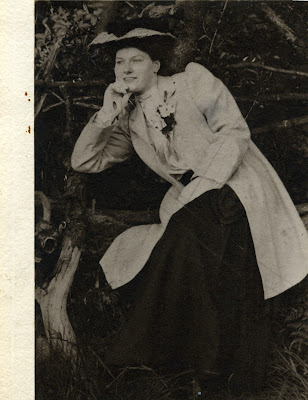
Below  is one of the few photographs of Alice.  As she is wearing a corsage, could this have been taken on her wedding day?  A question I should have asked my mother, but didn't.


WHAT WERE THE FACTS?

  • My starting point for research was the marriage certificate, held by the family.  - Alice married my grandfather William Danson in April 1907, at St. Chad's Church, Poulton-le-Fylde, Lancashire,   when Alice was 22 i.e. born around  1884. Her father's name was given as Henry, a painter (deceased).
     
  •  I was always told Alice and I  shared the same birthday - September 23rd. 
  • The family story was that Alice  had moved to Poulton as a nursemaid to the Potts family - prominent Methodists whose photographs featured in books on old Poulton, attending civic functions,  opening  fetes etc.
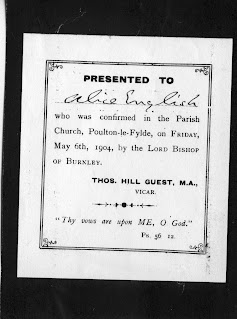
  • Alice was confirmed at St. Chad's Church, Poulton in 1904 - I   have the prayer book presented to her on that occasion.

  • Early census returns proved no help - I could  not trace her in 1891. In 1901  there was an Alice A. English, born Bolton aged 17, so born c.1884,  a living-in domesticiI had had to wait patiently for the release of the 1911 census to  find her entry  under her married name of Danson, with  her birthplace given as Bolton. Yet even that did not take me further forward as the GRO  (General Register Office)  and Bolton Registrar had no record of an Alice English with the details I had.  The release of the 1921 census confirmed the Bolton  birthplace. 
  • The 1939 Register compiled to  facilitate  the issue of ID cards and ration cards in the Second  World War confirmed Alice’s birthdate as 23rd September 1884.  I had hoped for more details on her birthplace but these did not feature.  
     
  • Alice  died  5th July 1945,  so I never knew her.   Her age of 60  on the  death certificate again confirmed her year of birth as c. 1884. 


FURTHER SEARCHES

 The Improved search facility for BMD and parochial records online  came up with a number of possibilities but none that tied in with my limited information. So more frustration!    I also have had no luck in tracing  a record for her father Henry English with very little to go on.  

I placed many queries on various websites  and message boards without  much success, though Lancashire Genealogy on Facebook gave me some useful pointers;  as did Curious Fox  the village by village contact site for anyone researching UK  family history.  The immediate response was gratifying in number, but not particularly helpful,  apart from one respondent who took on board my query with great enthusiasm and pointed me in certain directions   But these avenues came to nothing.

THE DISCOVERY   

In 2024 I put a query on The Facebook page of FindMyPast Family History Forum  - and SUCCESS when a contributor asked if I had seen the entry for an Alice English born in the Liverpool Board of Guardians Workhouse   in 1883, with the crucial fact her birthday was the same as mine – 23rd September.  Even better I was given the links to the workhouse records at Liverpool Archives, available on Find My Past.   This surely  was “my” Alice?  So I took out a monthly subscription to FMP to access these records.   The images of the entries were  poor  and I contacted Liverpool Archives who were very helpful with transcriptions.

 Alice’s mother, Alice Ann, a pregnant single woman, aged 30, born Beverley, Yorkshire  was admitted  to the Workhouse from 25 Sun Street, Liverpool on  13th September 1883 and gave birth to her daughter Alice on September 23rd,   baptised there into the Church of England the following day.

I obtained Alice’s birth certificate in a digital format from the GRO. (General Register Office)  It indicated that  her mother could only make her mark. The column for her father’s name was blank. 

 Mother and baby were discharged from the Workhouse 29th December 1883   but,  unhelpfully, without any comment   indicating where they had been discharged to. 

Young Alice  was re-admitted  on 11th September 1890 with “May (8 months)”, but discharged the same day with the nearest relative noted as Kent Street.   On 18th September their mother Alice Ann was readmitted and discharged the next day, with the nearest relative noted as Alma Street. 

There is no indication about the reasons for 7 year old Alice’s readmission but under the section ‘By whose order admitted’ .  it appears to say ”Police Book”   -  a worrying statement.I had heard  that children who were begging on the street could picked up by the police and removed to the workhouse.  

It was frustrating to see that under the heading “Nearest Relative” , the answer in all the cases was not a person’s  name or a relation  but a street  name.  I have tried to find out a bit more about Sun Street,  Kent Street and Alma Street  and gather they were in the Dockland areanear the Royal Albert Dock.  Can I assume this was a crowded, poor housing area? 

Why had I failed  for so long to find Alice’s birth and the name of her mother?

·  I had always worked on the basis that Alice  was born around 1884, given her age at marriage  and death which occurred before her September birthday of that year.  Though surely in my searches I had  worked on the basis of a wider range for my searches?   

O Once I had  what I thought was confirmation of her birthplace as Bolton. I used this detail in all my searches and online queries and discounted further suggestions of Manchester and Liverpool – a big mistake!    

I II doubt if, in many queries  I had used the fact that  we shared the same birthday  - a fact which proved crucial in finding Alice. 

But lots  of questions remained and created further brick walls.  

  • Why did Alice give the Bolton birthplace name on official records?  What was her connection with Bolton?   (Later  research into her mother's life answered this question).

  •  What were the circumstances that brought 7 year old Alice back to the Workhouse in 1890 with a reference to the police? Liverpool Archives were unable to give any help on this point.
     
  • Was 8 month old baby May her sister, admitted to the Workhouse with Alice in 1890,  born around January 1890.  A birth record has not yet been traced. 
     
  • Alice could not be traced  in the 1891 census, but an Alice Ann English (her mother) born Beverley, Yorkshire  was  traced to Eden’ Orphanage. Higher End, Sharples, Bolton, where she was working as a domestic servant.  So here was the Bolton connection. But with no sign of her daughter  young Alice.   
The good news is I found some shared matched with Alice's mother  on my DNA results to confirm I was on the  right tracks beyond the coincidence of our birthdays. The story  of my great grandmother  is  for another  blog post.


So the story of Alice English  and her mother is still ongoing.  But it  was a Special Occasion,  when I  got some answers to my long search for my grandmother.

 
My grandparents William and Alice in 1916 
 
PATIENCE AND PERSEVERANCE PAID OFF!
 
***************
 
Join Amy Johnson's Crow's 
 Facebook Group  "Generations Cafe." 

to read posts from other bloggers taking part in the
 "52 Ancestors" Challenge, 2026
 
***************** 


Monday, 12 January 2026

Poignant Tales from WW1 - Week 3 of 52 Ancestors in 52 Weeks.

This week's prompt from "52 Ancestors" asks  me to consider what this story means to  me. 

We are at a dangerous point in our world history   with so much war and conflict dominating our news headlines.    

I take a look back at  my ancestors, who  fought  in World War 1 to remind us what war entails with suffering of those fighting  and and the anguish those families back home. 

    "I had to assist the wounded at a dressing station and stuck to     it for about 40 hours. It's blooming hard work being a            stretcher bearer in the field."  


These were the words of my great uncle George Danson (1894-1916),  written three weeks before he was killed on the Somme 

One of the many embroidered cards sent from Flanders by her sons to my widowed great grandmother, Maria Danson, nee Rawcliffe.  

George Danson was the youngest of eight sons (surviving infancy) of James Danson and Maria Rawcliffe of Poulton-le-Fylde, Lancashire.  Born in 1894, he was followed three years later by the birth of an only daughter Jennie.  The photographs and memorabilia here come from my great aunts coillection.  

Young George 


George (above) was the favourite uncle of my mother and aunt,  and they had fond memories of him, perhaps because he was nearest to them in age and took on the role of the big brother. I can see why in the photograph of him above.  George worked on W.H. Smith bookstalls at different railway stations in Lancashire and West Yorkshire.

George joined the Royal Army Medical Corps in 1916 and I was lucky enough to trace his service record on www.ancestry.co.uk  as many were destroyed  in the Second World War.  On his enlistment,  George's  medical report stated he was 5'3" tall,  weighed 109 lbs. (under 8 stone), with size  34 1/2 chest and he wore glasses - so a slight figure to be a stretcher bearer in the turmoil of war, carrying men who were badly wounded or dead.   


Also amongst the family papers were two letters written on  headed paper of the British Expeditionary Force.  A letter of 19th March 1916 to his eldest brother Robert said:
 
     "I will tell you one thing it is no easy job the army life today         and I am of the opinion as most of the chaps are here they         won't be sorry when it is all over."

The second letter of 23rd August 1916 was to Frank, the brother nearest to him in age:

     "At present we are about  8 miles behind the firing line. I had       to assist the wounded at a dressing station and stuck to it for     about 40 hours. It's blooming hard work being a stretcher             bearer in the field. On Friday I was in a big bombardment and     will say it was like a continual thunder and lightening going         off. As I write there are blooming big guns going off abut 50         yards away every few minutes. 
 
    Don't I wish that all of us could get home. Wouldn't that be           great, lad, there's a good time coming and I hope we shall all         be there to join in." 
 
Sadly it was not to be.  

 
 Three weeks later, and a week after his 22nd birthday,  George was killed on 16th September 1916 at the Battle of the Somme, and buried in the Guards Cemetery, Les Boeufs, near Albert.
 
 
A report in the local paper  


 A photograph, sent to his widowed mother,  of George's initial grave.  It conveys in a stark way the reality of war amid the mud and blood that George must have experienced - and contrasts with the pristine white of the more lasting memorials that we recognise today. 


George remembered on Poulton War Memoral  along with his brother John who died in 1917.

 I have written about George before on my blog,  but it is such a poignant tale, that  I make no apologies for telling it again.
 

 ***********


This is just one story in my family history but there is much more  to tell another time - 

  • My great uncle John Danson who in 1917 committed suicide whilst in army  training,  leaving  his young daughter an orphan.

  •  My great uncle Arthur  Weston killed at Gallipoli in 1915, aged 35,  leaving a wife and two young children with her  expecting their third child.  
     
  • My cousin's grandfather Edward Stuart Ingram Smith - a broken man  following his war experiences  which led to his broken marriage.  
     
  • My husband's great uncle ~ Fredrick Donaldson  killed the very same day as George above.  He is remembered on the Thiepval  Monument in France -  the- largest British battle memorial in the world. On Portland stone, piers are engraved the names of over 72,000 men who have no known grave and who were lost in the Somme battles between July 1916 and March 1918.

Just five member from  one extended family   an experiences  mirrored in millions of other  families - this is what war is all about!
     Somme, Thiepval, Memorial, Wwi

 **************


Join Amy Johnson's Crow's 
 Facebook Group  "Generations Cafe." 

to read posts from other bloggers taking part in the
 "52 Ancestors" Challenge, 2026
 
********************