.jump-link{ display:none }

Saturday, 14 April 2012

M is for Mortcloths, Militia Lists, Middle Names & Much More - A to Z Genealogical Challenge

Ros at http://genwestuk.blogspot.com/ has come  up with the idea of an A to Z genealogical challenge for the month of April.  It soon got me thinking, so here are my contributions.

M is for:

Mortcloth Records - A mortcloth or pall was draped over the coffin or the body itself for the funeral, and the  payment of a fee to hire one from the church is sometimes  recorded in old parish or kirk session records.  Prior to compulsory registration, It can often be the only evidence that a death has occurrred. I must admit I am unsure whether this is just a Scottish custom or more widespread.

Medical Terms - are you stuck to understand a cause of death on a certifcate?   Then take a look at http://rmhh.co.uk/medical.html  which explains medical terms.


Militia Lists - Was your  male ancestor aged around 20-30 in the period of the Napoleonic Wars (1790's-1815)?  Then he might well appear on the Militia Lists, whereby each parish was charged with setting up a volunteer force in the  event of a French invasion.  The lists may give little more than a name, address and occupation but, as with all archives,  there is a fascination in seeing actual handwriting relating to an ancestor, written during his  lifetime.  They are also particularly noteworthy in pre-dating  the first published census of 1841, so may be  the only record of an ordinary man.
Militia List, Castleon Parish, Roxburghshire, 1797.
Other lists can be more informative with details of age and occupation

Middle Names - I like middle names as they can often be a big clue, not only  in  confirming that you've  found the right person, but also in alighting on the possible   maiden name of a mother or grandmother.  For instance I was once looking on the internet  for a George Hogarth from Scotland who emigrated to Canada.  I found him amongst many George Hogarths, because of his mother's distinctive surname used as his middle name.   In my own family,  my uncle Harry Danson had his grandmother's maiden name Rawcliffe. as his middle name.

Maps - Are you wanting to find a map of where your ancetor lived in Scotland?  Then take a look at the website of the National Library of Scotland at http://www.nls.uk/collections/maps.  Its map collection is the  largest in Scotland with over 2 million items, many of which you can download.      

Money Values -I like to use to find out respective money values over the centuries   and use  http://www.nationalarchives.gov.uk/currency/.  Prior to the Act of Union in 1707, Scotland had its own currency, so for more information see  http://www.scan.org.uk/researchrtools/scots_currency.htm 


Plus Much More such as:  Marriage Bonds and Marriage Certifcates,  Message Boards, Monumental Inscriptions, Military Records, Mariners, Mormons and Miners.

Master MarinerJohn Robert Moffat (c1814-1881)  my husband's great great grandfather
in a Napole0nic pose.

Archive images courtesy of the Heritage Hub, Hawick heartofhawick.co.uk/heritagehub 

Mortcloth Book of Smailholm Parish, near Kelso, Roxburghshire 1822-1847.

Wednesday, 11 April 2012

L is for Letters, Leisure, Language & anything Local - A-Z Genealogical Challenge

Ros at http://genwestuk.blogspot.com/ has come  up with the idea of an A to Z genealogical challenge for the month of April.  It soon got me thinking, so here are my contributions.

L is for:
Letters from the past let us hear the thoughts and emotions of our ancestors and are a potent legacy.  After the death of my parents,  I came across letters written just after their marriage when my father was working away from home, and a few years later during wartime.  It is very moving to read them and they amongst my family treasures.
Even more poignant is a letter dated  20th August 1916 written by my great uncle George to his brother Frank.  Three weeks later George was killed at the Battle of the Somme.


Leisure - how did our ancestors spend their free time?    Here are two images, courtesy of the Heritage Hub, Hawick. (www.heartofhawick.co.uk/heritagehub)


Local - Libraries, Newspapers, Publications and Websites  - where would we be without them?  They are the foundation to finding out more about how and where our ancestors lived.  I have quite a collection of Local Publications on Poulton-le-Fylde, Lancashire, expecially the compilations of old photographs, which can do so much to enhance the picture of our ancestral background.  

Local Newspapers are goldmines, full of snippets of information that give a contemporary  eye view of life at the time, with local, national and foreign "Intelligence" reported, and the advertisements equally fascinating. This is not textbook history but it is full of vigour on many varied aspects of life at the time for ordinary people.

Language - Family history can take you down diverse paths.  Dialects and regional language are  part of our ancestors' make up.  We don't know how they spoke, but we can find out about the words and how they used them.    

One example - when we first moved to Scotland,  friends used to talk about "having to get a lot of messages".   I was puzzled by this.  To me from the north of England, a  message was something scribbled on a bit of paper and surreptiously passed to a friend in a classroom,  or your mother asked you to run round to your gran with a message  - before the days of phones etc.  So I had this image in Scotland  of someone  collecting lots of paper messages  pinning  them to her  jumper and rushing round to deliver them all.   

And in the Scottish context - doing the messages means doing the shopping!

In the Borders we have our own words -  such as haugh, heugh, cleuch and knowe.  (gh and ch sound as in loch).  The place name of Wolfcleuchhead particularly appeals to me  but more of that later under P for Place Names.    Hawick people have their own way of speaking, such as "mair" for "more", "yin" for "one", "twae" for "two", "yow" for "you" and "mei" for "me".   

Want to find out more?  Have a look at the two links regarding Scottish words.
http://www.scotlandspeople.gov.uk/content/help/index.aspx?r=551&431
http://www.scan.org.uk/researchrtools/glossary.htm

Tuesday, 10 April 2012

K is for Kirk Sessions Records, Kathleen and a Kettle - A to Z Genealogical Challenge

Ros at http://genwestuk.blogspot.com/ has come  up with the idea of an A to Z genealogical challenge for the month of April.  It soon got me thinking, so here are my contributions.


Kirk Session Records  of the Church of Scotland  give us a fascinating glimpse of the past, beyond citing just names and places.  

The Kirk duties were to maintain good order amongst its congregation, including
administering discipline and supervising the moral and religious condition of the parish. It also took a keen interest in irregular marriages, welfare and religious observance. So stories abound in the Kirk Session Records  of offences such as drunkenness, swearing, breaking the Sabbath, quarrelling, sexual misdemeanours and accusations of witchcraft  - alongside charitable activities, poor relief and mortcloth records.  

For the family historian  kirk session records, which date from the 1600's,  can provide a unique social commentary  on the community in which  ancestors  lived.

Until recently kirk session records could only be accessed at National Archives of Scotland (http://www.nas.gov.uk/), but now many have been made available in digital format at local archive centres, including my own  Heritage Hub, Hawick (www.heartofhawick.co.uk/heritagehub).

My stylish mother
Kathleen Weston, nee Danson (1908-1999) - my mother was the seocnd daughter of William Danson and Alice English of Poulton-le-Fylde, Lancashire  and the subject of many a blog posting. "Happiness in Stitching" could be my mother's motto.  For her going  into a fabric shop was like going into a jewellery shop.   If she sat down, she was rarely without a needle in her hand.  She was a creator in patchwork, crochet, collage, felt work, smocking, knitting, embroidery, smocking, dolls and dresses, with dabbles into  millinery, lampshade making and china painting. 


Kettle - I remember this copper kettle sitting in the hearth of my grandfather's house and was always led to believe  it was his mother's - my great grandmother Maria Danson, nee Rawcliffe (1859-1919).   I was abolutely  delighted when it eventually passed down to me. 


Copyright © 2012 · Susan Donaldson.  All Rights Reserved

Monday, 9 April 2012

J is for Jobs, Jewellery. Jennet & John - A to Z Genealogical Challenge -

Ros at http://genwestuk.blogspot.com/ has come  up with the idea of an A to Z genealogical challenge for the month of April.  It soon got me thinking, so here are my contributions.

J is for:


Jobs -  My Danson family came from a rural part of Lancahsire in north west England, so jobs on the land were the norm - whether it be Ag. Lab, husbandman, carter, or cowman, with two generations reaching the status heights of being described as yeoman farmers. It was all change in the 1860's when my great great grandfather Henry Danson of Trap Farm, Carleton  left farming  and became a toll collector at the newly built Shard Bridge over the River Wyre, near Fleetwood.


Great Uncle George at his station bookstall
This was an age of great social change, from rural to urban life.  The period saw the rise of the seaside resort of Blackpool and fishing town of Fleetwood with a  predominant theme the impact of the railway. 

New occupations appeared in the census entries for the family - pointsman, railway telegraph clerk, railway porter, railway coach examiner, and railway labourer, with a related trade that of my great uncle George who worked at W. H Smith's newsagent stall on station platforms. 

Trades in the family  included coal merchant, rope dealer, and even tripe dealer, with Danson daughters marrying  a shoemaker, joiner, innkeeper, and watchmaker.  The women were undertaking roles as laundress, and much more appealing - a confectioner's shop woman, and keeper of a sweet shop. 

Elsie Oldham in the 1920's opened her own home-based business  as a hairdresser, styling herself as "Elise". See the posting "Bobbing, Shingling and Marcel Waves"
  
In the early 20th century, three of my great grandparents large family, Harry, Robert and Jennie all worked for the post office. 

In my husband's Donaldson family history, the  linking factor was the sea with family occupations ranging from merchant, master mariner, seaman, caulker, roper, ship's carpenter and river policeman.

Have you ever puzzled over the occupation of a Scottish ancestor, as listed in the cesnus?  The take a look at the listing of over 1500 occupations with their definitions and variants at:  http://www.scotlandspeople.gov.uk/content/help/index.aspx?430

Keep an eye open too  for my posting on the letter O where I will look at Occupational Records.
   
Jewellery - My great grandmother Maria Danson, nee Rawcliffe  (1859-1919) had ten sons  and as her last child an only  daughter Jennie.  On a visit to see Jennie's daughters, I took photographs of Maria's jewellery and they remain among my family history treasures.  Here is a necklace and brooch  that her son Frank  brought back from Malta who was in hospital here  durng the first World War.

Jennet and John  - two Christian names that re-occur  down the generations of my Danson and Rawcliffe families.    Jennet has an old fashioned air that appeals to me and above  is the signature on the  will  of my great great great great grandfather John Danson (1736-1821). 

Copyright © 2012 · Susan Donaldson.  All Rights Reserved

Saturday, 7 April 2012

I is for Ironbridge, Illegitimacy, Irregular Marriages and (of course) the Internet - A to Z Genealogical Challenge -

Ros at http://genwestuk.blogspot.com/ has come  up with the idea of an A to Z genealogical challenge for the month of April.  It soon got me thinking, so here are my contributions.

I is for


Ironbridge, built 1779  over the River Severn
Ironbridge - my father  grew up  near Ironbridge , Shropshire, often described  as the birthplace of the industrial revolution with the building in 1779  of the first ever iron bridge (over the River Severn). It is now a World Heritage Site.

Illegitimacy - I am sure this must be  feature in many a family history.  In
 the course of research into my mother's Danson family,  I came across this document at Lancashire Record Office which identified such a case.

In 1810,  John Danson, aged 21 and eldest son of Henry Danson and Elizabeth Brown of Carleton, Lancashire  was served with an affiliation order ordering him to contribute to the upkeep of his “said bastard child”  - a daughter by Ann Butler of Marton.   The poor child was repeatedly given this tag in the document below which  is fascinating on its choice of language:

“Ann Butler, single woman, was upon the 27th day of August last, delivered of a female bastard child in the said township of Marton…and that John Danson, husbandman of Carleton did begot the said bastard on her body and is the father of the same.

Thereupon, we order… for the better relief of the said township…and the sustenance and relief of the said bastard child…John Danson pay unto the churchwardens and Overseers of the Poor…the sum of One Pound Eighteen Shillings for and towards the charges and expenses incident to the birth…further sum of four shillings towards the cost of apprehending and securing the said John Danson….the sum of Two Shillings weekly…towards the keeping, sustenance and maintenance of the said bastard child”.


In 1810, £1 18s 0d would have the same spending power of today's £64.52 with 2s 0d being  worth today  £3.40.  (www.nationalarchives.gov.uk/currency).  - not much for bringing up a child! 


Unfortunately I have been unable to trace anything further on this story.  John Danson died in 1836, aged 46, as far as I know unmarried and predeceased his father Henry by 3 years.


Irregular Marriages   -   a feature of Scottish family history.
A “regular marriage was conducted by a church minister following the reading of banns before a witnesses.  An "irregular marriage" did not require an established clergyman and only required that both parties gave consent.  No notice nor a waiting period  was requried.  Such marriages were  valid in Scotland, but often frowned upon and over time they became less and less acceptable.


An “irregular” or “clandestine” marriage was in the form of a verbal declaration by thThe The British Parliament outlawed irregular marriages in 1753 with the introduction of Lord Hardwicke’s Marriage Act, but this did not apply to Scotland. As a result, many English couples eloped to Scotland to obtain a quick and easy marriage. Toll houses on the Scottish-English border became “centres” for irregular marriages - at Annan and Gretna in Dumfriesshire and at Coldstream and Lamberton in Berwickshire.

In 1856 Lord Brougham’ s Marriage Act imposed a resident ial qualif icat ion of 21 days for least one of the partners, which made it more difficult for couples outwith the area. Irregular marriages were not formally abolished until 1940.

Because no minister was required, few records were kept of the event and few have survived 

Such a marriage might not come to light until the first child was born and the parents sought baptism for their children. They were summoned to the Kirk Session, confessed their fault, and werebuked, exhorted, and ordered to pay the charges'”. The charges went to the poor box, the normal fees for a regular marriage were then paid, and the marriage was thus regularised.  As a result, note of irregular marriages can sometimes be found in Old Parish Registers and in Kirk Session records.

So if you think your ancestors may have taken part in an irregular marriage, contact the Scottish Borders Archive Service at archives@scotborders.gov.uk or have a look at the source list on the topic at http://www.heartofhawick.co.uk/heritagehub/collections/source/irregularmarriages.pdf

And in this I of the A-Z Challenge, how could I fail to mention the Internet.  Where, as family historians,  would be  be without it?

H is for Heirlooms, Handwriting, Henry, Hambleton & Hawkyard - A to Z Genealogical Challenge

Ros at http://genwestuk.blogspot.com/ has come  up with the idea of an A to Z genealogical challenge for the month of April.  It soon got me thinking, so here are my contributions.

H is for:

Heirlooms - I watch with admiration programmes like  "Antiques Roadshow" where people show wonderful items, such as portraits, jewellery and furniture  that have been passed down the generations.  My heirlooms are much more mundane - my great grandmother's copper kettle and teaset, family photographs and the embroidered cards that my grandfather sent back  from Flanders to his family during the First World War.  But it is not the value that counts and to me they are very precious heirlooms.


Hambleton - my great grandmother Maria Rawcliffe  was one of eight daughters born in the small village of Hambleton, near Poulton-le-Fylde, Lancashire.  In a local history publication, I came across this witty little verse referring to the different villages in the  area. I  like to think that Maria was a "bonnie lass"!  

Pilling for paters (potatoes)
Presall for pluck
Hambleton for bonnie lasses
Stalmine for muck!

Hawkyard - this strong sounding, distinctive  name features in my husband's Donaldson family history.  They were  lodging house keepers in the old  town of Alnwick in Northumberland.  An internet search revealed that Hawkyards predominated in Yorkshire. This is another name that is on my list for further research and further blog stories.


Henry or Harry  - a name  with my Danson ancestors down the generations  from my great great great grandfather  to my uncle. 


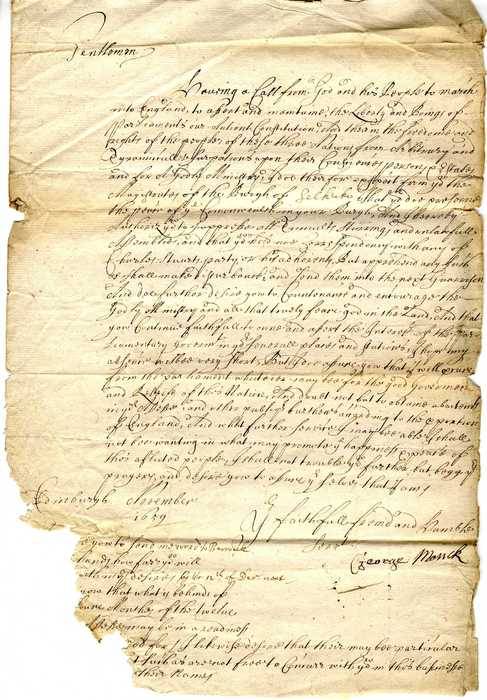
Handwriting - I struggle to decipher old handwriting but there is help at hand on the website  http://www.scottishhandwriting.com/

Above is the letter of 1659 from General Monck, written during the Civil War, in which he authorises the Burghers of Selkirk to “Supresse all tumults, Stirrings and unlawfull Assemblies, and that yow hold noe Correspondency with any of Charles Stuarts party, or his adherents".  (In the collection of the Heritage Hub, Hawick)

Heritage Hub, Hawick - my local archive centre and a "must contact" place for anyone with ancestors who lived in the four counties of the Scottish Borders - Berwickshire, Peeblesshire, Roxburghshire and Selkirkshire.  (www.heartofhawick.co.uk/heritagehub)

Friday, 6 April 2012

G is Geneabloggers, Genuki, Gravetones, Gazateers & George - A-Z Genealogical Challenge

Ros at http://genwestuk.blogspot.com/ has come  up with the idea of an A to Z genealogical challenge for the month of April.  It soon got me thinking, so here are my contributions.

G is for:

Geneabloggers (www.geneabloggers.com) - the network site that is "must see" viewing for anyone interested in writing about family history.  I was recommended it in the early weeks of starting my blog in summer 2010.   I fully expected to have run out of material for postings by now, but geneabloggers' prompts, plus the support of like-minded enthusiasts are so stimulating, I have never looked back.  So if you haven't joined the site, take a look and join us

Genuki (http://www.genuki.co.uk/) was one of the first genealogy websites that I used  and it is a  must for anyone trying to work their way around the geogeraphy of Britain. It is a virtual reference library and source list for parishes, towns, counties and countries that form the United Kingdom.  

Gravestones are fascinating places for family historians and many volunteers have done a sterling job in recording monumental inscriptions, which can sometimes list 3-4 generations of a family.  I must admit a childhood folly, when I saw a gravestone with a skull and crossbones carved on it and got all excited thinking it meant a pirate was buried there!  I later found out it was a symbol of death.  If you are puzzled at what you find, try to have a look at Betty Willsher's book on "Understanding Scottish Gravestones". 


Gazeteers - Stuck in finding information  about a place connected with your family?  For Scotland an indispensable tool is  Groome's "Ordnance Gazetteer of Scotland" first published in six volumes in 1882. It quickly established a reputation as the authoritative gazetteer of Scotland, and has been the standard reference to the present day. 


George Danson (1894-1916)  -  I have always had a soft spot for George Danson, the youngest of 8 surviving sons of James Danson and Maria Rawcliffe.  He looks very serious and studious in photographs and an image of what he was like came from a variety of sources.   My mother and aunt referred to him as their favourite uncle, more like an older brother.   But his life was cut short  at the young age of 22 on Septemer 16th 1916 when  as a stretcher bearer, he was killed at the Battle of the Somme.


George's service record (on www.ancestry.co.uk) notes that on enlistment he was was 5"4' tall, size  34 1/2 chest and wore glasses.  

The local newspaper reported  his death and told  how he was a member of St. Chad's Church choir, Poulton  and prior to enlisting had been manager of W. H.  Smith station bookstall at Todmorden, West Yorkshire.

Captain Macleod in writing to his widowed mother who had four other sons serving said
"He was one of my stretcher bearers and was gallantly doing his duty over open and dangerous ground which suddenly became subjected to severe shell fire.  He continued steadily bearing his burden and was only stopped by the shell that took his life. We mourn his loss and are very proud of him".

The death announcement in the local paper read: 

The bugle may sound, the war drum may rattle
But no more they arouse their young hero to battle
For his King and his Country his life he nobly gave
And now he lies sleeping in a soldier's grave

 From Mother, Brothers, Sister, 2 Bull Street, Poulton-le-Fylde