This week's Sepia Saturday prompt photograph features a large group of men sitting in row. I have shown in the past images of troops in rows, so this time I hunted my collection and that of my local heritage group Auld Earlston for something a bit different.

Isaac Wallace of Earlston (1841-1921), emigrated to Victoria, Australia, where he named his new home "Earlston", set up a butter factory, and involved himself in community affairs, both in Australia, but also on a return visit to Earlston towards the end of his life.
Isaac returned to Earlston in 1907 when the photogaph below was taken with his brothers and sister Isabella who herself was very community minded and became known as "Earlston's Friend and Benefactor".


An early image of Earlston Bowling Club members relaxing. The club was founded in 1882 - and is still gong strong today.
Onto 1945 and people in Earlston were celebrating the end of World War Two.

A happy group of girls at the Sports Day.

Southern Reporter: 23rd August 1945

Revellers at the dance in the Corn Exchange, with members of the Polish Band, billeted in the village, providing the music.

Staff and visitors at Earlston Railway Station, c.1920, posed in front of, the station footbridge. The Berwickshire Railway reached Earlston in the Scottish Borders in 1863, but following severe flooding in 1948, the line only continued with freight traffic, not passengers, and was finally closed in 1965.
Onto my family collection

A phtograph from the collection of my great aunt Jennie Danson. Unfortunately it is not identified, but seems to date by the fashions to the late 1920s. But why do they all look so glum?

Another photograph from Great Aunt Jennie's collection - with the note on the back "George's friends in Manchester". believed to be work colleagues, all working for the bookseller and newsagent W. H. Smith. My great uncle George Danson is on the back row far right. George was the youngest of eight Danson brothers. He was conscripted into the army in 1916 and a few months later was killed at the Battle of the Somme, a week after his 22nd birthday. One cannot help wondering how many of his friends survived the war.
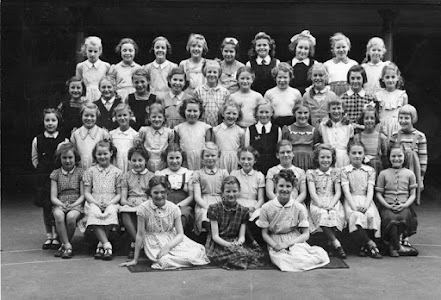
I was at Devonshire Road Junior School in Blackpool. where the boys and girls were in separate classes. When I was there boys were on the ground floor, with playground to the back, whilst girls were upstairs with our own assembly hall, and our playground was at the front of the red brick building - and "never the twain should meet"! I think we were the last council junior school to go co-ed in Blackpool, following the death of our headmistress.
Here in c.1954 I am the prim little girl second from the right on the front row of seats. A large class of of 43 - the current limit in Scotland is 33. We are all very regimented with crossed hands in our laps and crossed ankles in our Clark sandals. Another feature missing from the group - no signs of any obesity crisis (as of today) amongst us here, as we were growing up when rationing was still in force. It only came to an end in July 1954 - 9 years after the end of the war.
Onto 1985 and here I am , front row, second from the left, sporting our new uniforms as tourist information centre staff in the Scottisy Borders.

It was the 1980's when kilts were then a fashion statement, so for the first time at work I wore an attractive uniform - a kilt in the mid blue/green of the local Douglas tartan. However kilts became too expensive as a uniform item, and we later had pencil skirts - but still in tartan. Men on the staff were just given a tartan tie, so the women had the bet

A happy group photograph of family and friends with my grandmother at the centre, with my mother, aunt and uncle on the right - but I never found out what the occasion this was. c,1940s.

Donkeys all in a row - My daughter (in the middle) enjoying a donkey ride on Blackpool beach. This was taken in Blackpool in the school October half term holiday, so not exactly summery.
**********************


What great photos of people in a row. So glad you found a way to follow the theme this week. I gave up, though. Needed to go to my ancestry photos where there are class pics etc. Oh well. Now for next week...
ReplyDeleteAn excellent choice of various folks lined up for differing reasons. The crowd at the dance in the Corn Exchange looked like a happy bunch of folks! I'll bet they had a great time dancing to that Polish band. A fun & interesting post from all angles! :))
ReplyDeleteYou've covered quite a few people and donkeys, too. It's interesting to see how smiles progress through the decades.
ReplyDelete