.jump-link{ display:none }

Monday, 27 May 2019

A Memorial to Anne: 52 Ancestors - Week 22.

"In the Cemetery" is the theme of this week's "52 Ancestors" prompt.  The  gravestone (below)  is the only photographic link I have with my great great Aunt Anne,  the eldest sister of my great grandmother Maria.   I have a soft spot for Anne and just wish I had a photograph of her.  
 
For my research uncovered that Maria was staying with Anne and family at the time of her wedding to James Danson, and Anne named her own daughter Maria - so there must have been a closeness between the two sisters,  daughters of  Robert and Jane Rawcliffe of Hambleton, near Poulton-le-Fylde, Lancashire.    

Anne's  family history encompasses three names - Rawcliffe, Roskell and Hesketh -  names that were prominent in the Fylde - the area of Lancashire between the River Ribble at Preston to the south and River Wyre at Fleetwood  to the north.
 
Research through census records and parochial records  traced evens in Anne's life. 


Anne was born 1 June 1847 at Hambleton, and baptised 23rd June at the Church of the Blessed Virgin Mary  at  Hambleton (above)  - the eldest of eight daughters (five surviving infancy)  born to Robert and Jane Rawcliffe.   346 residents lived in Hambleton at the time of the 1851 census.

Ten years on in 1861, Anne was not listed with her parents and sisters, but may well be the 13 year old Anne Rawcliffe, a house servant,  resident with John Rawcliffe, a taylor and grocer, his wife Barbara, 5 year old son Thomas and apprentice Richard Parkinson.  So far no family connection has been traced between these two Rawcliffe families.   
 

By the time of the 1871 census, Anne, at 23,  was back home with her father (by this time a widower) and two sisters Jane and Maria. 


Anne married gamekeeper Robert Roskell at St. James, Stalmine on 17th March 1874, the witnesses her sister Jennet with her future husband Richard Riley.   Internet contacts produced a wealth of information on local Roskell ancestors.


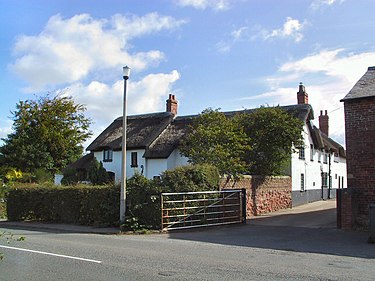
The 1881 census showed the Robert and Anne  to be living in the small hamlet of Thistleton at Thistleton Cottages (below)

Thatched Cottages - geograph.org.uk - 41962.jpg


This fact,  for the first time explained why my great grandmother Maria's  address was Thistleton  at the time of her marriage to James Danson in 1877 - presumably staying with her eldest sister and family – with James in the neighbouring village of Singleton.  
The 1881 census entry showed  the population of Thistleton as 386 - among  them:

Robert Roskell
Gamekeeper
29
Born Garstang
Ann Roskell
Wife
32
Born Garstang
John Roskell
Son, scholar
  6
Born Kirkham
Jane A. Rawcliffe
Daughter, scholar
 8
Born Garstang


Anne’s birthplace, given as Garstang (the registration district)  could be a mistake, as her birth record is clearly shown   Hambleton.  This also brought  the first knowledge of  daughter Jane Alice  bor  illegitimately c. 1873 before Anne's marriage, with Jane retaining her mother’s surname.  Parish records at Hambleton noted Jane's baptism - with both her Christian names those of Rawcliffe sisters.


In 1882 the parish records of St. Anne’s Singleton showed the baptism of Matthew and Agnes, son and daughter (twins) of Robert and Anne Roskell, Thistleton and named after their paternal grandparents. Sadly Matthew did not long survive and was buried at Singleton on 21 June 1882 aged just three weeks.


A daughter Maria (named after her aunt, my great grandmother) was baptised 14 February 1886.   Burial records, however, showed a year later  another death in the family - Anne’s eldest daughter Jane Alice buried 4 May 1887 at the young age of 14.


The 1891 census entry showed the two daughters Agnes and Maria with their parents - but no mention of their brother John who would be 16 years old. 


Three years later, Anne's husband Robert  died, buried 4 May 1894 at the age  of forty-two - three immediate family deaths in twelve years that left Anne a widow with two young daughters - Agnes 12 and Maria 8, and older son John.  

By the time of the 1901 census, Anne, then a 53 year old widow, had moved from the hamlet of Thistleton to the busy fishing port of Fleetwood, where at 21 Kemp Street, her occupation was given as  she was a grocer/shopkeeper, living with her two daughters – Agnes A. Roskell aged 18, a draper’s assistant, and Maria Roskell aged 15, a draper’s apprentice - both born Thistleton.  


Come the 1911 census, I could find no trace of Anne, nor confirm a death.  Then a spurt of inspiration made me look for her daughter Maria, to discover  that Anne had remarried and was now Mrs Jenkinson married to John a retired farmer and living at Blakiston Road East, Fleetwood, with Maria - no occupation given.  Helpfully the census entry noted that Anne had been married for two years.


Daughter Maria was to marry, on 2 May 1912 at St. Peter’s Fleetwood, William Hesketh,  (another prominent Fylde surname),  a telegraphist of 7 Hesketh Place, Fleetwood.  Maria’s address was given as 4 Blakiston Street and her age 27.   The witnesses to the wedding included John Roskell – Maria’s brother?  On their third wedding anniversary in 1915,  son Frank was christened at St. Peter’s, with the family now living at Rose Cottage, North Street, and William described as a clerk. 
 
Sister Agnes could well be the Agnes Anne Roskell who married in the third quarter of 1901.   


Anne Roskell Jenkinson  nee Rawcliffe died 4 April 1928 and was buried, not in Fleetwood, but beside her first husband and young children Jane and Matthew at St. Anne's Church, Singleton.  Her age on her gravestone was given as 75. 


The monumental inscription for St. Anne’s Churchyard, Singleton no. 90 records:


 In Affectionate Remembrance of
  Matthew son of
Robert and Ann Roskell of Thistleton
Who died June 17th 1882 aged 3 weeks


Also Jane Alice, sister of the above Matthew Roskell
Who died April 7th 1887 aged 14 years.


We thought they were our own for yet a while,
That we had earned them by the love of heaven,
To be a life’s, not a season’s smile, then tears forever.


 Also of the above Robert Roskell 

Who died May 2nd 1894 aged 42 years. 


Also Ann, beloved wife of the above.  
Who died April 6th 1928 aged 75 years


*************

Join  Amy Johnson's Crow's Facebook Group  "Generations Cafe 
 to read posts from other bloggers taking part in

 the 2019  "52 Ancestors" Challenges 

Wednesday, 22 May 2019

A Hero in a Forgotten Conflict: 52 Ancestors - Wk 21

 "Military" is this week's theme from "52 Ancestors" and I am featuring an often forgotten conflict  - the South African Boer War, 1899-1902.

My interest was sparked by seeing this plaque in the  War Memorial Gardens in Kelso in the Scottish Borders,  honouring   Kelso-born Sergeant Donald Farmer who, at the age of 23,  was awarded the Victoria Cross  for action in the Boer War.  


After seeing the plaque, I wrote a short blog post on the memorial,   and was delighted  to hear from Donald's granddaughter, who very kindly supplied me with more information on her  ancestor, with personal memories and Donald's own words on his experience.

Sgt. Donald Farmer VC 1st Cameron Highlanders  


The Victoria Cross, instituted in the Crimean War,  is the highest and most prestigious award for gallantry in the face of the enemy that can be awarded to British and Commonwealth forces.

************


Background Information  on the Boer War 
The Boer War was fought between the British Empire and the  descendants of Dutch settlers (Boer being the Dutch and Afrikaan word for farmer.   Between 1835 and 1845,  the people  of Dutch extraction,  in conflict with British rule,   moved out of the British  Cape Colony   into the interior of South Africa and established two independent republics - the Transvaal and the Orange Free State. 

The discovery of gold and diamonds led to renewed antagonisms and war erupted.  At first the Boers were successful and laid siege to  the British garrisons at Ladysmith, Mafeking and Kimberly.     The British counter offensive led to the relief of the garrisons and the capture of Boer capital of Pretoria. 

The Boers adopted guerrilla warfare tactics and the the British responded with a "scorched earth" policy, and  the herding of Boer families and synmpathisers into camps.   These measures were largely responsible for bringing the Boers to the negotiation table.  The war ended with the Treaty of Vereeniging with the two republics absorbed into the British Empire, with the promise of self-government in the future. This promise was fulfilled with the creation of Union of South Africa in 1910.  

British lost almost 30,000 fighting men and 78 Victorian Crosses were awarded for acts of bravery during the conflict   Prominent commanders included Lord Kitchener, Lord Roberts and Lord  Baden-Powell. The young Winston Churchill was in South Africa as a newspaper war correspondent for "The Morning Post".  

Sources:
 ************

 Donald Farmer's Military Life
Donald was born in 1877 in Kelso; his father Thomas a pastry cook and confectioner.  Following  arguments, he left home and joined the Queen's Own Cameron  Highlanders - was two months short of his 15th birthday but gave his age as 18. 

After serving in Malta and Gibraltar, Donald fought in the Sudan War were he wrote:
 "Conditions were appalling and the battlegrounds were bleak.....It was hard going, nothing but marching ever onwards, the terrific heat and the husbanding of water.... We did about 100  miles in 4 days, with constant heat and followed by the dreaded flies". 
In January 1900 the Battalion was ordered to South Africa.   Donald, now a sergeant and still only 22, became part of a mounted infantry.  

The Victoria Cross citation in the London Gazette of 12th April 1901 records Donald's heroism in action:


“During the attack on General Clement’s camp at Nooitgedacht, December 13th 1900, Lieutenant Sandilands, Cameron Highlanders, with 15 men went to the assistance of a picquet which was heavily engaged, most of the men having been killed or wounded. The enemy, who where hidden by trees, opened fire on the party at a range of about twenty yards, killing two men and wounding five, including Lieutenant Sandilands.  Sergeant Farmer at once went to the officer, who was perfectly helpless and carried him away under a heavy and close fire to a place of comparative safety, after which he returned to the firing line and was eventually taken prisoner.”
Three days after capture, Donald  knocked his guard unconscious and managed to escape eventually finding his way back to his Battalion.


Donald was presented with his Victoria Cross by HRH Prince of Wales (later King George V)  at Pietermaritzburg, Natal on August 15th1901. 

Donald's dearest wish was fulfilled when he took part in the Victoria Cross Centenary Celebrations,   attended by the Queen. in Hyde Park on June 26th 1956.   He died six months later at the age of 79, having served his country in the  Sudan War, Boer War and First World War, and achieving the rank of Lieutenant Colonel.
Donald Dickson Farmer VC.jpg


 With grateful thanks to Donald's granddaughter for her contributions to this post. 

Adapted from two blog posts  first published in 2014

******************

Join  Amy Johnson's Crow's Facebook Group  "Generations Cafe 
 to read posts from other bloggers taking part in
 the 2019  "52 Ancestors" Challenges
 

Saturday, 18 May 2019

Family Traits: 52 Ancestors - Wk. 20

"Nature" is the theme for this week's  "52 Ancestors" Challenge and I have opted to look at "nature" in terms of personality, with a snapshot at the characteristics that I perceived in my extended family of ancestors  - from Active  and  Adventurous  to Resilient and Talented.  

ACTIVE
My great great grandfather Thomas Weston (1826-1917), a bricklayer,   was an active man late into his life.  Born in Shropshire,  he married at the age of 24 Annie Walker, a domestic servant and they  had seven children.  But by the time of the 1881 census, Thomas was a 54 year old widower, living in Pattingham, Wolverhampton with his three youngest children, then aged 15, 13 and 7.  He soon remarried  - his wife Harriet Edwards  18 years his junior, with their son Thomas born in 1882. A family anecdote told how Thomas, when in his 90's  was still climbing a ladder to pick plums and apples from his trees.   He died 26th December 1917 at the age of 91.   
 

ADVENTUROUS
My husband's maritime ancestors (Donaldson, White & Moffet)  must have had a streak of adventure in them to venture out from South Shields into the North Sea in all weathers as they plied their trade as master mariners.    Below, a photograph of John Robert Moffet (c.1814-1881), supplied by an Internet family contact - the only image I have of my husband's mariner ancestors who faced storms at sea  as part of their daily lives - as evidenced by local newspaper reports of shipping disasters. 
You also have to admire the sense of adventure that drove our ancestors to take a leap into the unknown and emigrate - such as my great grandmother's sister Alice Mason, nee Rawcliffe of Fleetwood, Lancashire,   who in 1887 set sail  with six children aged 1 to 13, (plus "two pieces of baggage") to join her husband John  and live in the teeming tenements of  Brooklyn, New York.   The couple went on to have five more children  in America, the eldest Arthur Valentine, born appropriately on 14th February 1888 - a reunion baby!

BRAVE - the men who fought in wars, amongst them:
  • The five Danson brothers (my grandfather and great uncles) who served in the First World War.
  • Three great uncles who died - George Danson, John Danson and Arthur Weston.  
  • My father who landed with the American forces on Omaha Beach just after D Day in 1944  and experienced the winter Battle of  the Bulge. 
  • My uncle who was one of the many men evacuated by the flotilla of small ships off Dunkirk in 1940.
  • My uncle who faced the horrors of a Japanese POW camp.

CRIMINAL 
My husband's great grandfather Aaron Armitage, (1849-1889), a miner in Yorkshire,  spent much of his short life in court or in prison, as revealed by  searches in the British Newspapers online.  His crimes ranged from stealing a pig to assaulting the woman whom he later married. Was this is "nature" or was "nurture" a factor, as research showed that Aaron's father  Moses, also had a criminal record? 

DEVOUT
My cousin's Scottish ancestor William Dower (1837-1919)  was  appointed by the London Missionary Society as a Wesleyan Missionary in South Africa   setting  sail there in 1865 with his new wife Jesse. William and Jesse set out on an ox wagon journey to East Griqualand and the town of  Kokstad.  William began his working life as a joiner before studying for the ministry  and his trade stood him in good stead for helping to build both his new home and a new church.  He went on to write a definitive history of the area in "The early annals of Kokstad and Griqualand East" and is remembered in the local museum. He died on 21 December 1919 at  "Banchory", his home named after his birthplace in Scotland.  He left behind a legacy in the country he came to love and a family who made their mark in many different fields.

 
William and Jesse Dower in 1913.

ENTERPRISING 
My Mother Kathleen Weston, nee Danson (dressmaker)  and her second cousin Elsie Oldham, (hairdresser)  in the 1920's and 30's both set up businesses in their home. 


Elsie's father  was the only son of a  firm of well established carters and coal men in Blackpool,in a house with a large yard, hay loft, tack room. and stabling for around sseven  horses.  Founded c. 1890, by Joseph Prince Oldham,  it was eventually sold in 1948 to another local firm.


ESTEEMED 
My GGG grandmother  Elizabeth Danson, nee Brown, (1766-1840)  was little more than a name to me,   as the wife of Henry Danson, yeoman farmer, until I decided to  revisit the records to find out more about her.

I came across this short but  beautiful testimony to Elizabeth  almost by chance during a  quite casual browslng of  British Newspapers Online 1710-1953 on the website Find My Past. -
"Blackburn Standard Wednesday 20 May 1840  Betty, widow of the late Mr. Henry Danson, yeoman, Trap Estate, Carleton, near Poulton-le-Fylde. She was much esteemed, and will be greatly regretted by a large circle of acquaintances".
This little piece somehow brought Elizabeth (or the more familiar Betty)  alive for me, as no other record had done. 
 
FEISTY 
I think of my Aunt Edith (1907-1995) as one of a line of "Feisty Danson Females".  She was my “maiden aunt”, and my godmother,  who played a key role in my life.  She was also a  teacher, traveller, craftswoman -  and a great talker. 

Edith must have been great to know in her 20's, with tales of the young men she went dancing with in Blackpool.  She kept home for her widowed father and brother for much of her life, alongside her work as an infant teacher,  and travelled widely, even to Russia in Iron Curtain days, bringing me back gifts  to add to my collection of costume dolls.

In line with her spirit of adventure,  she  married for the first time in 1981 at the age of 73, a widower friend of my parents.


IMMORAL  (according to the conventions of the time) 
John Danson,  the eldest son of my GGG grandparents  in 1810 at the age of 21, was served by Lancashire Quarter Sessions with an affiliation order,  ordering him to contribute to the upkeep of his “said bastard child”  The poor unnamed  child (no name stated)  was repeatedly given this tag throughout  the document. 

“Ann Butler, single woman, was upon the 27th day of August last, delivered of a female bastard child in the said township of Marton, and that John Danson, husbandman of Carleton did begot the said bastard on her body and is the father of the same."
LONG-LIVING
In 1900 the average life expectancy was 50 - largely influenced by the high rate of infant mortality.  Yet in the early 19th century my GGGG Grandfather James Danson (1736-1821)  lived to the great age of 85.  Below his signature on his will.


MUSICAL 
Although not formally trained, many of my ancestors enjoyed music, with my father, mother, uncle, and great uncle all in choirs;   my grandmother played the harmonium and my grandfather was in the local band.  

I was particularly proud to be given  the silver crested  baton,  presented in 1904 to my great grandfather John Matthews for  his long-serving role as conductor of the choir at Ladymoor Wesleyan Chapel,  in Wolverhampton.   From the days of my being in a school choir, choral music remains  one of my main interests. 
 

 NE'ER DO WELL
My Aunt Edith used to describe her grandfather as "A bit of a ne'er do well. Granny had some trouble with him", though I never found out any detail for this remarkBut this photograph of him perhaps bears out that description! 

My great grandfather James Danson (1859-1906) is the bearded figure, sitting merrily in the stocks in Poulton-le-Fylde Lancashire - the only photograph I have of him.


POETIC  
My cousin's  great great great uncle John Critchley Prince (1808-1866),was  well known in his time as a writer of poetry in the Lancashire dialect.  He  published his first poetry collection, "Hours with the Muses" in 1841. It sold well, running to five editions and attracting attention in London. Other collections followed, some published and sold privately by the author.


His verse is, for the most part, surprisingly optimistic. A notable exception is "Death of a Factory Child", in which he addressed the social conditions of the time, with these stark lines to end the poem. :

Hard had he labour'd since the morning hour,—
But now his little hands relax'd their pow'r—
Yet, urg'd by curses or severer blows,
Without one moment's brief, but sweet, repose,
From frame to frame the exhausted sufferer crept,
Piec'd the frail threads, and, uncomplaining, wept.


RESILIENT 
Many of our ancestors experienced in their lives hardship, misfortune, and sadness, especially with the high incidence of infant deaths. 

My Great Grandmother Maria Danson, nee Rawcliffe (1859-1919) had already seen in:  
  • 1905 - her daughter-in-law died aged just 21, leaving a one- year old baby daughter. 
  • 1906 - her husband Jame died 
  • 1907 - her eldest son Harry died  at the young age of 30. 
  • 1916 - her youngest son George was  killed on the Somme. 
  • 1917- her son John took his own life, whilst in army training.
Widowed with three of her eight surviving children then under 14 years old, Maria demonstrated  determination, stoicism  and commitment to her family - not least in also providing a loving home and a supportive family network for her orphaned  granddaughter Annie.  

TALENTED
The three Danson sisters, Edith, Kathleen and Peggy were all talented dressmaker, using the old treadle sewing machine in a house that did not get electricity until the mid 1950s.  Thy also  enjoyed crafts, including knitting, crochet, embroidery, patchwork, art, china painting, collage and doll making. I have my mother  to thank for introducing me to a wonderful world of colour in crafts - I inherited her interests, but not necessarily her  talents! 
 
Peggy, Edith and Kathleen Danson with their mother Alice, c.1941


                                      Victorian collage made by my mother 

                              Human nature is all there amongst my ancestors!


***************


Join  Amy Johnson's Crow's Facebook Group  "Generations Cafe 
 to read posts from other bloggers taking part in
 the 2019  "52 Ancestors" Challenges