.jump-link{ display:none }

Tuesday, 31 July 2018

A Trio of Colourful Lives: 52 Ancestors - Week 30

Week 30's  theme is "Colour" in Amy Johnson Crow's year long prompt "52 Ancestors in 52 Days".   I have chosen to look at the colourful  lives with tales of:
  • A possible Spanish blood link.
  • A stepmother with a colourful past. 
  • A butler who secretly married an heiress.  
AM I OF SPANISH DESCENT? 
 
The character of my great-grandmother, Maria Rawcliffe had always appealed to me.   Her name was an evocative mixture of down-to-earth Lancashire grit with echoes of a more flamboyant Latin nature. She looked a formidable lady from the one photograph I had initially of her. 


To give additional colour,  there was a family  story that “granny’s dark looks” came from Spanish descent, after an Armada ship had been wrecked off the Fylde coast of Lancashire. All this captured my imagination and, as a young teenager.  

The findings in the actual research were much more prosaic.  Maria was born in Hambleton, near Poulton-le-Fylde, Lancashire in 1859, the seventh  of eight daughters, to Robert Rawcliffe (an agricultural labourer and carter)  and Jane Carr.


As for the Spanish Armada story, a local history of Hambleton village told of an incident in 1643 at the time of the English Civil War. A Spanish frigate, the Santa Anna ran aground in the River Wyre estuary, near what is now the town of Fleetwood.  The crew were taken off the ship, which was set alight to prevent it falling into the hands of the Roundheads. No efforts were made to get the crew home several marrieded local farmer’s daughters. The dark Spanish features showed up in their children.   

So maybe I do have some Spanish blood in me after all!

Note:  With very few relatives alive, I have not yet gone one down the DNA route - perhaps this is the time to do it.  
  
A STEP-M0THER WITH A COLOURFUL PAST 
Maria's mother died when she was was only six years old, with her surviving sisters  Jennet 8, Alice 11, Jane 14 and Anne 17. I knew from my own mother that "Granny had a step brother Joe Brekall", so presumed that father Robert had married a widow.  How wrong I was - the cardinal mistake in family history - don't assume! 

I knew from census returns that Robert's second marriage must have taken place between 1871 and 1881, so sent away for his  marriage certificate.  It revealed that Robert remarried in 1875 when Maria was 16  years old - his new wife, 
Elizabeth Brekall, 20 years his junior and a spinster! 
Census returns and parish records established that Elizabeth was born in 1840 and had three illegitimate chidren - Dorothy in 1860, Mary Ellen in 1869, and Joseph (the Joe of the family memory) in 1873- just  two years  before her marriage to  Robert.  I traced the baptism records for the children, but none included a name of their  father.

You cannot help but speculate on the circumstances that led Elizabeth to have three illegitimate children over  over 13 years, and what was her life like, living still with her parents  - her father only  an agricultural labourer.  Times must have been hard.  

In six years of her marriage to Robert Rawcliffe, Elizabeth  had a further  four children  - John, Grace, Margaret and Robert. The 1891 census showed a large, no doub,  crowded, household of Robert, aged 58, described as a farmer of three acres, Elizabeth,  and six children under eleven years old.   ]

So the Rawcliffes  became  what we now term a "blended" family of sisters, step silbings and half-siblings.
 Robert died in 1904 aged 83.  In the 1911 census, his widow Elizabeth was listed at the  home of   her married daughter Mary Ellen. 

As for my great grandmother Maria, she married at 18 years old, two years after her father's second marriage. Her address on the certificate was the home of her eldest sister Anne and her husband.  Maria's eldest sons were the same age as the children of her father and step-mother. 

THE BUTLER'S SECRET MARRIAGE TO AN HEIRESS 
Derbyshire  Advertiser: 22.3.1912
This story come to light when my cousin asked if I Could trace information on his maternal grandmother Sarah Haydon Lounds who married my great uncle John Danson.  He knew very little of her background.  but was aware of some kind of scandal with  a "black sheep" of the family who had been a servant in a large country house. 
Haydon Lounds was Sarah's brother and the British Newspaper Archive on FindMyPast  revealed his story.

Haydon's employer was wealthy widow, Mrs Eleanor Ward-Fox, who on her death in 1911   left in her  will £13,000 to her daughter, Maud,  with a legacy of £200 to "my butler Lounds in my service at my death".  (In today's money terms, these sums equate to  £938,066 and £15,634.

However  not known at the time  was the fact that her butler Haydon Lounds, "a good looking  and well educated man", according to the newspaper report, had been for three years the husband of Maud, following a secret marriage ceremony in Devon in 1909.   The online Index to marriages confirms this event.
  
But two years later in the 1911 census,  Haydon was still describing   himself as single  - a 38 year old  bachelor,  working as a butler for the Ward-Fox family - Mrs Eleanor Ward-Fox, with her  daughters Gertrude,  and Maud, aged 30, (cited in the census also as single) - all living at Bramhope, Torquay in a household that included a footman, groom, cook, kitchen maid and two housemaids.  Mrs Ward Fox died later that year at her home. Haddon Hall, in Bakewell, Derbyshire
The wedding was kept a secret for three years and was first reported in the then "Morning Post": 9th  February 1912,  when Haydon changed his surname by deed poll to Haydon Stephen-Fox. "The Derbyshire Advertiser and Journal":  22nd March 1912 gave a fuller report with the photograph featured here. 
 
The newspaper report noted that they were to make their home in Canada. No children were born to the marriage, with Maud dying in 1945 and Haydon two years later.
A "Downton Abbey" story if there ever was one!
************* 
52 Ancestors in 52 Weeks


Friday, 27 July 2018

Ship Ahoy: Sepia Saturday

MmAn industrial looking ship puffing black smoke featured as this week's Sepia Saturday prompt photograph.  The obvious match from my collection was this photograph (below) of the River Tyne at South Shields in north east England.

 
 The River Tyne, with the Norwegian ferry  in the background at North Shields. . 


My husband's ancestors (Donaldson, White, Moffet) were mariners, sailing out of South Shields, whilst extended family members were in related occupations   as a caulker, seaman, river policeman, shipwright, roper, ship’s carpenter, and marine engine fitter.

It  is amazing what diverse directions family history can take you.  To me "snow" was the white stuff falling in winter and a "smack" was a slap to a recalcitrant child. But that all changed as I began researching maritime history, and learnt about the different names for ships in the 19th century - barque or bark or barc, brig, sloop. smack and snow. 

********** 

My own connection with ships is slight, but here are some memories. 

In September 1966,  I returned home from a year in the USA, travelling aboard the Cunard liner "Sylvania" from New York, calling at Boston and Cobh, Ireland,   before reaching Liverpool.  The ship, small by today's cruise ship standards, was very quiet and I was lucky to get a cramped 4 berth cabin all to myself.  Goodness knows how four adults could have managed in the space, without someone  being perched on top of their bunk.  Commercial jet planes services  were hitting the transatlantic  scheduled shipping and the Liverpool-New York sailings were axed in November after my return.  Still I enjoyed this experience  and had my first glimpse   of Ireland with dawn over Cobh. 


The town's former name was Queenstown, after Queen Victoria who visited there in 1850.  Seventy years later in 1920, with the foundation of Eire as the Irish Free State,  it was renamed Cobh.   Queenstown/Cobh was a major  departure point for the millions of  Irish people who emigrated to North America  during the 19th and 20th centuries.

 
A statue (above)  on the waterfront commemorates this leaving of Ireland.  It depicts Annie Moore and her brothers.  Annie was the first person to be admitted to the United States of America through the new immigration centre at Ellis Ireland, New York on 1 January 1892.    On 11 April 1912 Queenstown was the final port of call for the "Tatanic"   as she set out across the Atlantic on her ill-fated maiden voyage.
  
*********
The Western Isles of Scotland is  one of our favourite holiday destination, and the "Cal Mac" ferries are a familiar sight.  


 Sailing out of Oban
 
Fishing boats in Oban Harbour 
   A Tall Ship Training Ship moored at Oban

Oban, meaning "little bay" in Gaelic, lies on the Firth of Lorne on the west coast of Scotland. and is often regarded as the unofficial capital of the West Highlands. and "Gateway to the Isles", with the  Cal Mac ferries sailing from there  to Mull, Coll, Tiree, Colonsay, Barra and South Uist.  

McCaig's Tower (or Folly) stands high above Oban, named after its originator John Stuart McCaig (1824-1902). His intention was to provide work over the winter for local stonemasons and to build an imposing monument to the McCaig family. However the ambitious  project ran out of money and on McCaig's death, his relations successfully contested provisions in his will for the Tower's completion.

Durring World War Two, Oban was an important place  in the Battle of the Atlantic, with a Royal Navy signal station, and RAF flying boat base.   In the Cold War, the first Translantic Telephone Cable, carrying the hot line between the USA and USSR Presidents came ashore at Oban.
                   

 We had the top desk to ourselves on this dreicht day, sailing from Oban to the Isle of Mull.  Even our dog did not look very happy!  

**********

To sunnier climes

The ferry on Wolfgangsee, near Salzburg, Austria
where we celebrated our ruby wedding anniversary.


 *********

And finally:  the prompt photogrpah below immediately made me think of the final verse of John Masefield's poem "Cargoes".  We were taught at school to read this out aloud to get the full power  of his words.  The first two verses convey beauty, but this last one was always our favourite as we spat it out, enunciating the words in an exaggerated manner.

"Dirty British coaster, with a  salt-caked smoke stack,
Butting through the Channel in the mad March days
With a cargo of Tyne coal,
Road-rail, pig lead
Firewood, iron-ware and cheap tin trays."

                                                                         *********
Sepia Saturday give bloggers an opportunity 
to share their family history through photographs.
Sail  by  HERE to read this week's posts  from other Sepia Saturday bloggers.


Monday, 16 July 2018

Musical Moments: 52 Ancestors - Week 29

My family's love of church music,  featured HERE in an earlier theme of "52 Ancestors", so for this week, I am looking back at my own musical memories for Week 29 of Amy Johnson Crow's year long challenge.

"I am in an  all singing/dancing chorus, swirling my skirts,  in a  London West End show  - such as Carousel, Oklahoma, West Side Story or 42nd Street .......
But It Was All One of My Wildest Dreams!  

Back to reality! Playing the triangle in my infant school percussion group  is my earliest musical memory.  I was non too pleased at being given  this instrument.  Like everyone else, I wanted the favourite choice  - the sleigh bells.  


I made my singing debut in my primary school nativity play where I sang the first verse of "We Three Kings of Orient Are".  I had no wish to sing solo every again!. 

My next stage performance  was at a Brownie's concert when, clutching our teddies,  we sang "The Teddy Bear's Picnic". 

In my primary school days,  every Wednesday afternoon we gathered in the hall for community singing and I learnt such patriotic songs as The British Grenadiers, Hearts of Oak, The Bonnie Bonnie Banks of Loch Lomond, Bluebells of Scotland and my favourite Men of Harlech, sung with much gusto.  Sea shanties were also popular as we swung from side to side to sing What Shall We Do with the Drunken Sailor?   Are these now all forgotten,  as I doubt that children are familiar with them today? 


I began learning the piano at the age of eight, largely because it was a sore point with my mother that her older sister and much younger sister learnt, but she missed out. 
 So she was determined that I had the chance, and the piano, complete with candlesticks, was transported  from my grandfather's house to our cold front room, which only had a fire on for special occasions such as birthdays and Christmas - not conducive to nimble fingers across the keyboard! 

One of my worst musical experiences, at the age of 12, when my piano teacher enrolled me to take part in a local musical festival - I hated it, but reckon the adjudicator must have felt worse having to listen to  us children playing (or murdering) the same piece of music over and over again. I vowed never to go through that again. 

I
didn't  progress beyond Grade 3 as we moved house across country and I never took up lessons again, but the love  of music stayed with me.   my limited piano playing ability  (for hymns, community singing and party games) did come in useful in applying for a job as a school auxiliary.   


My mother
My parents and aunt were the people I have to thank for making music so much a  part of my life from an early age, introducing me to musicals, operetta and ballet (my most  favourite art form).  I was lucky to grow up in Blackpool, Lancashire which  had regular touring companies to the Opera House and Grand Theatre.  
I loved "The Gypsy Baron" and wanted  a gypsy costume and headdress with long coloured ribbons  - the nearest I got was full skirt  trimmed with rows of  ric rac.  My first ballet was "Coppelia" - an ideal choice for a little girl with the feisty heroine in a lovely pale blue tutu,  the handsome hero - and more gypsy dances.  

Coppelia
 In my teens, my mot her and I went  to see the ballet  "Sleeping Beauty" and I was mesmerised by the magic of it - from the orchestral overture,  the transforming scenery, the costumes and of course the dancing.  "La Boheme" was the first grand opera I saw and my hanky was well and truly soaked as I wept at the death of Mimi.  Ditto seeing Carmen and La Traviata. 

We weren't a particularly musical family, but my mother sang in the Townswomen's Guild Choir and my father sang in the church choir.  Radio & TV  programmes such as "Melodies for You, 100 Best Tunes, Friday Night is Music Night  and Songs of Praise  - were regulars we listened  to or watched.

Singing in a choir (school, church, community)  has been a key activity throughout my life from primary school days onwards, whether it was folk songs from round the world, spirituals, carols, sacred music, opera and operetta choruses,   or songs from the shows - musical tastes that still mean a lot to me today. I was very happy to be a chorus girl, with no pretensions to be a soloist - I knew my limitations!  It is a marvellous form of music making, whatever your age, a great creator of the "feel good factor",  and there is nothing to beat singing with the full blooded accompaniment of an an orchestra or  organ.

High school introduced me to Gilbert & Sullivan (another of my mother's favourites)   and I was hooked, singing in most of the operas over the years.  At University, I joined the  Savoy Opera Group and the annual G & S performances were the highlight of my years there - I loved taking part in them - the dressing up (the girls made their own costumes), the singing and some dancing. 


Here I am ina scgool performance  of "Patience" which is a skit on Oscar Wilde and the aesthetic  movement. I am one of the  "Twenty lovesick maidens we" - second standing figure  on the right, plucking my cardboard lyre.


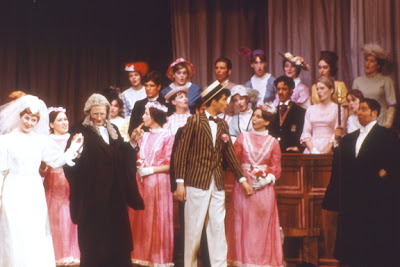
In the public gallery in "Trial By Jury" 

 
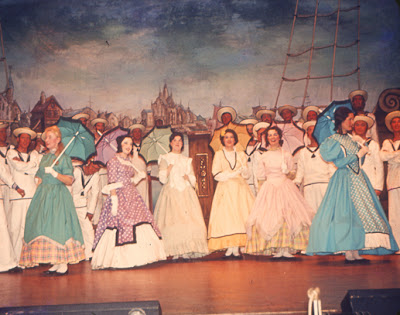
 In "HMS PInafore" - I am second on the right, twirling my pink parasol.

My other musical highlight was a few years ago when I  was  one of over a 1000 singers, plus orchestra and organ  in a "Come and Sing" performance of "The Messiah"  in the iconic Royal Albert Hall in London - an exhilarating,  moving  and unforgettable experience in front of a packed 4000 audience.  I was on a high,  walking back to our hotel.   

I have now decided it is time  to "retire" my voice, but music still plays an important part in my life.  "Classic FM" is my favoured radio channel and a natural accompaniment to being at the computer.   

The  musical moments and memories live on.  

************* 

Postscript:
With a lesson that no experience is ever wasted - in a university exam for Modern British Social History, I was faced with a question  about how did music in the period  reflect issues of the time.  I had some  knowledge about Felix Mendelssohn (love of all things Scottish), Edward Elgar (patriotism and post-war despair) and the popularity of oratorios (Victorian attitudes to religion). / 
 

But I came into my own with Gilbert & Sullivan with their many witty satires  on such Victorian institutions as the navy, the legal profession,   the military,   the police, the Houses of Parliament, the peerage, bureaucracy, women's education, social status,     the pre-Raphelite movement and the craze for with all things Japanese.  There was no shortage of material to write about.  I passed with credit! 

*************  

52 Ancestors in 52 Weeks


Sunday, 8 July 2018

A Far East Wartime Journey: 52 Ancestors - Wk. 28

Travel is the theme of this week's prompt in the year long challenge "52 Ancestors in 52 Weeks", initiated by Amy Johnson Crow. 

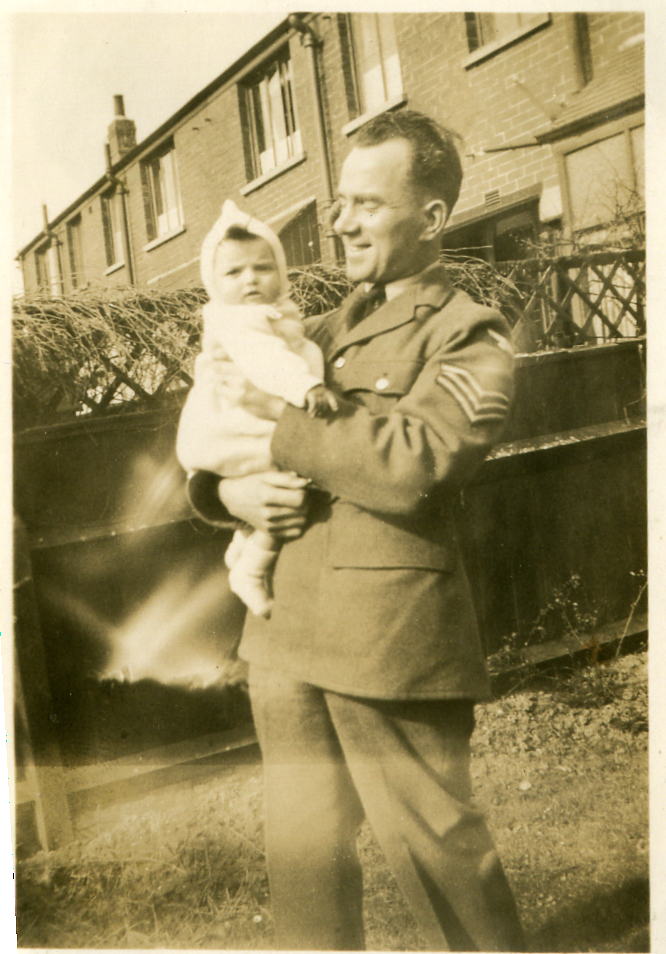
My father, John P. Weston. served in the RAF Codes & Ciphers Branch Here is a story from his wartime memories that he wrote down for me/  Left  is the only photograph I have of him in tropical kit.

"VE Day I spent at Wiesbaden in Germany.  The following day a signal arrived from London saying I was to go the Cocos Islands in the Indian Ocean, where there was a tracking station.  


I flew back home via Paris, landing at RAF Benrose, Oxford and then by rail home for 10 days leave.   I then received instructions to report to RAF Lyneham, Wiltshire to fly out east.  On the last night there, I made a telephone call home.  I said to the operator "I am off to the Far East, will you give me some extra time" - she did - which I did not have to pay for." 
"Then off on a circuitous route because we were not allowed to overfly certain counties.  My travel documents said I was priority three – there were ten degrees, with Generals number one. We flew to Marseilles, then to Sardinia (refuel), over Malta to El Adam, near Tobruk., along the North African coast past Cairo and onto Palestine for a 36 hour break and went to Bethlehem.  Our base was Lydda right on the coast.  The flies were a major menace!" 
 

"We flew onto Bahrain in the Gulf and then to Habayra (RAF airfield in Iraq) – temperature 104F when we landed there at 4a.m.  I could hardly breath.  Then onto Pakistan, Bombay, Calcutta, Madras and across to Ceylon.  I went by rail to Mountbatten’s HQ some 8000 feet in a tropical town of  Kandy.

My stay there was brief, but I remembered the good food.  I was told plans had changed and I was rerouted to Bombay. 


It was take off in Colombo and we had almost reached the point of no return when the plane burst a tyre, which delayed us 24 hours. We took off at 4am on the second occasion. 


"In Burma things were moving to a close.  I was there at the ceremony in Rangoon when the Japanese capitulated.  I was based at the university.  We were always short of tea, which seemed odd in that part of the world, but there was plenty of cocoa.  I also had a ration of one bottle of gin and one of lime juice a month.  I used to drink that under my mosquito net at night watching the mosquitoes  run up and down the wall. 

In November 1945, I was called back for demob.  A driver took me by jeep to the airfield some 20 miles away.  I sat with a rifle (loaded) on my knee since we had to travel through some forests frequented by Dacoits (a terrorist organization in Burma).  The time was 5am. and we made it all right. I flew to Calcutta again and was there for some days.  Calcutta was an awful experience.    Flies crawled over people sitting in the gutters day and night.
We were due to take a train across the desert to Bombay, some 3000 miles.  But there was rioting against the English  in Calcutta and we had to return to camp.  Later we were taken by armoured cars to the station.  On the long journey across India, we stopped at stations to get some food.  We had this on trays, and as we walked along the platform back to the train, hawks dived down and snatched the food.  
I had a short break in Bombay before sailing on the "City of Asia" for home.  I was in charge of a deck of some 200 men.  We eventually arrived at Liverpool on Christmas Day and went to a camp at Birkenhead.  Then I caught a train to Blackpool and arrived home by taxi at 2pm. 

One of the first things I did was to cradle you in my arms – you were shy – no wonder!" 


***************
The travel documents above I found amongst my father's papers, following his death. I was so proud to have these wartime accounts by my father and they have formed the basis of a nrrative I wrote on his experiences.  


Dad would have loved the world of blogging!  
************ 
52 Ancestors in 52 Weeks 

Friday, 6 July 2018

One, Two, Three: Sepia Saturday

Sepia Saturday's  prompt photograph this week, show a rather doleful trio sitting in an old darkly lit pub.  My focus is on threesomes in my family history.

Below is a much cheerier photograph of my grandfather William Danson (in the middle),  with his brother  Robert on the left (with dog)  and a friend, sitting perhaps in a local social club.  

THREE FRIENDS 
 

THREE SIBLINGS

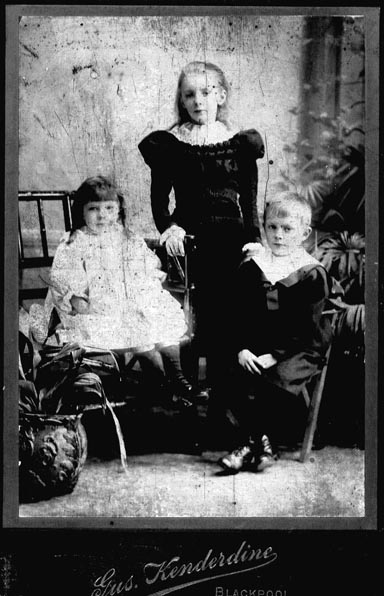
              Florence Annie (born 1894),  Lily (born 1886) & William (born 1891)  - 
                    children of Henry Baile & Annie McAffray of Blackpool, Lancashire 


This charming photograph is  one of the oldest  in my family collection and comes from my cousin.  Elizabeth Danson, the  mother of Henry Bailey above,  was  the eldest sister  of my great grandfather James Danson.   Henry, a stone mason, died at the age of 41 in 1903, leaving his young family fatherless. 

THREE SOLEMN CHILDREN

Tom, Janie and Jack Riley, the grandchildren of Maria's sister 
Jane Riley, nee Rawcliffe, c.1913  


THREE SAILOR LADS
Jack Riley (above)  is identified in the centre  of this group,  
wearing sailor’s uniform  and a cap HMS Chester.

On the left is Marcus Bailey, a neighbour of Jack in Fleetwood. 


 I have tried to trace Jack  in service records without success.  HM Chester was a ship involved at the Battle of Jutland in the First World War.


I have  a postcard sent by Jack's  mother to my great grandmother Maria to say " Jack went out to sea today.  He went in good spirits".  The postmark is difficult to make out but could be 7.?? 16  or 18. 


THREE SISTERS
                   
A photograph from in the collection of my great aunt Jennie,  identified as 
Amy,  Edna and Lavinia Dodd, Todmorden.


Jennie's youngest brother George had enlisted  January 1916 at Todmorden, West Yorkshire.  His army service record gave his   address at the time as  17 Harker Street, Harley Bank,  Todmorden, with occupation station bookstall manager.  I turned to the 1911 census online  and found the Dodd family at  17 Harker Street, Harley Bank,  Todmorden, with head of household Elizabeth Dodd (occupation charing) and three daughters Amy aged 15 (a cotton weaver) , Edna 12 (a fustian sewer)  and Lavinia  aged 9.  They never saw George again, as he was killed on the Somme in 1916.
  

A  FAREWELL TRIO 
 
 My father in RAF uniform, with my mother on the right and her sister, my Aunt Edith on Dad's left - taken in the garden of my grandfather's house, c.1940.


THREE IN A ROW

Dad on the left  and his older brother Fred - 
whilst I am the little girl, not looking too happy 

A PROUD TRIO

 My graduation, 1965, with my parents outside the McEwan Hall, Edinburgh.
   It was a windy day! 


THREE GENERATIONS
Myself with daughter and my mother, 1981. 


 THREE HAPPY HOLIDAYMAKERS  
 My brother Chris and I,  with our father on a busy promenade in Bournemouth, c.1952  


AND THE FAMILY TRIO 45 YEARS ON........
Dad, my brother and myself. 

 ************ 
AND FINALLY
This week's prompt photograph below reminded me so much of the old country places we went into for a drink  in the  little villages in Austria  - with the window style, the dark interior, wooden benches, and rafted ceiling.  Unfortunately I have no photographs of them - but here is a more modern version. 


         ************ 
Sepia Saturday give bloggers an opportunity 
to share their family history through photographs.


Click HERE to read this week#s posts  from other Sepia Saturday bloggers.

Copyright © 2018 · Susan Donaldson.  All Rights Reserved