.jump-link{ display:none }
Showing posts with label Working |Lives. Show all posts

Thursday, 27 November 2025

Sea Stories from Master Mariner Ancestors - Sepia Saturday

"Ships" feature in this week’s Sepia Saturday prompt photograph -  a theme I featured earlier this year HERE.  So this time I am taking a look at the lives of my husband's ancestors who were 19th century mariners,  who sailed out of the River Tyne at South Shields, County Durham  in north eat England.  

Great Great Great Grandfather - Robert Donaldson, Master Mariner  (1801-1878)
Mariner records at the National Archives at Kew  showed that Robert Donaldson was  registered as a mariner on 20th July 1852.

Tyne and Wear Archives provided information on the sea-going  life of Robert Donaldson and the ships he sailed on, listed in "“A Dictionary of Tyne Sailing Ships: a record of merchant sailing ships owned, registered and built at the Port of Tyne 1830-1930”, compiled by Richard Keys. This is a complete A-Z of Ships, master mariners and owners, detailing ships, voyages, disasters and share-ownerships, and much more - a must for anyone with maritime ancestors in this region.

The entries make fascinating reading, with all six ships on which Robert Donaldson sailed, having an eventful history and coming to a sad end  - though not under his charge. 
 

Free Sailing Ship Sunset illustration and picture 
Image - Pixabay

  • The Thetis became a wreck after sinking off the Yorkshire coast in 1869.
  • The John was stranded in 1861 and became a wreck during a severe easterly gale. Twenty-eight other Tyne ships went ashore in the same area during the same gale.
  • The Emerald, in December 1855, when on passage from the Tyne to London, foundered in five fathoms on the Dough Sand (Long Sand) Thames estuary. Three survivors were brought ashore by two Bridlington smacks. Eleven others were unaccounted for, including some of the crew of the rescuing smack who were in a small boat, which disappeared.
  • The Hebe was wrecked in Robin Hood’s Bay, along with other vessels on 27 January 1861. The Ann & Elizabeth disappeared after leaving the Tyne in November 1863, with her captain leaving a wife and six children.
  • The William Metcalfe was Robert Donaldson's largest ship.  On her maiden voyage, it transported 240 male convicts from Portsmouth to Hobart,TAsmania  on a passage that took 102 days. In January 1855 eight of her crew were sent to goal for three months each by the North Shields magistrates for refusing duty. In October 1858 her master and one man were washed overboard. Nine days later, the ship was abandoned, with the crew taken off.

These incidents were by no means unusual and bring home the hazards our mariner ancestors faced in their daily lives.

Great Great Grandfather John Robert Moffet (1814-1881)   

John Robert Moffet in a Napoleonic pose - the only photograph I have of my husband's mariner ancestors - shared with me by internet contact who was also a descendant of John.  
 

John's family originated from Tynmouuth, north of the river Tyne,  with his father Robert and brother William both mariners. Two puzzles about the family  remain unanswered.   John was born in Chatham, the site of the Royal Navy dockyard on the River Medway on the south  of England.  What had brought his family there?    John's   wife Frances Dunn Thomas, daughter  and widow of a mariner,   had three children, with two  born in the USA.   It would be wonderful to find the background to that, but nigh impossible without any indication of which state.  The family first settled in the London docklands area before returning to South Shields..   

In the 1861 Census,  John  was listed as master of "The Brotherly Love" sailing off Flamborough Head in the North Sea.     The crew of eight included three young apprentices, four seamen, and a mate, with most born in South Shields.


The caption  reads"The Brotherly Love" model. made for her  master Captain  Moffet."    

llustration supplied by a Moffet descendant. 

In South Shields Museum and Art Gallery, there is  a portrait  " The Brig "Brotherly Love" and the Tug "William" painted by  John Scott (1802-1885).


 Other mariner ancestors of my husband included, on his mother's side:

Great Great Grandfather  Matthew White (1821-?) 
The 1861 census listed Matthew  as master mariner on board the brig "Caroline" off South Shields.  Lloyd’s Captains’ Register,  recorded the ships he sailed on, travelling as far as the Adriatic, Mediterranean and Baltic ports.
 
From: the National Archives at  Kew, London 
 
 Great Grandfather  Matthew Iley White. (1849-1901)
On his marriage to young widow Louisa Moffet Pierce in 1884 at South Shields, Matthew was described as a mariner.  However he had a change of occupation and was next found as a member of the Tyne River Police, along with his brother Henry.
 
A  long-held story in my husband's family recollected a photograph (sadly lost) of a White ancestor in a top hat in the uniform of the River Tyne police.   A silver uniform button  (below) is  still held by the family.   


Tyne and Wear Archives provided some answers. The Nominal Roll of the Tyne River Police gave details that  two sons of Matthew Iley White  (senior),   had been  members of the river police force – but both with rather a chequered career.    Henry White  joined 9th January 1882 and brother Matthew June 1896.  
 
The Police Defaulters Book recorded on 11th June 1889 their  misconduct in the same incident -  "for assaulting a seaman A. W. Hanson and other irregularities, whilst off duty".   
 
Matthew was fined 2/6 and transferred to the Newcastle Division at his own expense.  However he resigned a few months later. Henry was fined 2/6 and transferred to Walker Division at his own expense.  The Nominal Roll of 1904 noted his age as 42 and that he had 22 years of service, with a wage of 29/6
 
Storms off South Shields
 "The Shields Gazette" on  (FindMyPast Newspaper Archive)  abounds with  headlines and reports on disasters at sea, storms and gales;  the lifeboat responses. and the ensuing work of the Mariners' benevolent societies in helping families in distress.  Below is one typical  of what mariners faced. 


 Image - Pixabay 
 
 
Fascinating Fact  - one of the first purpose built lifeboats  was constructed in South Shields in 1789, prompted by a tragedy  when a ship with all its crew was  lost  at sea just off shore.  
 
 
* *******************
  
 Sepia Saturday gives bloggers an opportunity to share 
their family history and memories through photographs.


Click HERE to see more posts  from Sepia Saturday bloggers. 

 
 *******************

Saturday, 16 March 2024

Women in the Workplace - Sepia Saturday

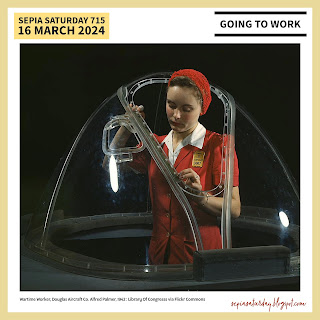
Last week on  Sepia Saturday  I looked at Men at Work, this time Women are in tthe spotlight beginning with images from my local heritage group Auld Earlston.


Mill Workers at Rhymer's Mill. Earlston, Berwickshire - early 1900's. As in other Border textile towns, women were a significant part of the ẃorkforce.  But to me, as someone who is non-technical,   that machinery in the first image looks frightening!


Earlston Munition Workers in World War Two

Around 950,000 British women worked in munitions factories during the Second World War, making weapons such as shells and bullets. Munitions work was often well-paid, but involved long hours, sometimes up to seven days a week. Workers were also at serious risk from accidents with dangerous machinery or when working with high explosive material.  Some munitions workers dealt with  toxic chemicals every dayThose who handled sulphur were nicknamed ‘Canary Girls’, because their skin and hair turned yellow from contact with the chemical. [Source: My Learning.Org ]


Earlston Nurses on Parade in a fund raising event in the Second World Wa.

Let's not forget Housewives at Work - Shopping in the Traveling Co-op Van in Earlston

I remember my mother wearing this kind of pinny with a handy front pocket for dusters etc. . She made them for many a sale of work. 


Workwear at the Egg Packaging Station at Georgefield Farm, Earlston 

 
 The distinctive work costume of the Bondagers.

Bondagers were female farm workers in south east Scotland and Northumberland. As part of their husband's contract (or bond) with the farmer, he would undertake to provide another worker (usually his wife) to help as and when required. The women wore a distinctive dress with bonnet, described as the "last remaining peasant costume" in Britain.  The custom of bondagers lasted well into the 20th century.

And from my own family collection  three photographs I have featured before, but are among my favourites and fit the theme so well. 


My great aunt Jenny Danson  (second on the left) with her work colleagues from the post office in Poulton-le-Fylde, Lancashire.  Her daughter Pam recalled a story that during the First World War, a telegram was received at the Post  Office for Jenny's mother Mrs Maria Danson.  Fearing the worst, Jenny was allowed to run home with it.  Fortunately it was good news to say that brother Frank was wounded in hospital in Malta but was doing well.    

                                           
Both before and after her marriage, my mother offered dressmaking services from her home.  Mum had been apprenticed to a tailor at the age of 14, and was still sewing well into her 80's.  I only came across her early business card after her death. 


My mother's second cousin was Elsie Oldham, who as "Elise" (note the French version of her name!) offered "Bobbing, Shingling, Marcel Waving and Perming", from her home in Blackpool, Lancashire, and advertised on this lovely evocative 1920's blotter.


Elsie's old set of scissors and hair clippers

Elsie's son recalled how she continued working  until shortly before she died in 1989 - by that time the number of customers had dwindled to about three a week all of whom were as old as she was!  When the house was emptied  a cupboard was discovered full of bottles of hair dye.
 
 
 A different source gave me a lovely  insight  on my Aunt Edith (Danson) a teacher . Ex pupils at the school set up a Facebook page  ahead of the centenary of the school in 2014 and in a google search found my blog and got in touch. I was delighted to read comments from former pupils of "Miss Danson",  who was remembered with fondness: "I always thought she was a wonderful teacher with lots of patience and 8nderstanding".


 And finally: 

 
  As for my working life life 
 - that ranged from student work in a variety of shops including a fishmongers (totally out of my comfort zone), a bookshop (my favourite) and a tartan trash souvenir shop in Edinburgh  - think garish tasteless  tartan products aimed a tourists. I spent a year in the USA on an exchange  programme as a trainee librarian (wonderful American experience);  as a young mother I did voluntary work setting up a library  at my daughter's school and at the local Citizen's Advice Bureau.  
 
I returned to the workplace in 1978 at my local tourist information centre - above.  It now looks so old fashioned - old telephone, no computer, let alone a typewriter, no uniform, just a name badge - they came years later!   But I loved it   -  until I was made redundant.  Finally I returned to my roots in the Local Studies Library at ibrary HQ,  before    finally being the Family History Researcher in the Scottish Borders  Archive Centre. How many people can say their hobby became their job!!

*****************


Sepia Saturday gives an opportunity for genealogy bloggers   to share their family history and memories through photographs


 Click HERE to see  other bloggers at work.

 ***************