.jump-link{ display:none }
Showing posts with label Travel & Transport. Show all posts

Friday, 17 April 2026

Delivering the Goods - Sepia Saturday

This week's Sepia Saturday prompt image shows a van  with the local business clearly identified on the side and all set to deliver goods,  whether they be coal and timber or food and drink. 

My mind turned immediately to my cousin's Oldham family of Blackpool, Lancashire, who were carters and coalmen down three generations - Joseph Prince Oldham (1855-1921), his son John William Oldham (1880-1939) and his granddaughter Elsie Smith, nee Oldham (1906-1989),The business  went from  using horses to horsepower  - and below is their first lorry purchased in 1921. 


This Oldham vehicle  was requisitioned during the Second World War by the Government  for use by  the Fire Service. It was never returned.  
 
 The Oldham business was founded around 1890, steadily became prosperous and in 1905 moved to near North Station, Blackpool, Lancashire in a house with a large yard, hay loft, tack room. and stabling for around 7 horses.
 
In the 1901 census Joseph Prince Oldham (below), son of William Oldham and Sarah Prince,  was described as a self-employed carter and coal merchant,  with his 20 year old son John  driver of a coal lorry.  Also in the  household were Joseph's  wife Mary Alice, 3 young daughters, Sarah Alice, Edith and Beatrice, and also mother-in-law Mary Ann Knowles.
Joseph Prince Oldham, with, on the left, his granddaughter Elsie 
who later took over the business. 


The Oldham family c.1910 - Back: Sarah and John William 
Front:  Father Joseph,  Beatrice, Edith  and mother Mary Alice. 
 
John William Oldham married Mary Jane Bailey (my grandfather's cousin)   in 1905 at St. John's Church, Blackpool.  


 ****************

From Blackpool to Earlston in the Scottisy Borders and photographs from  my local heritage group. 


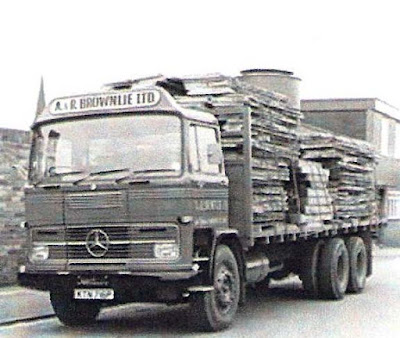
Two Lorries of the  Brownlie family who have been in the Saw Mill business since the mid 1850s and purchased the Earlston yard in 1920. in July 1988 it became part of BSW Timber Group 
 
 
  Another  Brownlie's lorry negotiating this tight bend 


Two lorries from a long standing local business Rodgers, builder, established in 1847  and operated until the 2020s.  Its work in the village included the renovation of the Parish Church in 1891  and the building of the War Memorial in 1921.  


 Taylors Grocers opened in Earlston in 1908 and was in business until the mid 1950s with members of the same family.  


A Baker's van in Earlston  

 From Baker to Butcher  with Donaldson's (no reelation) still serving customers today in Earlston. 


 ****************
 
And Finally: - My father in law John Robert Donaldson was a signwriter  and this is an example of his work. 


************** 
 
Sepia Saturday gives an opportunity for genealogy bloggers  
to share their family history and memories through photographs


Friday, 13 March 2026

Holiday Time in the 1950s - Sepia Saturday

This week's Sepia Saturday prompt photograph shows a happy family striding along, carrying suitcases  - heading for a holiday perhaps?  Cue for me to share my family, setting out in the car for our holiday in the 1950s.  

We lived outside Blackpool, the famous English north west seaside  resort, but for our summer holiday we travelled to Bournemouth on the  south coast, where a close friend of my mother (known as Auntie Phyllis)  had moved to open a hotel. 

It was a long journey, before the days of motorways, through industrial Lancashire.  My brother and I (below) hated crossing the swing bridges over the Manchester Ship Canal at Wigan and Warrington with visions of the bridges   swinging around whilst we were on them.  We would crouch down behind my parents' seats and hide our eyes.
With my brother , c.1948 


Another journey was crossing the  hills of the Pennines through the Peak District to visit my aunt and uncle in Sheffield, passing over the Snake Pass,  or in the Lake District going over the  Kirkston Pass - we must have seemed such wimps, but we hated the twisty roads and sudden drops below us, so it seemed safer not to look out,  until we reached  safer ground.


A family group with my auntie Fran  in the middle - with my Uncle Fred at the camera.  

This was  long before the days of electronic games , Walkman and I Pads - I don't think we even had a car radio. To pass the time, we did the usual car games of I Spy, I went to the seaside or the market , and bought A ...B..C ...etc.. ,and making up silly sentences from the registration numbers of cars MXD - Mummy kisses Daddy  and also making up silly songs.  My father was a commercial traveller (sales rep.) for the Beecham Pharmaceutical Group and one ditty we came up with was: (I still remember it!)

There was a hermit in the hills
Living off his Beecham Pills
He ate two in the morning
And two at night
To make him feel so merry and bright.


We usually stopped somewhere for a picnic, prepared by my mother.  One notable time, she excelled herself by making chicken pieces instead of the usual sandwiches and a fruit tart - and left them all behind at home  in the pantry!   We had to stop somewhere and find a cafe for lunch. My father got the blame here, as he was always chivvering us get a move on and get away, whilst m,y mother eas seeing to everything domestic.  We returned home a week later to discover the food covered in fur! 

Like all children, the excitement of going away quickly turned to boredom and the perennial question was voiced   "Are we nearly there?"
*********
Once there - we enjoyed ourselves! 

 ***************


Sepia Saturday give bloggers an opportunity 
to share their family history through photographs.


Look HERE to see more contributions 
from Sepia Saturday bloggers.
 
 
********************************* 


Friday, 24 October 2025

Up in the Air - Sepia Saturday

Aeroplanes feature in this week's prompt photograph from Sepia Saturday.  Take a look att how the early days of flight were regarded in a small  rural village in Earlston in the Scottish Borders. 


This 1930s poster   is in the collection of my local heritage group Auld Earlston.  Printed in the nearby town of Galashiels, it appears to be a "shell" poster, with space to fill in the details of date and venue.  

The event promised
"Famous pilots, aerobatics, stunts, looping, rolling, upside down flying,  crazy flying and  walking the wings at 100m.p.h. by Daredevil Draycott - the man who rides the winds" - plus passenger flights from  5 shillings a time.
"The Berwickshire News" of 28th July 1931  gave a fuller account, with the revelation that the local firm of Messrs Wm Rodger & Sons owned the plane. 

"Earlston is very fortunate in being the first town in Berwickshire to witness an aeronautic display.  On Monday evening a large number of Earlstonians were entertained to a succession of thrills by the advent of an aeroplane, the property of Messrs W. Rodger  & Sons which gave several aerial exhibitions at a newly constructed aerodrome at Purveshaugh, Earlston.  The enterprising firm is lucky to have secured the services of an skilled aviator and pilot   in the person of Mr J. Hinklin of Hornchurch and late of the Royal Air Force.  They have also secured the services of a competent ground engineer  viz Mr. J. Hellon  of the Scarborough Aero Club.  The pilot gave a thrilling exhibition of  flying in the presence of a crowd of nearly 400 spectators, many of whom were desirous of "getting up".  Messrs Rodgers gave a couple of free flights which were greatly enjoyed and appreciated.  It is understood that operations are to commence immediately".  
The next week's paper of  4th August 1931 noted that
"A considerable number of spectators...visited the Purveshaugh Aerodrome , near Earlston...when about 100 persons of both sexes, mainly young people, booked flights  and were taken up in   Messers Rodgers aeroplane.  The plane had also been in commission the previous evening when 50 passengers went up. All seemed to enjoy the novel and enthralling sensation".
What was the background to this event?
Wilbur and Orville Wright made the first powered flight on December 17th  1903. 
 
 
Wright Brothers Aircraft | Glenn Research Center | NASA 
 
 The aeroplane came of age in World War One.   But, despite there being hundreds of sites used by fixed-wing aircraft across the UK, most British people had never been close to an aircraft and it appears that a quite large proportion of the population still hadn't actually seen one.
 
Free Aircraft Plane photo and picture  
Photograph courtesy of Pixabay 
On 24th July 1924, local newspaper  "The Southern Reporter" thought it noteworthy to write that:  
"Three aeroplanes  passed over the west end of Earlston about 8.30 a.m  but were observed by comparatively few persons."
Following the First World War, experienced fighter pilots were eager to show off their new skills, flying into towns across the country, as well as taking paying passengers for rides. It was men like Alan Cobham who promoted air tours to raise awareness of the importance of aviation. To attract the crowds  he included displays of not just aerobatics, but stunt' flying too. 
 
 Not all sections of society were in agreement with this intensive event schedule.   in Berwick, the Lord's Day Observance Society  objected to Commercial Air Displays and Pageants being held on a Sunday - but the council decided to take no action. on the complaint. (Reported in "The Southern Reporter": 3rd December 1931.)
 
"The Berwickshire News" of August  1932 reflected the interest in this new form of transport with reports:  
"Considerable interest  was evinced....by several Earlstonians of the younger generation, especially when one of Messrs Rodger's aeroplanes landed in a field adjacent to the local football pitch owned by Mr Alexander Brownlie, The machine which had just arrived from Blairgowrie after a successful series of flights, under the pilotage of Mr Wells, made convenient landing preparatory to being overhauled  for further service. 
An optimistic  writer in "The  Berwickshire News" of 9th September 1930 expressed the hope that: 
"We must concern ourselves  with the laying out of aerodromes. I thoroughly believe that it will not be long before every town planning scheme will include provision for aeroplane traffic."  
1939 of course changed the face of air travel, as war became the focus.  

Never again was Earlston  to be at the forefront of the aeroplane age in the Sottish Borders.
 
**************** 

Onto more modern times:
 
 My brother Chris in the 1980s had a half  share in a small plane and gained his pilot’s licence.  Chris flew the plane from his home on the English south coast to the small airport at the seaside resort of Blackpool in north west England for a family gathering,  

  
Daughter sitting at the controls! 
 
 
********** 
 

 And if you feel like being more adventurous,  - but definitely not my idea of fun   - a para glider - a photograph taken from our hotel balcony near Innsbruck Austria.


************* 

 Sepia Saturday gives bloggers an opportunity to share 
their family history and memories through photographs.  


Click HERE To see more posts from Sepia Saturday bloggers.

************************ 


Friday, 17 October 2025

Carriages and Carters - Sepia Saturday

A busy street scene is the focus of this week's prompt photograph from the Sepia Saturday website.  My eye centred on the horse  drawn carriage, so take a look at how our ancestors travelled around in times past. 


The date  is 1907 and  Earlston Parish Church Choir is setting   off from the Red Lion Hotel in the village  to drive to Yarrow Manse in Selkirkshire -  according to the Distances website a distance of some 29 miles over what would be a hilly, twisting  route.   

Hopefully it would be a dry day as there was no protection from the elements.     It was surprising they did not take the railway  for part  of the route and and then by waggonette to Yarrow.


 They must have got there  safely,  for here they are relaxing, with some hats off, relaxing outside Yarrow Manse.  


In more modern times, a horse drawn charabanc in Krakow, Poland.  

My cousin's ancestors, the Oldham family of Blackpool, Lancashire  were carters and coalmen down three generations - Joseph Prince Oldham (1855-1921), his son John William Oldham (1880-1939) and his granddaughter Elsie Smith, nee Oldham (1906-1989).
 

The business was founded around 1890, steadily became prosperous and in 1905 moved to near North Station, Blackpool, Lancashire in a house with a large yard at the back with hay loft, tack room. and stabling for around 7 horses.


John William Oldham on one of the carriages in the family business of coal men and carters.


Here is My third cousin, Gloria a top of this carthorse.   In the 1901 census Joseph Oldham   was described as a self-employed carter and coal merchant with his son John a coal wagon driver. An accident at the coal sidings in the railway station resulted in Joseph being blinded and he died in 1921, with his will, signed with his "mark.  

Below - two advertisements in the stable yard at Beamish Open Air Museum in north east England.  It recreates life in the 19th and 20th century - a favourite place for a day outing.   


Anyone tracing their family history may well have  a "carter or carrier " in their ancestry - an essential occupation in transporting goods around.  Such a man was my great great grandfather Robert Rawcliffe of Hambleton,  Lancashire. More carter images are shown here  with  vintage photographs from  the collection of my local heritage group Auld Earlston. 


 The 1851 census for Earlston (population 1,819)  listed 9 men working as  blacksmiths, 7 carters/carriers, 3 saddlers, 2  stable boys, an ostler, a farrier, a groom and a coachman - plus of course all those who would be working  with horses on the many farms in the rural parish. 


 Thinking of a convivial drink? Large Clydesdale Horses here are pulling the dray, advertising Vaux Brewery  Fine Ales -  at the Border Union Agricultural Show in Kelso, Scottish Borders.   

But being a carter was not without its risks.   Local newspapers  reported cases appearing in police courts - the   offence ‘being drunk while in charge of horse" or "careless and reckless driving".  

 Likewise many graphic reports of road accidents appeared  in  local papers.  

One such casuality was my great great grandfather Henry Danson (1806-1881)  of Poulton le Fylde, Lancashire. 

 I had done a lot of research on his life many years previously, using standard resources, to find his family (6 daughters and 3 sons) and his occupations as a farmer and later as a  toll collector at nearby Shard Bridge over the Riuver Wyre.  

But it  is never too late to discover new information on an ancestor,  as more and more records come online.  Such was the case for me.    In  2021 I was doing a casual browsing on the British Newspaper Archive website.  The result was a fascinating  discovery  in newspapers that had only recently been indexed -  an obituary and a coroner’s report  on Henry Danson's  death - and information on Henry that was completely new to me.
 
I found out that he was well known locally as "a famous judge in  horse flesh"  and had died in a tragic accident on  his horse and cart. 


Manchester Courier and Lancashire General Advertiser: Wednesday 02 Nov. 1881

“FATAL FALL FROM A CART. On Monday evening Mr. Gilbertson held an inquest at Poulton-le-Fylde, on the body of Henry Danson, collector of the Shard Bridge tolls. The deceased, who was 75 years old, was riding in a cart with Mr. John  ? farmer, on the way to Poulton, when the horse took fright and jumped forward. Danson was standing in the cart leaning on his stick at the moment he  was jerked out upon the road. He was attended Mr. Winn, surgeon, but could never walk afterwards, his left thigh being injured, and he had an attack of pleurisy fortnight before his death, which occurred on Thursday night last. The jury returned verdict of Death  from the effects of injuries received, and resulting illness, through fall from a cart."

It is both sad and ironic that Henry,  noted for his skill with horses,  should have died,  whilst driving his horse and cart.  

************************ 

Sepia Saturday gives bloggers an opportunity to share 
their family history and memories through photographs.


Click HERE to see more posts from Sepia Saturday bloggers.
 
****************