Friday, 28 September 2012

U is for Umquihile, Unfortunate, and Unflagging


I am enjoying participating in this series from Aona at ttpw.gouldgeneogy.com/2012/05/take-the-family-history-through-the-alphabet-challenge


U is for:


Umquihile  - this word was new to me until I began researching Scottish records. in more  depth   You may come across this in old documents, wills etc. and it  is an archaic Scots word meaning "the late" or "the deceased."  I lay claim  for this being  most unusual U word| 


We come across in family history research many Unfortunate souls, particularly when browsing through  Poor Law Records.  Some cases unearthed from Scottish Borders archives:

  • Robert Leck, once a well known clockmaker of Jedburgh, admitted to the poorhouse aged 67, with a pattern of admissions and discharges until the time came when he was "wholly disabled, nearly blind and wholly destitute". Interestingly when I did a Google search, I found an illustration of a Robert Leck grandfather clock about to be auctioned in London.
  • The story of Janet Scott had a more positive outcome. Her admission record in 1877 gives us a glimpse of the desperate situation in which many applicants for poor relief found themselves. A single mother with two children and a baby, working as an agricultural labourer, she was "wholly disabled by a cart falling on her". She was on parish relief for three years. However she also demonstrated her resilience, as in the 1881 census she was back earning a living, as an Ag. Lab, along with her two eldest daughters.


Janet Scott's entry in the Jedburgh Union Poorhouse Register, 1877.

  • 15 year old James Robertson is described as "delicate and deformed by spine curvature and will never be able to do much. He needs a suit of clothes, 2 pairs of stockings and 2 handkerchiefs. Allowed.
  • Mary Burns, also in need of clothing, was granted " 1 frock, 2 yards flannel, 2 yards drugget, 2 pinafores and a pair of boots.
  • At Melrose, Rosburghshire, a mother and young children were "footsore and weary" and given help as they made their way from Newcastle to Glasgow to rejoin family - a distance of 114 miles.
  • Mary Phllips was admitted to the Poorhouse as "this woman's husband deserted her, having absconded to America. She has 2 children and is about to be confined. Her parents very poor."

Unlucky - sometime researching family history is a matter of luck.  I have recently been reserching my father's childhood in Shropshire.  I was delighted to find that the Brosely Historical Society website includes extracts from newspapers  with fascinating titbits of life in the local church and school.  But guess what?  The crucial years I wanted of 1925 and 1926 were missing!  

You may also be unlucky when trying to trace  World War One service records for an ancestor, as so many were destroyed in a 1940's bombing raid on the National Archives in London.  My five Danson great uncles served, but I have only managed to trace the records for one of them - George.


Tom and George Danson


 Whether  it is military, school or work, photographs of our ancestors in Uniform  put them in the context of their wider lives.  Below  is my Great Aunt Jenie Danson  (second left)  with colleagues who worked in the local post office in Poulton-le-Fylde, Lancashire.


We are always looking for that Undisputed record on  our ancestor

My four times great grandfather John Danson had a daughter Ellen Danson, baptised at St. Chad's Church in 1763 (Poulton Parish Register) In searching for a marriage I came across an Ellen Danson marrying a Ralph Dewhurst - and made the basic fatal error of assuming this was "my " record - until I disoscvered that there were two other young Ellen Danson's in Poulton around the same time.  Given that the marriage entry does not name her father, I remain Unsure that I do have the right record. 

And finally I remain Unflagging in my family history activities and in following this A-Z challenge - soon to come to its end. 

Wednesday, 26 September 2012

Pigeon Post told of the Win- Sepia Saturday


Sepia Saturday encourages bloggers to record their family history through photographs.


When I saw this prompt of three young men carrying  football boots, there was only one photograph I had to feature and  it only came into my possession  a few weeks ago.

Thanks to a local historical society,  I now have the earliest photograph of my father, aged 14 in 1926  as a member of a winning football team.


My father is on the right of the middle row, identified as Perce Weston.


My  father John Percy Weston (1912-2003) had written down for me the memories of his  early life in Brosely, near Ironbridge, Shropshire.

"I was mad keen on soccer, so much so that I had a trial at Birmingham with the English schoolboys. My teacher took me in his car to that and to a second trial at Shrewsbury.

One Saturday when I was working as an errand boy, two directors from Birmingham Football Club came to see Dad and Mum to sign me on for the junior team  - they refused, saying I was too young to be away from home. I was not told about this until later and sulked for a month!

But a bit of glory followed, when my school team entered a cup competition. I was vice-captain and we got to the final - and won the cup, the first ever for Brosely.

One of the supporters took a carrier pigeon along with us and set it loose at the end to let Brosely know the result and to prepare a welcome, as we were bringing home the cup! "

The pigeon was obviously  an ancestor of Twitter!

Apparently a photograph was taken of the team's success, but no pictures of my father's early life passed down the family. I have only one photograph (below)  of him prior to his meeting my mother in 1936. Family memorabilia (including Dad's church choir and football team photographs) were thrown out by a widowed relative.  How sad!

Unfortunately I only had a broad indication of the year for the event, which made tracing it in local newspapers difficult. In an effort to find out more, I contacted Brosely Historical Society who put my enquiry on their online newsletter.   I am delighted to say I have heard from three members of the society with more personal memories - and even better have a photograph of the winning football team, with my father on the middle row right, identified as Perce Weston. I always thought he hated his middle name Percy, but he seemed to be known by that as a child.

This is the earliest photograph I have of my father and I am so grateful to the Society for filing this gap in my family history.  

My father retained his love of football all his life.   He was a great follower of Wolves and Aston Villa and was an avid watcher of matches on television, right up to his death at the age of 91.

And an important lesson from this - don't forget the value that can be gained from contacting local societies.


My father in the 1930's proudly showing off his car with his younger brother Charles, 


Based on a recent posting under the banner of Geneabloggers Thankful Thursday


Click here to find how other bloggers' stories on this week's theme.

Saturday, 22 September 2012

T is for Tributes, Treasures, Telegrams, Timelines, and Thanks


I am enjoying participating in this series from Aona at ttpw.gouldgeneogy.com/2012/05/take-the-family-history-through-the-alphabet-clle


T  is for:
Tributes


I perhaps was slow to realise this, but I have discovered that blogging gives me a mavellous opportunity to pay Tribute to my ancestors through profiles of my great grandmother Maria Danson, nee Rawcliffe, to my great uncle George Danson who was killed in the First World War, a week after his 22nd birthday, to my grandfather William Danson who won the Military Medal at Givency on the Somme, to my feisty Great Aunt Jennie, to the war time experiences of my father John Weston, to my uncle Harry Danson (right)  who was evacuated at Dunkirk, to the talents of my mother and aunt - Kathleen and Edith Danson. I am proud to have done this.


Treasures of the Family
One of the many World War One postcards
sent back from Flanders
by my grandfather William Danson
to his family back home.


Do you, like me, gasp in amazement at the heirlooms that have survived down generations of ordinary families, as shown on TV's "Antique Roadshow" and "WDYTYA", or on blog postings. I marvel in particular at diaries, christening robes, and artist portraits. My heirlooms are much more mundane but still mean a great deal to me and can be summed up as stitching, paintings, and postcards, plus a copper kettle and teasets.


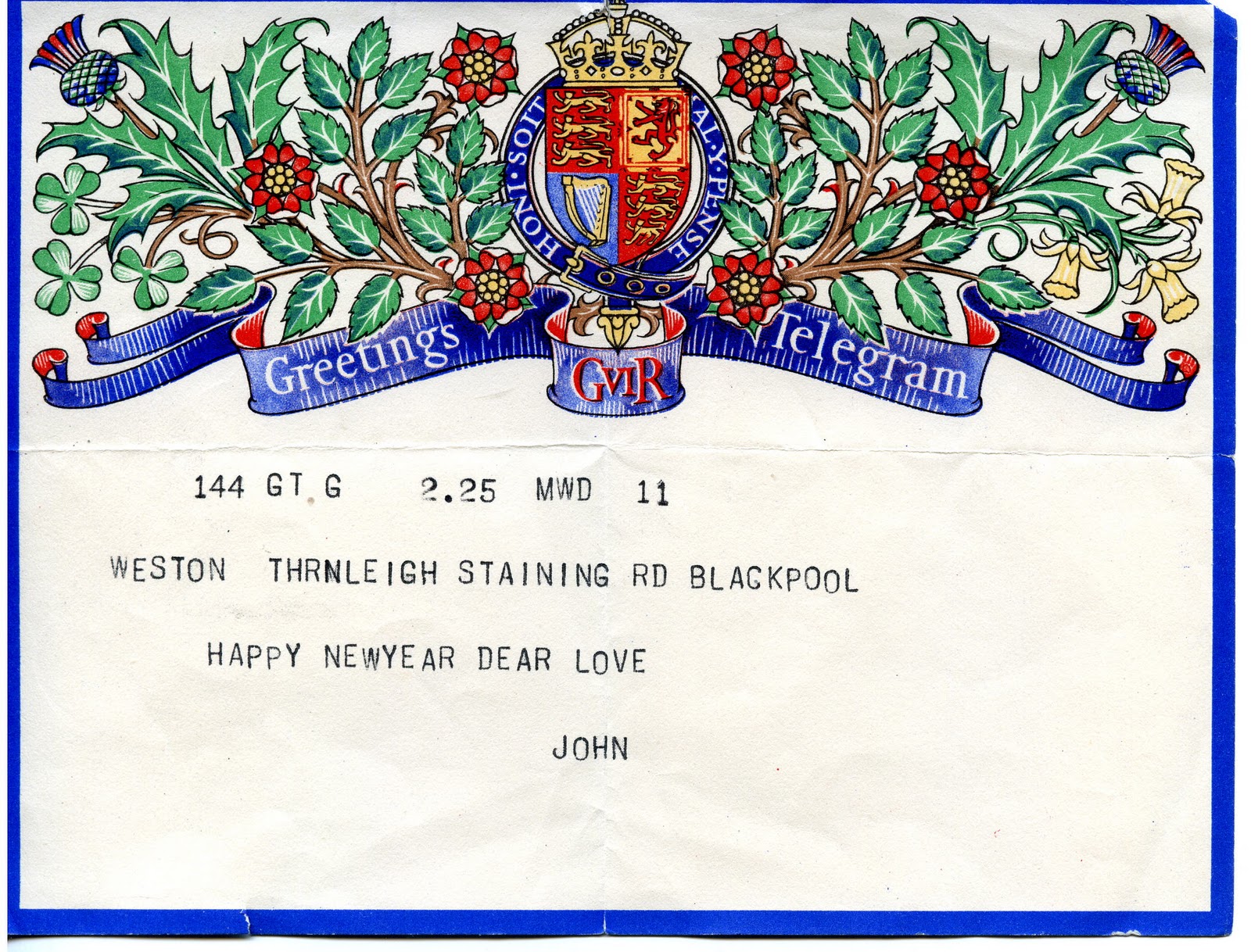
Telegrams. We perhaps associate telegrams from the past with dreadful news from war fronts. Here, however,  I was lucky to find, after my parents' deaths,  these happy momentoes from their wedding in 1938 and the time when they were separated through war in 1940.


Wedding telegram sent on the occasion of my parent's marriage in 1938

 
Sent by my father to my mother January 1940
when he was with the MInsitry of Defence in London

 
Travel is a sideline on family history whether we  go exploring in  the footseps of our ancestors or discover  how our ancestors got about. 


Winter transport in Earlston, Berwickshire
From the postcard collection of the Heritage Hub, Hawick
www.hesartofhawick.co.uk/heritagehub
 
 
A charabanc outing  - from my Great Aunt Jenny's collection
Timelines  to me are an important feature of a  family history narrative. I am  a firm believer in setting our ancestors lives in a wider context of life around them - what was happening at a local, national and itnernational leve?  I usully present this in the form of a text box in each chapter.


In 1846

 when Robert Rawcliffe

 married Jane Carr
 
à     The Preston to Fleetwood Railway was extended from Poulton to Blackpool.

à     The sewing machine was invented

 Ã      The Irish Potato Famine reached its height with one million people dying by 1851.


I have so much to be Thankful for in my family history activities.
 
  • Tracking down fascinating sources
  • Tracing new ancestors
  • The Tips, support and online friendship from fellow bloggers.
  • The Touching stories that I have come across.
  • The Topics that It has led me to further study on the ancestral Trail such as Christian, surname and place names, the role and status of women, the social conditions that our ancestors experienced.


  •  


    •  


    So to summarise  - Family History is Terrific sometimes Tantilizing, sometimes Thrilling, often Theraapeutic, and  I have no intention of Terminating my interest.

     
    With apologies for the odd spacing in this post.  I am driven to distraction by the new blogger Interface.  Still learning it! 

    Wednesday, 19 September 2012

    In his Sunday Best Suit - Sepia Saturday

     
    Sepia Saturday gives bloggers an opportunity to share their family history through photographs.

    I don't  have a jailbird in the family, as far as I know.  So I decided to focus on the little boy- standing up straight, looking smart in his jacket and knee breeches. 

    It is the females of the family who usually get featured for their costume, but here from my family collection are four boys in their  Sunday best.


    Frederick Henry Weston (my Uncle Fred),  born 1905. 
    This photograph has only just come into my possession via a distant relative and is one of the very few early photographs I have of my father's Weston family. 
    The story was that photographs were thrown out  following a death.
    What a crime!    
     
     
    Harry Rawcliffe Danson, (my Uncle Harry), born 1912
     
    
    Harry's middle name came from  his grandmother Maria Danson, nee Rawcliffe.
    This is a section of a larger photograph (below)  showing Harry with his mother Alice, sisters Edith and Kathleen (my mother) and baby brother Billy, taken in 1916 - the year when his father William Danson went off to war in Flanders. 

    24 years later Harry survived the Battle of Dunkirk.  He retained his good dark looks all his life.


    Below are two photographs from the large collection left by my Great Aunt Jennie (Danson), who grew up in Poulton-le-Fylde, Lancashire. She had written names on the back, but otherwise little is known about them.   I suspect they are the children of friends, but I was unable to make any headway in further identification through a search of the 1911 census.
    
    Jackie Threlfall

    
    Jesse and Bernard Pennington


    To read contributions from other bloggers on this theme, click here

    Tuesday, 18 September 2012

    Finding Florence - Thankful Thursday

    
    Florence Adelaide, with her father
    John Thomas Mason.  c.1905 .
    Florence Adelaine Mason was my grandfather's cousin on his mother's side and I have to thank my newly found American third cousin, Bonny (Florence's granddaughter) who discovered my blog and made contact with the photographs featured here.


    Florence was the youngest of 11 children of John Mason and Alice Rawcliffe - my great grandmother's sister. 

    Alice from Hambleton, near Poulton-le-Fylde, Lancashire  married,  at the age of 19,  John Mason and between 1874 and 1886,  they had six English-born children - Robert William, Jane Elizabeth, John Thomas, James Richard, Margaret Alice and George Rawcliffe - all family names. 

    It was only a casual browsing on www.familysearch.org that revealed that Alice had died in Jamesburg, Middlesex County, New Jersey.  I was delighted to find this unknown American  connection and began a new challenge to find out more  using www.Ancesstry.com
     
    The New York Passenger Lists online  revealed that John Mason had sailed from Liverpool to Brooklyn, New York, in 1886 followed by Alice, a year later travelling with 6 children aged 1-13 and two pieces of luggage.  What on earth was life like for them all  on the voyage?   If only I could discover why they took this step of adventure from a small Lancashire community to the teeming streets of New York!

    Between 1888 and 1898, Alice had a further five children, born in the USA - Arthur Valentine (born appropriately 14th February), Harold Arthur Victor, Lillian Eveline, Bessie Irene and the youngest Florence Adelaine. Sadly Arthur, Bessie and Lillian all died in infancy.  At some point after 1898,  the family moved from Brooklyn, New York, across the river to Jamesburg, Middlesex County, New Jersey.
     
    So Florence. born 1898  was the youngest of a large family of eight surviving children (three girls and five boys) , with her eldest sister Jane Elizabeth 23 years older.   Above is the earliest photograph of her with her father.  She looks to be about 7 years old, so taken c. 1905 -  and what a magnificent hat for a wee girl - and her skirts look surprisingly short for the period.

    The photograph (right)   was the only one of the family, that I had inherited from my great aunt Jennie's collection but unfortunately it was not identifed. By a process of elimination I suspected it was Alice and family but I had to wait 10 years of message board pleas for my patience to be rewarded and have this confirmed by Bonniy who had found my blog. Florence was the young girl in the middle of the group, with her parents, eldest sister Jane Elizabeth, who remained unmarried, and her youngest brother Harold Arthur Victor. Bonny had this very same photograph, but it was mounted with the vital clue that it was taken in Brooklyn, New York. I guess c. 1912.
     
    I was delighted to get this larger family group photograph (below)  from Bonny, showing all eight children of Alice and James Mason, with Florence in the dark dress sitting at the front. Alice died in 1930 and James 7 years later, both buried in Fernwood Cemetery, Jamesburg. 

    Top - Robert, Jenny (Jane Elizabeth), Mother Alice, Father John, Harry
    Bottom - Thomas (John Thomas), Alice (Margaret Alice), Florence, George and James


    Florence married Charles Urstadt - the information online varies between 1918 and 1921.  She is wearing  such a distinctive  headdress in this  photograph,that I wondered if it had any links to Charles German background. And what huge bouquets!


    Below - the home in Jamesburg where Florence and Charles lived all their married life and raised their six children - Ruth Alice, Charles Melrford. Beulah. William John Henry, Donald Wesley and Curtis Rawcliffe.   Charles senior  lived there until his death at  the age 99.


    Below a happy photograph of Florence surrounded by her grandchildren. 


    Florence died in 1965 aged 67. 
     
    **********
     
    Thankful Thursday is one of many blog prompts from www.geneabloggers.com to encourage bloggers to record their family history.


    Sunday, 16 September 2012

    Shopping Pleasures - Sepia Saturday


    Sepia Saturday gives bloggers an opportunity to share their family history through photographs. 

    When  I saw this  week's photo prompt, it conjured up a number of memories in my head:

    1. Shopping with my mother in the 1950's in the Home and Colonial Store in Blackpool, Lancashire; also a dark  haberdashery store which intrigued me - all the walls were  lined  with drawers and cupboards, and the staff seemed to know where everything was;  another fascination was the Co-op with the money travelling back and forth along wires  in the little canisters above the counters.  
    The old fashioned shops in Beamish Open Air Museum in County Durham.


    A  course I had to do at work on the dreaded ""Health and Safety".  How many contraventions of current legislation and practices can you spot in the photo prompt?  The assistant  perched precariously on the ladder for a start.


    My father  account,  written down in his   "Early Life"  -   "Leaving school in 1926, I went to work in a grocer's shop  where I had been the Saturday errand boy.  I graduated to delivering bags of corn 80lbs plus,  with the pony and trap - a Welsh cob called Tommy who was inclined to be lazy.  At night I rode him bareback to a field."   I cannot imagine my father on this job, as he never gave the slightest indication  of any affinity or interest  in  horses.  Perhaps this experience was enough!


    *********

    Unfortunately I have no photographs in my family history collection which reflect this theme, so am featuring instead recent happy holiday memories of  shopping in Austria and Bavaria  - with perhaps some ideas for brightening up our beleagured High Streets!  


    Copyright © 2012 · Susan Donaldson.  All Rights Reserved


    To see how  other bloggers  have looked at this theme, click here


    A Surfeit of S's - Sadness, Sisters, Surnames, Stimulus - and So much more.


    I am enjoying participating in this series from Aona at http://www.gouldgenealogy.com/2012/05/take-the-family-history-through-the-alphabet-challenge/
     
     
    S is for
     
     
    Sympathy and Sadness -  at what we discover.  In my own family:
    • Mary Gaulter, nee Danson whos died in childbirth.
    • Sarah Danson, nee Lounds who died of TB at the age of 21 leaving a one year old daughter  
    • Margaret Brownbill, nee Danson, widowed twice and childless by the age of 32.
    • Jane Rawcliffe, nee Carr, who died, leaving five young daughters including my great grandmother aged only 4.
    • George Danson, John Danson, Arthur Matthews, John Matthews, and Frederick Donaldson - all who died in the First World War.
    • The many children who did not survive infancy.

    Sadness, Solemnity and Sisters are all illustrated in this photograph of the MacFarlane family of nine sisters (Bridget, Kate, Mary, Ellen, Sarah, Annie, Jane, Maggie and Jemima)  and one brother  (Patrick), with their mother Annie.  The dark clothes and solemn expressions, with their mother holding a bible or prayer book suggest this was on the occasion of a funeral.   The style of dress and the estimated age of the youngest daughter indicated c.1910 and I believe this was taken after the death of their father James in 1912. 


    Surnames always fascinate me. Whenever I come across an unusual name in the news etc., my immediate reaction is - "I would love to research that". Two examples come to mind - in my own Scottish Borders the surname Govanlock and in my home county of Lancashire Sturzacker.  What is the background to such distinctive names?  One of the many challenges from my "to do" list would like to explore further.


    How often have you come across people saying "I have traced my ancestors back to William the Conqueror, (or Robert the Bruce)" !!!   Do you belive them?  Scepticism should be part of the family history experience,  as we should always be questioning information we find, sources we uncover, the validity of on line transcriptions and family trees etc. etc.  I know as a beginner, using contacts in my local family history society  I was delighted to get information and just assumed it was correct.  Some of it I now have second thoughts on.   
     
     
    Signatures - how great to have something actually penned by an ancestor, even if it is a  a photocopy - such as the wills found in the Lancashire Archives. signed by my g.g.g.g.grandfather  (dated 1813) and g.g.g. grandfather (dated 1833).  In this age of electronic communication  when handwriting is becoming a dead art, will our descendants have this experience?.  


      Sources. Searches and Stories - the bedrock of family history, found in:


    • School Records  have a look here for further information

    • Sasines - Scottish property records.
    • Statistical Accounts - if you have Scottish ancestors  these are "a  must see" rich  source of background information.   Written by each parish minister  they give a contemporary  account of life at the time, with the first edition published 1791-99 and the "New Statistical Account" 1834-45.    They tell you how many paupers, cattle, sheep, horses,  etc. were in the parish,  give details on the land,  trades and occupations, the school, the church, with frank comments on "miserable hovels", "the church roof leaks rain  on the congregation"  and "there is a  the want of fuel in winter".

      Hobkirk in Ropxburghshire was described as having "32 farmers in the parish, with 127 servants, 46 ploughs and 70 carts".
      For Wilton parish in Roxburghshire  
      “The people are, in general industrious, sober-minded, compassionate and devout.  Work is not difficult to be had; and provisions are reasonable.  The dearth of fuel is the greatest hardship, which the poor experiences in this part of the country.”
    Take a look at http://stat-acc-scot.edina.ac.uk/sas/sas.asp?action=public
      
    Family History is Stimulating.    If one line of research hits the buffers, I go sideways to look at extended family.  I thought I would only have enough personal material to last about 18 months on a blog.  How wrong I was!  The prompts from Geneabloggers and from fellow contributors are inspiring and  mean I have a have  a long iist of drafts, even if they are no more than an initial thought or a  title to develop further.  

    This A-Z Challenge is a classic example of how blogging keeps the  brain buzzing. So thank you, Aona. 

    A final thought -  I heartily recommend Family History as a
    Safeguard Against Senior Moments! 


    Wednesday, 12 September 2012

    Remembering 9-11: Memories from Scotland.

     Thomas MacEntee at Geneabloggers has asked us to record our memories of 9/11. 

    11th September 2001 - I was working at Library Headquarters that day in the Local Studies Room when my daughter phoned to tell me that a plane had crashed into the twin towers in New York. I had visited the city many many years ago, long before the twin towers were built and I was a bit hazy about them, but my first reaction was "what an appalling accident".

    I told colleagues and we logged onto the BBC website and saw the dreadful news of the second strike. There was an American visitor in the Study Room and we broke the news to him - he immediately went outside to phone friends and family. We then dashed to the Training Room where there was a television. Two work colleages had daughters holidaying  in New York and had the agonizing wait of days, with communications down,  to hear that they were safe.

    Words cannot describe the horror. What struck in my mind most was the experience of those on the planes who had left Boston,  to discover they were flying to their death - yet whose thoughts were to phone family expressing their love.

    Celtic Cross on Iona
    looking over to the Isle of Mull
     A week later we were on holiday on the west coast of Scotland and took the ferry from Oban to sail to the Isle of Mull and then onto the Isle of Iona. It was the most perfect September day you could have asked for - sunny blue skies, a calm deep blue sea, a panorama of hills and the seals bobbing around the ferry.    The atmosphere was strangely quiet and subdued. There were many American tourists on the boat, and   people were going up to them to shake their hands and extend their sympathy.


    Everyone talks abut the magical nature of Iona - the seat of Scottish Christianity where St. Columba founded his Abbey in 563AD. It is amazing that even though the boat seemed busy, visitors spread out on the small island and it seems as if you have the place to yourself.

     It was so peaceful - a beautiful haven in what suddenly seemed a very evil world. 


    Adapted from from a posting on the 10th anniversary.
    Island Photographs - Copyright Susan Donaldson, 2011